Adoption statistics for England – signals of improvement?

I am adopted so I follow the politics of adoption fairly carefully. I was therefore interested to see this report on the BBC, claiming a “record” increase in adoptions. The quotation marks are the BBC’s. The usual meaning of such quotes is that the word “record” is not being used with its usual meaning. I note that the story was repeated in several newspapers this morning.

The UK government were claiming a 15% increase in children adopted from local authority care over the last year and the highest total since data had been collected on this basis starting in 1992.

Most people will, I think, recognise what Don Wheeler calls an executive time series. A comparison of two numbers ignoring any broader historical trends or context. Of course, any two consecutive numbers will be different. One will be greater than the other. Without the context that gives rise to the data, a comparison of two numbers is uninformative.

I decided to look at the data myself by following the BBC link to the GOV.UK website. I found a spreadsheet there but only with data from 2009 to 2013. I dug around a little more and managed to find 2006 to 2008. However, the website told me that to find any earlier data I would have to consult the National Archives. At the same time it told me that the search function at the National Archives did not work. I ended up browsing 30 web pages of Department of Education documents and managed to get figures back to 2004. However, when I tried to browse back beyond documents dated January 2008, I got “Sorry, the page you were looking for can’t be found” and an invitation to use the search facility. Needless to say, I failed to find the missing data back to 1992, there or on the Office for National Statistics website. It could just be my internet search skills that are wanting but I spent an hour or so on this.

Gladly, Justin Ushie and Julie Glenndenning from the Department for Education were able to help me and provided much of the missing data. Many thanks to them both. Unfortunately, even they could not find the data for 1992 and 1993.

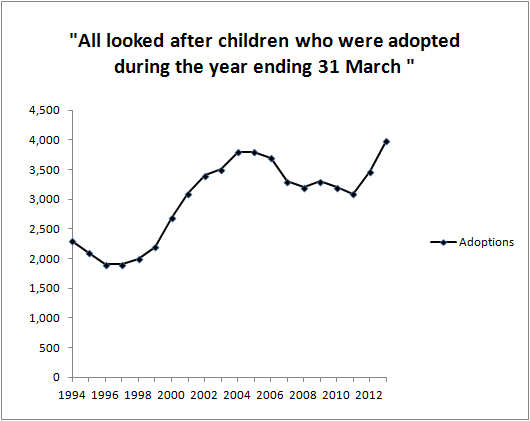
Here is the run chart.
Adoption1

Some caution is needed in interpreting this chart because there is clearly some substantial serial correlation in the annual data. That said, I am not able to quite persuade myself that the 2013 figure represents a signal. Things look much better than the mid-1990s but 2013 still looks consistent with a system that has been stable since the early years of the century.

The mid 1990s is a long time ago so I also wanted to look at adoptions as a percentage of children in care. I don’t think that that is automatically a better measure but I wanted to check that it didn’t yield a different picture.

Adoption2

That confirms the improvement since the mid-1990s but the 2013 figures now look even less remarkable against the experience base of the rest of the 21st century.

I would like to see these charts with all the interventions and policy changes of respective governments marked. That would then properly set the data in context and assist interpretation. There would be an opportunity to build a narrative, add natural process limits and come to a firmer view about whether there was a signal. Sadly, I have not found an easy way of building a chronology of intervention from government publications.

Anyone holding themselves out as having made an improvement must bring forward the whole of the relevant context for the data. That means plotting data over time and flagging background events. It is only then that the decision maker, or citizen, can make a proper assessment of whether there has been an improvement. The simple chart of data against time, even without natural process limits, is immensely richer than a comparison of two selected numbers.

Properly capturing context is the essence of data visualization and the beginnings of graphical excellence.

One my favourite slogans:

In God we trust. All else bring data.

W Edwards Deming

I plan to come back to this data in 2014.

The graph of doom – one year on

I recently came across the chart (sic) below on this web site.

GraphofDoom

It’s apparently called the “graph of doom”. It first came to public attention in May 2012 in the UK newspaper The Guardian. It purports to show how the London Borough of Barnet’s spending on social services will overtake the Borough’s total budget some time around 2022.

At first sight the chart doesn’t offend too much against the principles of graphical excellence as set down by Edward Tufte in his book The Visual Display of Quantitative Information. The bars could probably have been better replaced by lines and that would have saved some expensive, coloured non-data ink. That is a small quibble.

The most puzzling thing about the chart is that it shows very little data. I presume that the figures for 2010/11 are actuals. The 2011/12 may be provisional. But the rest of the area of the chart shows predictions. There is a lot of ink on this chart showing predictions and very little showing actual data. Further, the chart does not distinguish, graphically, between actual data and predictions. I worry that that might lend the dramatic picture more authority that it is really entitled to. The visible trend lies wholly in the predictions.

Some past history would have exposed variation in both funding and spending and enabled the viewer to set the predictions in that historical context. A chart showing a converging trend of historical data projected into the future is more impressive than a chart showing historical stability with all the convergence found in the future prediction. This chart does not tell us which is the actual picture.

Further, I suspect that this is not the first time the author had made a prediction of future funds or demand. What would interest me, were I in the position of decision maker, is some history of how those predictions have performed in the past.

We are now more than one year on from the original chart and I trust that the 2012/13 data is now available. Perhaps the authors have produced an updated chart but it has not made its way onto the internet.

The chart shows hardly any historical data. Such data would have been useful to a decision maker. The ink devoted to predictions could have been saved. All that was really needed was to say that spending was projected to exceed total income around 2022. Some attempt at quantifying the uncertainty in that prediction would also have been useful.

Graphical representations of data carry a potent authority. Unfortunately, when on the receiving end of most Powerpoint presentations we don’t have long to deconstruct them. We invest a lot of trust in the author of a chart that it can be taken at face value. That ought to be the chart’s function, to communicate the information in the data efficiently and as dramatically as the data and its context justifies.

I think that the following principles can usefully apply to the charting of predictions and forecasts.

  • Use ink on data rather than speculation.
  • Ditto for chart space.
  • Chart predictions using a distinctive colour or symbol so as to be less prominent than measured data.
  • Use historical data to set predictions in context.
  • Update chart as soon as predictions become data.
  • Ensure everybody who got the original chart gets the updated chart.
  • Leave the prediction on the updated chart.

The last point is what really sets predictions in context.

Note: I have tagged this post “Data visualization”, adopting the US spelling which I feel has become standard English.

The Monty Hall Problem redux

This old chestnut refuses to die and I see that it has turned up again on the BBC website. I have been intending for a while to blog about this so this has given me the excuse. I think that there has been a terrible history of misunderstanding this problem and I want to set down how the confusion comes about. People have mistaken a problem in psychology for a problem in probability.

Here is the classic statement of the problem that appeared in Parade magazine in 1990.

Suppose you’re on a game show, and you’re given the choice of three doors: Behind one door is a car; behind the others, goats. You pick a door, say No. 1, and the host, who knows what’s behind the doors, opens another door, say No. 3, which has a goat. He then says to you, “Do you want to pick door No. 2?” Is it to your advantage to switch your choice?

The rational way of approaching this problem is through Bayes’ theorem. Bayes’ theorem tells us how to update our views as to the probability of events when we have some new information. In this problem I have never seen anyone start from a position other than that, before any doors are opened, no door is more probably hiding the car than the others. I think it is uncontroversial to say that for each door the probability of its hiding the car is 1/3.

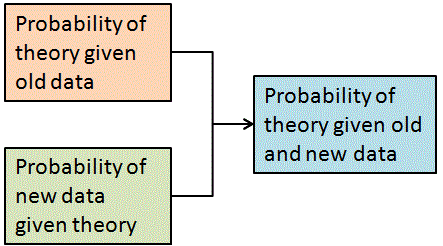
Once the host opens door No. 3, we have some more information. We certainly know that the car is not behind door No. 3 but does the host tell us anything else? Bayes’ theorem tells us how to ask the right question. The theorem can be illustrated like this.
Bayes

The probability of observing the new data, if the theory is correct (the green box), is called the likelihood and plays a very important role in statistics.

Without giving the details of the mathematics, Bayes’ theorem leads us to analyse the problem in this way.

MH1

We can work this out arithmetically but, because all three doors were initially equally probable, the matter comes down to deciding which of the two likelihoods is greater.

MH2

So what are the respective probabilities of the host behaving in the way he did? Unfortunately, this is where we run into problems because the answer depends on the tactic that the host was adopting.

And we are not given that in the question.

Consider some of the following possible tactics the host may have adopted.

  1. Open an unopened door hiding a goat, if both unopened doors have goats, choose at random.
  2. If the contestant chooses door 1 (or 2, or 3), always open 3 (or 1, or 2) whether or not it contains a goat.
  3. Open either unopened door at random but only if contestant has chosen box with prize otherwise don’t open a box (the devious strategy, suggested to me by a former girlfriend as the obviously correct answer).
  4. Choose an unopened door at random. If it hides a goat open it. Otherwise do not open a door (not the same as tactic 1).
  5. Open either unopened door at random whether or not it contains a goat

There are many more. All these various tactics lead to different likelihoods.

Tactic Probability that the host revealed a goat at door 3: Rational choice
given that the car is at 1 given that the car is at 2
1

½

1

Switch
2

1

1

No difference
3

½

0

Don’t switch
4

½

½

No difference
5

½

½

No difference

So if we were given this situation in real life we would have to work out which tactic the host was adopting. The problem is presented as though it is a straightforward maths problem but it critically hinges on a problem in psychology. What can we infer from the host’s choice? What is he up to? I think that this leads to people’s discomfort and difficulty. I am aware that even people who start out assuming Tactic 1 struggle but I suspect that somewhere in the back of their minds they cannot rid themselves of the other possibilities. The seeds of doubt have been sown in the way the problem is set.

A participant in the game show would probably have to make a snap judgment about the meaning of the new data. This is the sort of thinking that Daniel Kahneman calls System 1 thinking. It is intuitive, heuristic and terribly bad at coping with novel situations. Fear of the devious strategy may well prevail.

A more ambitious contestant may try to embark on more reflective analytical System 2 thinking about the likely tactic. That would be quite an achievement under pressure. However, anyone with the inclination may have been able to prepare himself with some pre-show analysis. There may be a record of past shows from which the host’s common tactics can be inferred. The production company’s reputation in similar shows may be known. The host may be displaying signs of discomfort or emotional stress, the “tells” relied on by poker players.

There is a lot of data potentially out there. However, that only leads us to another level of statistical, and psychological, inference about the host’s strategy, an inference that itself relies on its own uncertain likelihoods and prior probabilities. And that then leads to the level of behaviour and cognitive psychology and the uncertainties in the fundamental science of human nature. It seems as though, as philosopher Richard Jeffrey put it, “It’s probabilities all the way down”.

Behind all this, it is always useful advice that, having once taken a decision, it should only be revised if there is some genuinely new data that was surprising given our initial thinking.

Economist G L S Shackle long ago lamented that:

… we habitually and, it seems, unthinkingly assume that the problem facing … a business man, is of the same kind as those set in examinations in mathematics, where the candidate unhesitatingly (and justly) takes it for granted that he has been given enough information to construe a satisfactory solution. Where, in real life, are we justified in assuming that we possess ‘enough’ information?

Music is silver but …

The other day I came across a report on the BBC website that non-expert listeners could pick out winners of piano competitions more reliably when presented with silent performance videos than when exposed to sound alone. In the latter case they performed no better than chance.

The report was based on the work of Chia-Jung Tsay at University College London, in a paper entitled Sight over sound in the judgment of music performance.

The news report immediately leads us to suspect that the expert evaluating a musical performance is not in fact analysing and weighing auditory complexity and aesthetics but instead falling under the subliminal influence of the proxy data of the artist’s demeanour and theatrics.

That is perhaps unsurprising. We want to believe, as does the expert critic, that performance evaluation is a reflective, analytical and holistic enterprise, demanding decades of exposure to subtle shades of interpretation and developing skills of discrimination by engagement with the ascendant generation of experts. This is what Daniel Kahneman calls a System 2 task. However, a wealth of psychological study shows only too well that System 2 is easily fatigued and distracted. When we believe we are thinking in System 2, we are all too often loafing in System 1 and using simplistic learned heuristics as a substitute. It is easy to imagine that the visual proxy data might be such a heuristic, a ready reckoner that provides a plausible result in a wide variety of commonly encountered situations.

These behaviours are difficult to identify, even for the most mindful individual. Kahneman notes:

… all of us live much of our lives guided by the impressions of System 1 – and we do not know the source of these impressions. How do you know that a statement is true? If it is strongly linked by logic or association to other beliefs or preferences you hold, or comes from a source you trust and like, you will feel a sense of cognitive ease. The trouble is that there may be other causes for your feeling of ease … and you have no simple way of tracing your feelings to their source”

Thinking, Fast and Slow, p64

The problem is that what Kahneman describes is exactly what I was doing in finding my biases confirmed by this press report. I have had a superficial look at the statistics in this study and I am now less persuaded than when I read the press item. I shall maybe blog about this later and the difficulties I had in interpreting the analysis. Really, this is quite a tentative and suggestive study on a very limited frame. I would certainly like to see more inter-laboratory studies in psychology. The study is open to multiple interpretations and any individual will probably have difficulty making an exhaustive list.  There is always a danger of falling into the trap of What You See Is All There Is (WYSIATI).

That notwithstanding, even anecdotally, the story is another reminder of an important lesson of process management that, even though what we have been doing has worked in the past, we may not understand what it is that has been working.

Walkie-Talkie “death ray” and risk identification

News media have been full of the tale of London’s Walkie-Talkie office block raising temperatures on the nearby highway to car melting levels.

The full story of how the architects and engineers created the problem has yet to be told. It is certainly the case that similar phenomena have been reported elsewhere. According to one news report, the Walkie-Talkie’s architect had worked on a Las Vegas hotel that caused similar problems back in September 2010.

More generally, an external hazard from a product’s optical properties is certainly something that has been noted in the past. It appears from this web page that domestic low-emissivity (low-E) glass was suspected of setting fire to adjacent buildings as long ago as 2007. I have not yet managed to find the Consumer Product Safety Commission report into low-E glass but I now know all about the hazards of snow globes.

The Walkie-Talkie phenomenon marks a signal failure in risk management and it will cost somebody to fix it. It is not yet clear whether this was a miscalculation of a known hazard or whether the hazard was simply neglected from the start.

Risk identification is the most fundamental part of risk management. If you have failed to identify a risk you are not in a position to control, mitigate or externalise it in advance. Risk identification is also the hardest part. In the case of the Walkie-Talkie, modern materials, construction methods and aesthetic tastes have conspired to create a phenomenon that was not, at least as an accidental feature, present in structures before this century. That means that risk identification is not a matter of running down a checklist of known hazards to see which apply. Novel and emergent risks are always the most difficult to identify, especially where they involve the impact of an artefact on its environment. This is a real, as Daniel Kahneman would put it, System 2 task. The standard checklist propels it back to the flawed System 1 level. As we know, even when we think we are applying a System 2 mindset, me may subconsciously be loafing in a subliminal System 1.

It is very difficult to spot when something has been missed out of a risk assessment, even in familiar scenarios. In a famous 1978 study by Fischhoff, Slovic and others, they showed to college students fault trees analysing potential causes of a car’s failure to start (this is 1978). Some of the fault trees had been “pruned”. One branch, representing say “battery charge”, had been removed. The subjects were very poor at spotting that a major, and well known, source of failure had been omitted from the analysis. Where failure modes are unfamiliar, it is even more difficult to identify the lacuna.

Even where failure modes are identified, if they are novel then they still present challenges in effective design and risk management. Henry Petroski, in Design Paradigms, his historical analysis of human error in structural engineering, shows how novel technologies present challenges for the development of new engineering methodologies. As he says:

There is no finite checklist of rules or questions that an engineer can apply and answer in order to declare that a design is perfect and absolutely safe, for such finality is incompatible with the whole process, practice and achievement of engineering. Not only must engineers preface any state-of-the-art analysis with what has variously been called engineering thinking and engineering judgment, they must always supplement the results of their analysis with thoughtful and considered interpretations of the results.

I think there are three principles that can help guard against an overly narrow vision. Firstly, involve as broad a selection of people as possible in hazard identification. Perhaps, diagonal slice the organisation. Do not put everybody in a room together where they can converge rapidly. This is probably a situation where some variant of the Delphi method can be justified.

Secondly, be aware that all assessments are provisional. Make design assumptions explicit. Collect data at every stage, especially on your assumptions. Compare the data with what you predicted would happen. Respond to any surprises by protecting the customer and investigating. Even if you’ve not yet melted a Jaguar, if the glass is looking a little more reflective than you thought it would be, take immediate action. Do not wait until you are in the Evening Standard. There is a reputation management side to this too.

Thirdly, as Petroski advocates, analysis of case studies and reflection on the lessons of history helps to develop broader horizons and develop a sense of humility. It seems nobody’s life is actually in danger from this “death ray” but the history of failures to identify risk leaves a more tangible record of mortality.