Deconstructing Deming IX – Break down barriers between staff areas

9. Break down barriers between staff areas.

W Edwards Deming

Something there is that doesn’t love a wall,
That wants it down!

Robert Frost
Mending Wall (1914)

Point 9 of Deming’s 14 Points. One that is always attractive to a self describing iconoclast. Barriers must be bad if they prevent the exchange and interaction of ideas, or worse if they lead to optimisation within a subunit that suboptimises the wider system. Deming was thinking of managers such as John Browett. Browett was given charge of Apple’s retail operations and immediately started to cut staff numbers and hours in order to reduce his own budget. However, Apple’s avowed strategy is to foster reputation and brand loyalty through a distinctive, unconventional and delightfully effective Apple Store encounter. My wife is more of an enthusiast for Apple products than I, but I am always wowed by our Store visits.

I feel sorry for Browett as he was clearly left to guess the corporation’s strategy. Some organisational functions are just there because they enable the principle value streams. Without them profits would fall. Silo management is the term mockingly used to satirise a management dominated by pillars of functional expertise bolstered by professional status and mute to its “rival” silos.

Deming reminded us that somebody in a leadership position does need to maintain a synoptic view of the business system to prevent Browett type misunderstandings.
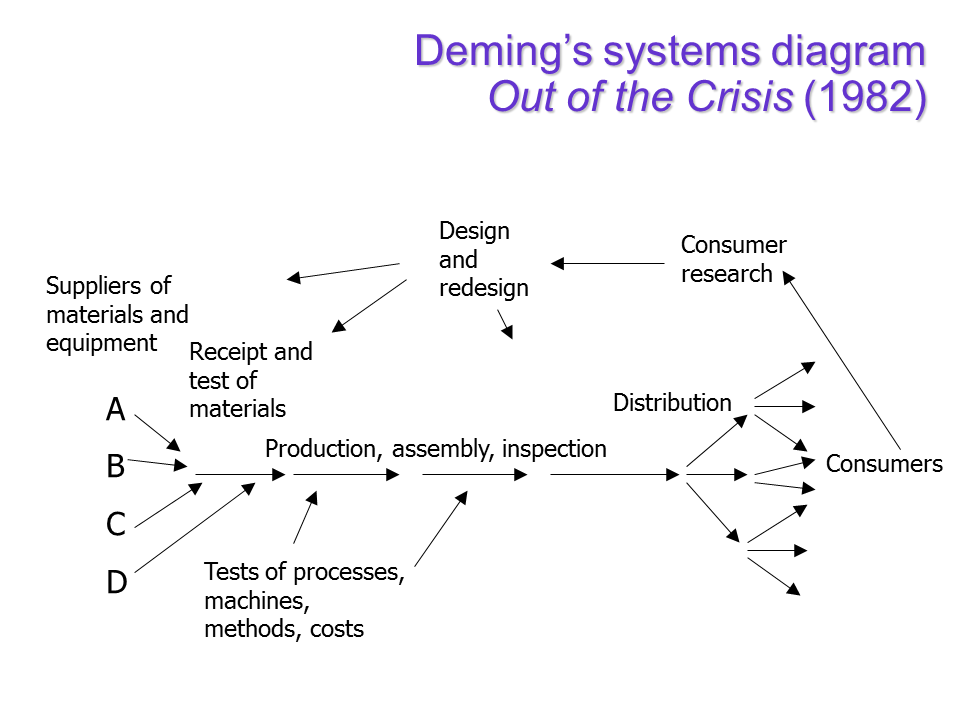
Deming system diagramAnybody who has been to a Deming seminar will have seen the Deming system diagram. Deming invited participants to focus on the system that created revenues for the organisation and, further, to see that system as a network of processes. Deming used the diagram to emphasis that the critical business processes transect organisational boundaries. Raw materials, whether physical or transactional, run into and out of the silos. Some processes don’t transform the raw materials but act as critical support for the supplier-customer strand. Deming argued that equipment maintenance, product development etc. are nonetheless processes transforming their own inputs into vital enablers and accelerants of the revenue generating activities.

Further, held Deming, those processes run across the external boundaries of the organisation into suppliers and customer. A manufacturer making car tyres is part of a bigger picture including the manufacture of the tyre rubber and even the way the end user drives his motor car. Only by understanding the whole can the tyre performance be optimised, customer value maximised, and growing market share and revenues realised.

Yet the power of the functions remains and is seldom mitigated by implementing process management. Process management is something with which organisations still struggle.Those who try to follow the idea of dispersing expertise into the processes frequently find that individuals embedded in cross-functional teams perform less well than within their concentrated centres of excellence. It is worth remembering how two counterbalancing forces arise.

Behaviour

Any proposed system of reward must be risk assessed against the behaviours it is likely to encourage or discourage. Managers given the job of reducing the cost of running their own silo will do just that. All managers are optimising within their own bounded rationality.

Goal deployment

One tactic that can help prevent managers from optimising their own subsystem at the expense of the greater is to adopt some system of goal deployment such as hoshin kanri. Visibility, both horizontally and vertically, of how individual results contribute to organisational goals, effected through objective supervision and strategic governance, ought to discourage suboptimisation and reveal any such trends at an early time.

Professional expertise is important

In 1776, Scottish philosopher Adam Smith told the parable of the pin maker. Smith set out a detailed argument for the benefits of specialisation and the division of labour. The silos provide the means of rewarding the development of expertise in itself, something whose value may only be seen in the future, and of fostering the application of that expertise in management.

Deming was somewhat inimical to this idea and thought that managers should work in a variety of roles across functions as they ascended the hierarchy, as he felt they did in Japan. Yet it is critical in that environment to maintain the virtues of the silos as incubators of expertise. This is not so easily achieved.

Organisational boundaries exist for a reason

In The Democratic Corporation (1994) Russell Ackoff asked why we could not make a business out of mutually and severally co-operating individuals, each negotiating a web of personal contracts that made up the system that delivered the goods.

Nobel laureate economist Ronald Coase had already answered the question in his 1937 paper The Nature of the Firm. Coase explained why organisations are promoted and employ the people who might otherwise be a market of interacting individual contractors. It simply came down to the costs of operating such a market and the savings that could be made from making a global decision to bring some people and facilities under a single enduring roof.

Organisational and even function boundaries often arise from subtle cost structures. Perhaps these develop over time as more connected ways of remote working become commonplace. But it is important to analyse the forces that created and perpetuate the silos. Otherwise, it should be no surprise when the benefits of process management go unrealised.


Deconstructing Deming VIII – Drive out fear

8. Drive out fear.

W Edwards Deming Point 8 of Deming’s 14 Points and quite my least favourite of all his slogans. As Harry Lime averred in the motion picture The Third Man:

Like the fella says, in Italy for 30 years under the Borgias they had warfare, terror, murder, and bloodshed, but they produced Michelangelo, Leonardo da Vinci, and the Renaissance. In Switzerland they had brotherly love – they had 500 years of democracy and peace, and what did that produce? The cuckoo clock.

It’s a wisecrack and not analysis but I quote Lime to remind myself that fear isn’t inevitably the debilitating sentiment that Deming made it out to be. Inspirational writer Helen Keller vividly captured an alternative reality.

Security is mostly a superstition. It does not exist in nature, nor do the children of humankind as a whole experience it. Avoiding danger is no safer in the long run than outright exposure. Life is either a daring adventure, or it is nothing at all.

In Out of the Crisis, Deming recounts several anecdotes of corrosive fear in the workplace. He directs his criticism at managers who threaten their subordinates with dire consequences for future outcomes that are, in fact, beyond the control of the workers. There is a recurring theme in Deming’s writing, and it is a good one, that many of the factors that determine an outcome are often outside the control of the person superficially held answerable. Any business process is influenced by diverse sources of variation. The aggregate of those sources determines the capability of the process and provides a fundamental bound on its future performance. An incapable process will never meet the aspirations of the business. Berating the person who works within it will never improve it because intervention is needed to re-engineer the process. Blind attempts to coax more out of an incapable process generally lead to over adjustment and even worse outcomes.

However, there have to be some people in an organisation for whom it wasn’t my fault isn’t available as an analysis of unsatisfactory outcomes. Some people willingly and enthusiastically own the goal of re-engineering the business process, of achieving higher and higher degrees of capability, of influencing the organisation’s environment, desensitising the system to external variation, of (following Eliyahu Goldratt) bringing the constraint back inside the system, fostering radical thinking, of managing unknown and unknowable risks.

Brian Joiner used to argue that it was wishful thinking to expect a prescribed outcome next year when the responsible manager had been incapable of achieving it last. Yet business is always a matter of resources and priorities. Typically, people do not energetically pursue objectives whose importance has not been urged upon them. They already have plenty to do. It is simply disingenuous to suggest that telling somebody that something is critical, and that they will be rewarded only for achieving it, is ultimately inexpedient.

Some people must manage and take responsibility for outcomes. They are responsible for the business system. They can change it.

There is nothing wrong in holding those who have the power to effect change responsible for outcomes.

Alternatively, some employees are responsible principally for operating a process in a disciplined and repeatable way. They are not responsible if that process is ultimately incapable but they are answerable for any lack of discipline. Their managers expect them to operate in a disciplined way, so do their co-workers. They should have no comfort that safety and security will be the consequence of failure to do their job.

Those workers will though, I fear, not be able to rest easily just because they turn up and do their job conscientiously. If management fail to take on the goal of the continual improvement of the alignment between the voice of the process and the voice of the customer then their diligence will be in vain. As business leader Ian MacGregor observed:

Management is a calling and people ought to be dedicated to it. British managers have far too much security. A poor manager should be dumped. What’s at stake is the happiness of society, not the comfort of managers.

The Productivity Paradox

File:City of London skyline at dusk.jpgThis last week saw a further report from the Bank of England that UK productivity has fallen inexplicably behind the nation’s aspirations. There is a compelling picture of the development of productivity over time on the Office of National Statistics (“ONS”) website here.

There is general puzzlement, and disquiet, among UK economists as to why productivity is not improving. It seems to suggest that cutting the costs of production is not at the top of UK business agendas. It’s true that there are other important things to worry about: design and redesign of products and services, reputation, customer experience, workplace engagement, safety and sustainability.

But I suspect that there is nothing more important than productivity. It is only by learning how to do more with less that resources can be freed up to develop novel income streams. Even on matters of safety and environment, it is the efficient organisation that finds the resources to take those matters seriously.

The road to increased productivity is well mapped out. The continual improvement of the alignment between the Voice of the Process and the Voice of the Customer, by the means of diligent criticism of historical data is an open secret.

Bang! UK Passport Office hits the kerb

Her Majesty's Passport OfficeThe UK’s Passport Office is in difficulties. They have a backlog that is resulting in customers’ passport applications being delayed. This is not a mere internal procedural inconvenience. The public has noticed the problem and started complaining. Emergency measures are being put in place to deal with the backlog. Politicians have become involved and are looking over their shoulders at their careers.

It is a typical organisational mess. There is a problem. Resources are thrown at it. Personalities wager their reputations. Any hero able to solve the problem will be feted and rewarded. There will be blame and punishment. Solutions will involve huge cost. The costs will be passed on to the customer because, in the end, there is no one else to pay.

A suggestion for investigation

From the outside, it is impossible to know the realities of what has caused the problem at HM Passport Office. However, I think I can respectfully and tentatively suggest some questions to ask in any inquiry as to how the mess occurred.

  • Had any surprising variation in passport processing occurred before the crisis hit?
  • If so, what action, if any, was taken?
  • Why was the action ineffective?
  • If no surprising variation was observed, were the managers measuring “upstream” indicators of process performance in addition to mere volumes?
  • Was historic data routinely interrogated to find signals among the noise?
  • If signals were only observed once it was too late to protect the customer, was the issuing process only marginally capable?

“Managing the passport issuing process on historical data is like …”

… trying to drive a car by watching the line in the rear-view mirror.

Myron Tribus

And, of course, that is what HM Passport Office and every manager has to do. There is only historical data. There is no data on the future. You cannot see out of the windscreen of the organisational SUV. Management is about subjecting the historic experience base to continual, rigorous statistical criticism to separate signal from noise. It is about having a good rear view mirror.

A properly managed, capable process will operate reliably, well within customer expectations. In process management terms, the Voice of the Process will be reliably aligned with the Voice of the Customer.

Forever improving the capability of the process gives it the elbow room or “rattle space” within which signals can occur that the customer never perceives. Those signals could represent changes in customer behaviour, problems within the organisation, or external events that have an impact. But the fact that they are unnoticed by the customer does not mean those signals are unimportant or can be neglected. It is by taking action to investigate those signals when they are detected, and by making necessary adjustments to work processes, that a future crisis can be averted.

While the customer is unaffected, the problem can be thoroughly investigated, solutions considered calmly and alternative remedies tested. Because the problem is invisible to the outside world there will be no sense of panic, political pressure, cash-flow deficit, reputational damage or destruction of employee engagement. The matter can be addressed soundly and privately.

Continual statistical analysis is the “rear view mirror”. It gives an historical picture as to how well the Voice of the Process emulates the Voice of the Customer. Coupled with a “roadmap” of the business, some supportive data from the “speedometer” and a little basic numeracy, the “rear view mirror” enables sensible predictions to be made about the near future.

Without that historical data, properly presented on live process behaviour charts to provide running statistical insight, then there is no rear view mirror. That is when the only business guidance is the Bang! when the organisation hits the kerb.

It looks like that is what happened at HM Passport Office. Everything was fine until the customers started complaining to the press. Bang! That’s how it looks to the customer and that is the only reality that counts.

#Bang!youhitthekerb

Deconstructing Deming V – Improve constantly and forever

5. Improve constantly and forever the system of production and service, to improve quality and productivity, and thus constantly decrease costs.

W Edwards Deming Point 5 of Deming’s 14 Points. Surely about this there can be no controversy.

Improvement means reducing operating costs, enhancing customer value, and developing flexibility and agility. Improvement means constantly diminishing the misalignment between the Voice of the Process and the Voice of the Customer.

The UK awaits fresh productivity statistics next month but the figures up to the end of 2013 make sobering reading. UK productivity has been in miserable decline since 2008. In response to tightening of demand, failures of liquidity, absence of safe investment alternatives, rises in taxation and straightened cash flows, the aggregate response of industry has been a decline in human efficiency.

The reasons this has happened are no doubt complex. The paradox remains that it is improvement in productivity that grows sustainable rewards, captures markets and releases working capital for new ventures. At first sight it appears the answer to all the ills of a recession.

How will you know?

In their seminal model for improving productivity, Thomas Nolan and Lloyd Provost posed the question:

How will you know when a change is an improvement?

It is such a simple questions but it is too seldom asked and I suspect that itself is a major barrier to improvement.

We are beset by human induced change, by government and by business managers. The essential discipline is critically to question whether such change results in an improvement. It is an unpopular question. Nobody who champions a particular change wants to be proved wrong, or confronted with a marginal improvement that fails to live up to an extravagant promise.

Business measurement is mandated in the modern corporation. Businesses, governments, organisations abound with KPIs, metrics, “Big Ys”, results measures … and often a distracting argument over what to call them. There is no lack of numbers for answering the question. We are constantly assured that we now have the Big Data whose absence frustrated past strategy.

The habitual analytic tool in old-style businesses was what Don Wheeler mischievously named the executive time series, two numbers, one larger (or smaller) than the other, selected to show movement in the desired direction. That is, as Scottish folklorist Andrew Lang put it:

… using statistics in the same way that a drunk uses lamp-posts — for support rather than illumination.

It is a moral certainty that no two measurements will yield the same number. One will be larger than the other. It will be easy to select two to support any pet project or theory.

Building a persuasive case that improvement has happened firstly requires a rigorously constructed baseline. Without an objective description of the historical experience base, claims as to improvement are simply speculative.

And beyond that, what the executive time series cannot do is distinguish signal from noise. It cannot help because the answer to the question When will you know …? is When there is a signal in the data. That can only be answered with the diligent and rigorous use of process behaviour charts.

At the top of this page is a “RearView” tab. Without the trenchant and determined use of process behaviour charts there is not even a white line in the rear view mirror. The only signal will come from the “bang” when we hit the kerb.

What to improve

Deming’s further message was that it was every process that was to be improved, not simply those whose customer was the end consumer. Many processes have internal customers with their own voice. Processes of management of human resources, maintenance and accounting can all have a critical impact on organisation performance. They must keep on getting better too.

Being held to account is never comfortable but neither is the realisation that we have surrendered control of assets without the means of knowing when such assets are incrementally put to increasingly efficient, effective and agile use.

We need louder demands of “Show me!”