UK railway suicides – 2014 update

It’s taken me a while to sit down and blog about this news item from October 2014: Sharp Rise in Railway Suicides Say Network Rail . Regular readers of this blog will know that I have followed this data series closely in 2013 and 2012.

The headline was based on the latest UK government data. However, I baulk at the way these things are reported by the press. The news item states as follows.

The number of people who have committed suicide on Britain’s railways in the last year has almost reached 300, Network Rail and the Samaritans have warned. Official figures for 2013-14 show there have already been 279 suicides on the UK’s rail network – the highest number on record and up from 246 in the previous year.

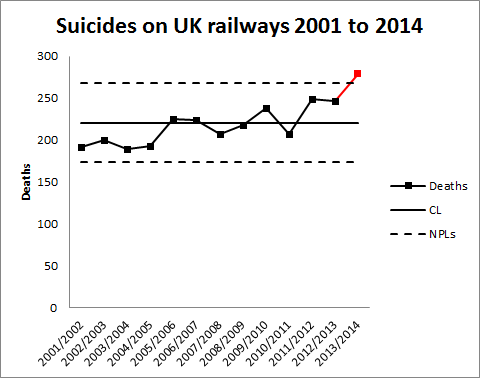
I don’t think it’s helpful to characterise 279 deaths as “almost … 300”, where there is, in any event, no particular significance in the number 300. It arbitrarily conveys the impression that some pivotal threshold is threatened. Further, there is no especial significance in an increase from 246 to 279 deaths. Another executive time series. Every one of the 279 is a tragedy as is every one of the 246. The experience base has varied from year to year and there is no surprise that it has varied again. To assess the tone of the news report I have replotted the data myself.
RailwaySuicides3

Readers should note the following about the chart.

  • Some of the numbers for earlier years have been updated by the statistical authority.
  • I have recalculated natural process limits as there are still no more than 20 annual observations.
  • There is now a signal (in red) of an observation above the upper natural process limit.

The news report is justified, unlike the earlier ones. There is a signal in the chart and an objective basis for concluding that there is more than just a stable system of trouble. There is a signal and not just noise.

As my colleague Terry Weight always taught me, a signal gives us license to interpret the ups and downs on the chart. There are two possible narratives that immediately suggest themselves from the chart.

  • A sudden increase in deaths in 2013/14; or
  • A gradual increasing trend from around 200 in 2001/02.

The chart supports either story. To distinguish would require other sources of information, possibly historical data that can provide some borrowing strength, or a plan for future data collection. Once there is a signal, it makes sense to ask what was its cause. Building  a narrative around the data is a critical part of that enquiry. A manager needs to seek the cause of the signal so that he or she can take action to improve system outcomes. Reliably identifying a cause requires trenchant criticism of historical data.

My first thought here was to wonder whether the railway data simply reflected an increasing trend in suicide in general. Certainly a very quick look at the data here suggests that the broader trend of suicides has been downwards and certainly not increasing. It appears that there is some factor localised to railways at work.

I have seen proposals to repeat a strategy from Japan of bathing railway platforms with blue light. I have not scrutinised the Japanese data but the claims made in this paper and this are impressive in terms of purported incident reduction. If these modifications are implemented at British stations we can look at the chart to see whether there is a signal of fewer suicides. That is the only real evidence that counts.

Those who were advocating a narrative of increasing railway suicides in earlier years may feel vindicated. However, until this latest evidence there was no signal on the chart. There is always competition for resources and directing effort on a false assumptions leads to misallocation. Intervening in a stable system of trouble, a system featuring only noise, on the false belief that there is a signal will usually make the situation worse. Failing to listen to the voice of the process on the chart risks diverting vital resources and using them to make outcomes worse.

Of course, data in terms of time between incidents is much more powerful in spotting an early signal. I have not had the opportunity to look at such data but it would have provided more, better and earlier evidence.

Where there is a perception of a trend there will always be an instinctive temptation to fit a straight line through the data. I always ask myself why this should help in identifying the causes of the signal. In terms of analysis at this stage I cannot see how it would help. However, when we come to look for a signal of improvement in future years it may well be a helpful step.

Deconstructing Deming XI A – Eliminate numerical quotas for the workforce

11. Part A. Eliminate numerical quotas for the workforce.

W Edwards DemingI find this probably the most confused part of Deming’s thinking. Carefully reading Out of the Crisis (at pp70-75) Deming’s attack is not on standardised work, that is advocated as central to his message, but against specifications for the volume of work: calls answered per hour, finished parts per day.

Deming recognises management’s need to predict costs and revenues but condemns quotas as destructive of achieving productivity.

Deming also deprecates such quotas as corroding workplace pride. I shall return to that in Point 12.

Deming’s criticism of work quotas goes as follows.

  • Some individuals may achieve them easily and their productive capacity will then stand idle.
  • Some individuals may struggle and suffer poor moral.
  • Some individuals may compromise quality so as to make a quota or so as to make it sooner.
  • Achievement of quotas may be frustrated by faults in “the system” which are outside the individual worker’s control.

Deming gives the following example of how he would advise financial planning in a call centre of 500 people (at pp73-74).

  1. Set a preliminary budget.
  2. Make it clear to every one of the 500 that their aim is to give satisfaction to the customer, to take pride in their work.
  3. Everybody will keep a record of calls made.
  4. Customers with special problems will be referred to the supervisor.
  5. At the end of each week, sample 100 individuals’ record and summarise the data.
  6. Repeat steps 2 to 5 for several weeks.
  7. Analyse the data.
  8. Establish a continuing study following the above steps but on a reducing basis.
  9. Use the data to predict costs.

Now there is much merit in forecasting costs based on actual data. Further, improving performance based on the relentless criticism of historical data is essential. However, I think Deming’s prescription naïve and idealistic. The trick is to extract the ideals and industrialise them.

Planning

The simple matter is that any new enterprise has to be established on the basis of a robust business plan. There is competition for resources: people, capital, infrastructure … and everyone has to make their case. It is impossible to do that without judgment. No matter how much historical data or even qualitative experience is to hand we cannot simply project it into the future without establishing further conditions (RearView). It is unlikely this can ever be done exactly in a new establishment.

That competition for resources then prevents us from taking an overly conservative view of what can be achieved. Setting the bar too low for call centre operators starts off from an uncompetitive position. Further, the modest answering rate in the plan has to be resourced with infrastructure. Intentions to improve the answering rate post-launch are all very well but what will happen to the personnel and materiel that we bought in to accommodate the unambitious start-up?

Sometimes work needs to be set at a rate that is recognised by a team of co-workers and other parts of the organisation. Excess production is as contrary to the philosophy of lean operations as is shortage. The idea of takt time allows production lines to be balanced, receipts and deliveries co-ordinated, stock turns to be minimised and cash flows improved. In many situations that is sufficient to answer Deming’s fears about individuals distorting production to bank an accomplished target.

Stretch

What is now proved was once but imagined.

William Blake

Is it so wrong to set a target that nobody involved has seen achieved before? Deming would say that it was fine so long as there was a plan defining the means by which this could be achieved. There are many compelling stories from sports science telling how records have been broken by incremental improvement (e.g. Dave Brailsford and the GB cycling team).

But what about setting an ambitious stretch target without a plan for achieving it? That would be brave indeed. It would be based on no more than an exhortation to the call centre operators to work more furiously, more furiously than anyone had ever done before. I cannot say that would never work. In my athletics days I ran some of my best times when team mates were urging me on from the sidelines. However, as a business strategy it faces the social realities of employees’ collective ability to resist quietly that to which they do not assent. With a carefully recruited and motivated team it could work. It would certainly require a high degree of collective problem solving and improvement by the operators. But of all strategies for operational excellence it looks the most limited and the most risky. There is no obvious Plan B.

The Ringelmann effect

There is a tension between unrealistic stretch targets and a further problem that Deming ignores entirely, the Ringelmann effect. It may sadden the hearts of those who believe in the inherent fulfilling joy of work and best intentions of workers to do a good job but evidence is overwhelming that there are situations where individuals exert less effort in a group environment than they would if acting individually.

In 1913, Max Ringelmann conducted experiments that showed that individuals pulled less strenuously on a rope when pulling in a group than when pulling alone.

A realistically set and communicated takt time can assist in concentrating effort and communicating common work standards and the expectations of peers.

The poor supervisor

If Deming was so pessimistic as to believe that workers would sacrifice quality to hit targets then they would surely be more than happy to shunt enquiries off to their supervisor in order to post commendable performance. All that Deming’s proposal does is to divert the whole problem of difficult calls to the supervisor who, presumably, is either beset with his own performance problems or operates outside business measurement.

Proposition 65

WarningPoster1I had break from posting following my recent family vacation to California. While I was out there I noticed this rather alarming notice at a beach hotel and restaurant in Santa Monica. After a bit of research it turned out that the notice was motivated by California Proposition 65 (1986). Everywhere we went in California we saw similar notices.

I stand in this issue not solely as somebody professionally involved in risk but also as an individual concerned for his own health and that of his family. If there is an audience for warnings of harm then it is me.

I am aware of having embarked on a huge topic here but, as I say, it is as a concerned consumer of risk advice. The notice, and I hesitate to call it a warning, was unambiguous. Apparently, this hotel, teeming with diners and residents enjoying the pacific coast, did contain chemicals emphatically “known” to cause cancer, birth defects or reproductive harm. Yet for such dreadful risks to be present the notice gave alarmingly vague information. I saw that a brochure was available within the hotel but my wife was unwilling to indulge my professional interest. I suspect that most visitors showed even less curiosity.

As far as discharging any legal duty goes, vague notices offer no protection to anybody. In the English case of Vacwell Engineering Co. Ltd v B.D.H. Chemicals Ltd [1969] 3 All ER 1681, Vacwell purchased ampules of boron tribromide from B.D.H.. The ampules bore the label “Harmful Vapour”. While the ampules were being washed, one was dropped into a sink where it fractured allowing the contents to come into contact with water. Mixing water with boron tribromide caused an explosion that killed one employee and extensively damaged a laboratory building. The label had given B.D.H. no information as to the character or possible severity of the hazard, nor any specific details that would assist in avoiding the consequences.

Likewise the Proposition 65 notice gives me no information on the severity of the hazard. There is a big difference between “causing” cancer and posing a risk of cancer. The notice doesn’t tell me whether cancer is an inevitable consequence of exposure or whether I should just shorten my odds against mortality. There is no quantification of risk on which I can base my own decisions.

Nor does the notice give me any guidance on what to do to avoid or mitigate the risk. Will stepping foot inside the premises imperil my health? Or are there only certain areas that are hazardous? Are these delineated with further and more specific warnings? Or even ultimately segregated in secure areas? Am I even safe immediately outside the premises? Ten yards away? A mile? I have to step inside to acquire the brochure so I think I should be told.

The notice ultimately fulfils no socially useful purpose whatever. I looked at the State of California’s own website on the matter but found it too opaque to extract any useful information within the time I was willing to spend on it, which I suspect is more time than most of the visitors who find their way there.

It is most difficult for members of the public, even those engaged and interested, to satisfy themselves as to the science on these matters. The risks fall within what John Adams at University College London characterises as risks that are known to science but on which normal day to day intuition is of little use. The difficulty we all have is that our reflection on the risks is conditioned on the anecdotal hearsay that we pick up along the way. I have looked before at the question of whether anecdote is data.

In 1962, Rachel Carson published the book Silent Spring. The book aggregated anecdotes and suggestive studies leading Carson to infer that industrial pesticides were harming agriculture, wildlife and human health. Again, proper evaluation of the case she advanced demands more attention to scientific detail than any lay person is willing to spare. However, the fear she articulated lingers and conditions our evaluation of other claims. It seems so plausible that synthetic chemicals developed for lethal effect, rather than evolved in symbiosis with the natural world, would pose a threat to human life and be an explanation for increasing societal morbidity.

However, where data is sparse and uncertain, it is important to look for other sources of information that we can “borrow” to add “strength” to our preliminary assessment (Persi Diaconis’ classic paper Theories of Data Analysis: From Magical Thinking through Classical Statistics has some lucid insights on this). I found the Cancer Research UK website provided me with some helpful borrowing strength. Cancer is becoming more prevalent largely because we are living longer. Cancer Research helpfully referred me to this academic research published in the British Journal of Cancer.

Despite the difficulty in disentangling and interpreting data on specific risks of alleged pathogens we have the strength of borrowing from life expectancy data. Life expectancy has manifestly improved in the half century since Carson’s book, belying her fear of a toxic catastrophe flowing from our industrialised society. I think that is why there was so much indifference to the Santa Monica notice.

I should add that, inside the hotel, I spotted five significant trip hazards. I suspect these posed a much more substantial threat to visitors’ wellbeing than the virtual risks of contamination with hotel carcinogens.