Royal babies and the wisdom of crowds

Prince George of Cambridge with wombat plush toy (crop).jpgIn 2004 James Surowiecki published a book with the unequivocal title The Wisdom of Crowds: Why the Many Are Smarter Than the Few and How Collective Wisdom Shapes Business, Economies, Societies and Nations. It was intended as a gloss on Charles Mackay’s 1841 book Extraordinary Popular Delusions and the Madness of Crowds. Both books are essential reading for any risk professional.

I am something of a believer in the wisdom of crowds. The other week I was fretting about the possible relegation of English Premier League soccer club West Bromwich Albion. It’s an emotional and atavistic tie for me. I always feel there is merit, as part of my overall assessment of risk, in checking online bookmakers’ odds. They surely represent the aggregated risk assessment of gamblers if nobody else. I was relieved that bookmakers were offering typically 100/1 against West Brom being relegated. My own assessment of risk is, of course, contaminated with personal anxiety so I was pleased that the crowd was more phlegmatic.

However, while I was on the online bookmaker’s website, I couldn’t help but notice that they were also accepting bets on the imminent birth of the royal baby, the next child of the Duke and Duchess of Cambridge. It struck me as weird that anyone would bet on the sex of the royal baby. Surely this was a mere coin toss, though I know that people will bet on that. Being hopelessly inquisitive I had a look. I was somewhat astonished to find these odds being offered (this was 22 April 2015, ten days before the royal birth).

odds implied probability
Girl 1/2 0.67
Boy 6/4 0.40
 Total 1.07

Here I have used the usual formula for converting between odds and implied probabilities: odds of m / n against an event imply a probability of n / (m + n) of the event occurring. Of course, the principle of finite additivity requires that probabilities add up to one. Here they don’t and there is an overround of 7%. Like the rest of us, bookmakers have to make a living and I was unsurprised to find a Dutch book.

The odds certainly suggested that the crowd thought a girl manifestly more probable than a boy. Bookmakers shorten the odds on the outcome that is attracting the money to avoid a heavy payout on an event that the crowd seems to know something about.

Historical data on sex ratio

I started, at this stage, to doubt my assumption that boy/ girl represented no more than a coin toss, 50:50, an evens bet. As with most things, sex ratio turns out to be an interesting subject. I found this interesting research paper which showed that sex ratio was definitely dependent on factors such as the age and ethnicity of the mother. The narrative of this chart was very interesting.
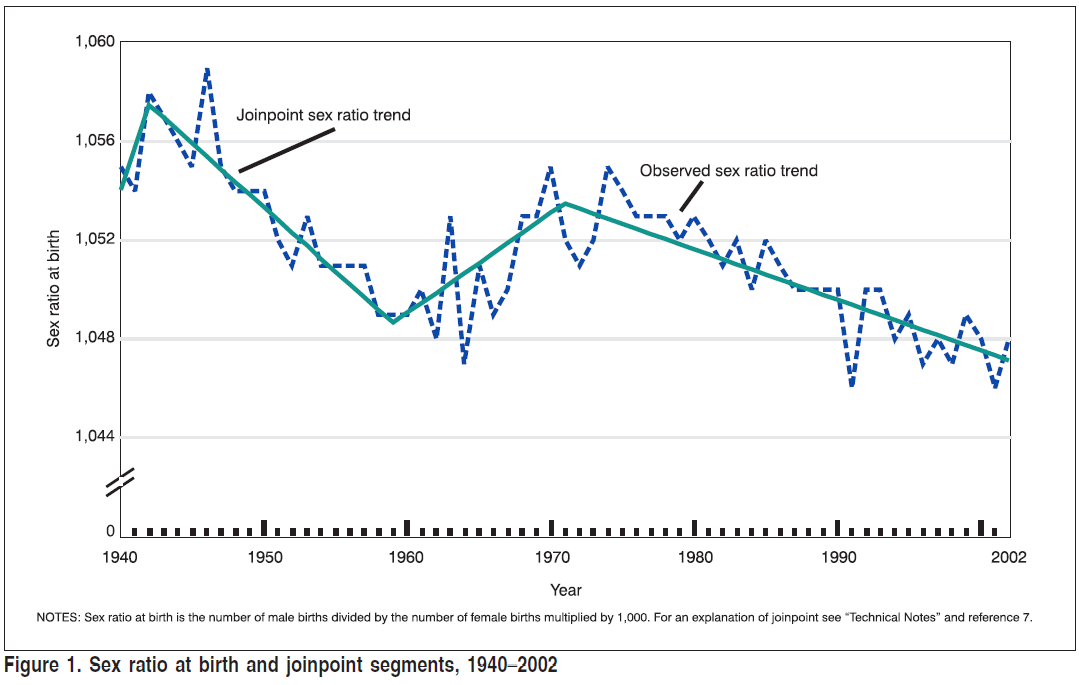
Sex ratio

However, the paper confirmed that the sex of a baby is independent of previous births, conditioned on the factors identified, and that the ratio of girls to boys is nowhere and no time greater than 1,100 to 1000, about 52% girls.

So why the odds?

Bookmakers lengthen the odds on the outcome attracting the smaller value of bets in order to encourage stakes on the less fancied outcomes, on which there is presumably less risk of having to pay out. At odds of 6/4, a punter betting £10 on a boy would receive his stake back plus £15 ( = 6 × £10 / 4 ). If we assume an equal chance of boy or girl then that is an expected return of £12.50 ( = 0.5 × £25 ) for a £10.00 stake. I’m not sure I’d seen such a good value wager since we all used to bet against Tim Henman winning Wimbledon.

Ex ante there are two superficially suggestive explanations as to the asymmetry in the odds. At least this is all my bounded rationality could imagine.

  • A lot of people (mistakenly) thought that the run of five male royal births (Princes Andrew, Edward, William, Harry and George) escalated the probability of a girl being next. “It was overdue.”
  • A lot of people believed that somebody “knew something” and that they knew what it was.

In his book about cognitive biases in decision making (Thinking, Fast and Slow, Allen Lane, 2011) Nobel laureate economist Daniel Kahneman describes widespread misconceptions concerning randomness of boy/ girl birth outcomes (at p115). People tend to see regularity in sequences of data as evidence of non-randomness, even where patterns are typical of, and unsurprising in, random events.

I had thought that there could not be sufficient gamblers who would be fooled by the baseless belief that a long run of boys made the next birth more likely to be a girl. But then Danny Finkelstein reminded me (The (London) Times, Saturday 25 April 2015) of a survey of UK politicians that revealed their limited ability to deal with chance and probabilities. Are politicians more or less competent with probabilities than online gamblers? That is a question for another day. I could add that the survey compared politicians of various parties but we have an on-going election campaign in the UK at the moment so I would, in the interest of balance, invite my voting-age UK readers not to draw any inferences therefrom.

The alternative is the possibility that somebody thought that somebody knew something. The parents avowed that they didn’t know. Medical staff may or may not have. The sort of people who work in VIP medicine in the UK are not the sort of people who divulge information. But one can imagine that a random shift in sentiment, perhaps because of the misconception that a girl was “overdue”, and a consequent drift in the odds, could lead others to infer that there was insight out there. It is not completely impossible. How many other situations in life and business does that model?

It’s a girl!

The wisdom of crowds or pure luck? We shall never know. I think it was Thomas Mann who observed that the best proof of the genuineness of a prophesy was that it turned out to be false. Had the royal baby been a boy we could have been sure that the crowd was mad.

To be complete, Bayes’ theorem tells us that the outcome should enhance our degree of belief in the crowd’s wisdom. But it is a modest increase (Bayes’ factor of 2, 3 deciban after Alan Turing’s suggestion) and as we were most sceptical before we remain unpersuaded.

In his book, Surowiecki identified five factors that can impair crowd intelligence. One of these is homogeneity. Insufficient diversity frustrates the inherent virtue on which the principle is founded. I wonder how much variety there is among online punters? Similarly, where judgments are made sequentially there is a danger of influence. That was surely a factor at work here. There must also have been an element of emotion, the factor that led to all those unrealistically short odds on Henman at Wimbledon on which the wise dined so well.

But I’m trusting that none of that applies to the West Brom odds.
UK railway suicides – 2014 update

It’s taken me a while to sit down and blog about this news item from October 2014: Sharp Rise in Railway Suicides Say Network Rail . Regular readers of this blog will know that I have followed this data series closely in 2013 and 2012.

The headline was based on the latest UK government data. However, I baulk at the way these things are reported by the press. The news item states as follows.

The number of people who have committed suicide on Britain’s railways in the last year has almost reached 300, Network Rail and the Samaritans have warned. Official figures for 2013-14 show there have already been 279 suicides on the UK’s rail network – the highest number on record and up from 246 in the previous year.

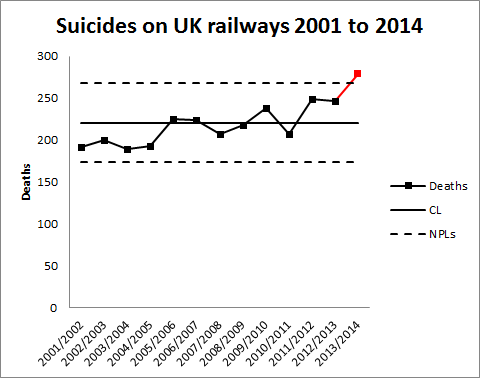
I don’t think it’s helpful to characterise 279 deaths as “almost … 300”, where there is, in any event, no particular significance in the number 300. It arbitrarily conveys the impression that some pivotal threshold is threatened. Further, there is no especial significance in an increase from 246 to 279 deaths. Another executive time series. Every one of the 279 is a tragedy as is every one of the 246. The experience base has varied from year to year and there is no surprise that it has varied again. To assess the tone of the news report I have replotted the data myself.

RailwaySuicides3

Readers should note the following about the chart.

  • Some of the numbers for earlier years have been updated by the statistical authority.
  • I have recalculated natural process limits as there are still no more than 20 annual observations.
  • There is now a signal (in red) of an observation above the upper natural process limit.

The news report is justified, unlike the earlier ones. There is a signal in the chart and an objective basis for concluding that there is more than just a stable system of trouble. There is a signal and not just noise.

As my colleague Terry Weight always taught me, a signal gives us license to interpret the ups and downs on the chart. There are two possible narratives that immediately suggest themselves from the chart.

  • A sudden increase in deaths in 2013/14; or
  • A gradual increasing trend from around 200 in 2001/02.

The chart supports either story. To distinguish would require other sources of information, possibly historical data that can provide some borrowing strength, or a plan for future data collection. Once there is a signal, it makes sense to ask what was its cause. Building  a narrative around the data is a critical part of that enquiry. A manager needs to seek the cause of the signal so that he or she can take action to improve system outcomes. Reliably identifying a cause requires trenchant criticism of historical data.

My first thought here was to wonder whether the railway data simply reflected an increasing trend in suicide in general. Certainly a very quick look at the data here suggests that the broader trend of suicides has been downwards and certainly not increasing. It appears that there is some factor localised to railways at work.

I have seen proposals to repeat a strategy from Japan of bathing railway platforms with blue light. I have not scrutinised the Japanese data but the claims made in this paper and this are impressive in terms of purported incident reduction. If these modifications are implemented at British stations we can look at the chart to see whether there is a signal of fewer suicides. That is the only real evidence that counts.

Those who were advocating a narrative of increasing railway suicides in earlier years may feel vindicated. However, until this latest evidence there was no signal on the chart. There is always competition for resources and directing effort on a false assumptions leads to misallocation. Intervening in a stable system of trouble, a system featuring only noise, on the false belief that there is a signal will usually make the situation worse. Failing to listen to the voice of the process on the chart risks diverting vital resources and using them to make outcomes worse.

Of course, data in terms of time between incidents is much more powerful in spotting an early signal. I have not had the opportunity to look at such data but it would have provided more, better and earlier evidence.

Where there is a perception of a trend there will always be an instinctive temptation to fit a straight line through the data. I always ask myself why this should help in identifying the causes of the signal. In terms of analysis at this stage I cannot see how it would help. However, when we come to look for a signal of improvement in future years it may well be a helpful step.

Deconstructing Deming XI A – Eliminate numerical quotas for the workforce

11. Part A. Eliminate numerical quotas for the workforce.

W Edwards DemingI find this probably the most confused part of Deming’s thinking. Carefully reading Out of the Crisis (at pp70-75) Deming’s attack is not on standardised work, that is advocated as central to his message, but against specifications for the volume of work: calls answered per hour, finished parts per day.

Deming recognises management’s need to predict costs and revenues but condemns quotas as destructive of achieving productivity.

Deming also deprecates such quotas as corroding workplace pride. I shall return to that in Point 12.

Deming’s criticism of work quotas goes as follows.

  • Some individuals may achieve them easily and their productive capacity will then stand idle.
  • Some individuals may struggle and suffer poor moral.
  • Some individuals may compromise quality so as to make a quota or so as to make it sooner.
  • Achievement of quotas may be frustrated by faults in “the system” which are outside the individual worker’s control.

Deming gives the following example of how he would advise financial planning in a call centre of 500 people (at pp73-74).

  1. Set a preliminary budget.
  2. Make it clear to every one of the 500 that their aim is to give satisfaction to the customer, to take pride in their work.
  3. Everybody will keep a record of calls made.
  4. Customers with special problems will be referred to the supervisor.
  5. At the end of each week, sample 100 individuals’ record and summarise the data.
  6. Repeat steps 2 to 5 for several weeks.
  7. Analyse the data.
  8. Establish a continuing study following the above steps but on a reducing basis.
  9. Use the data to predict costs.

Now there is much merit in forecasting costs based on actual data. Further, improving performance based on the relentless criticism of historical data is essential. However, I think Deming’s prescription naïve and idealistic. The trick is to extract the ideals and industrialise them.

Planning

The simple matter is that any new enterprise has to be established on the basis of a robust business plan. There is competition for resources: people, capital, infrastructure … and everyone has to make their case. It is impossible to do that without judgment. No matter how much historical data or even qualitative experience is to hand we cannot simply project it into the future without establishing further conditions (RearView). It is unlikely this can ever be done exactly in a new establishment.

That competition for resources then prevents us from taking an overly conservative view of what can be achieved. Setting the bar too low for call centre operators starts off from an uncompetitive position. Further, the modest answering rate in the plan has to be resourced with infrastructure. Intentions to improve the answering rate post-launch are all very well but what will happen to the personnel and materiel that we bought in to accommodate the unambitious start-up?

Sometimes work needs to be set at a rate that is recognised by a team of co-workers and other parts of the organisation. Excess production is as contrary to the philosophy of lean operations as is shortage. The idea of takt time allows production lines to be balanced, receipts and deliveries co-ordinated, stock turns to be minimised and cash flows improved. In many situations that is sufficient to answer Deming’s fears about individuals distorting production to bank an accomplished target.

Stretch

What is now proved was once but imagined.

William Blake

Is it so wrong to set a target that nobody involved has seen achieved before? Deming would say that it was fine so long as there was a plan defining the means by which this could be achieved. There are many compelling stories from sports science telling how records have been broken by incremental improvement (e.g. Dave Brailsford and the GB cycling team).

But what about setting an ambitious stretch target without a plan for achieving it? That would be brave indeed. It would be based on no more than an exhortation to the call centre operators to work more furiously, more furiously than anyone had ever done before. I cannot say that would never work. In my athletics days I ran some of my best times when team mates were urging me on from the sidelines. However, as a business strategy it faces the social realities of employees’ collective ability to resist quietly that to which they do not assent. With a carefully recruited and motivated team it could work. It would certainly require a high degree of collective problem solving and improvement by the operators. But of all strategies for operational excellence it looks the most limited and the most risky. There is no obvious Plan B.

The Ringelmann effect

There is a tension between unrealistic stretch targets and a further problem that Deming ignores entirely, the Ringelmann effect. It may sadden the hearts of those who believe in the inherent fulfilling joy of work and best intentions of workers to do a good job but evidence is overwhelming that there are situations where individuals exert less effort in a group environment than they would if acting individually.

In 1913, Max Ringelmann conducted experiments that showed that individuals pulled less strenuously on a rope when pulling in a group than when pulling alone.

A realistically set and communicated takt time can assist in concentrating effort and communicating common work standards and the expectations of peers.

The poor supervisor

If Deming was so pessimistic as to believe that workers would sacrifice quality to hit targets then they would surely be more than happy to shunt enquiries off to their supervisor in order to post commendable performance. All that Deming’s proposal does is to divert the whole problem of difficult calls to the supervisor who, presumably, is either beset with his own performance problems or operates outside business measurement.

Proposition 65

WarningPoster1I had break from posting following my recent family vacation to California. While I was out there I noticed this rather alarming notice at a beach hotel and restaurant in Santa Monica. After a bit of research it turned out that the notice was motivated by California Proposition 65 (1986). Everywhere we went in California we saw similar notices.

I stand in this issue not solely as somebody professionally involved in risk but also as an individual concerned for his own health and that of his family. If there is an audience for warnings of harm then it is me.

I am aware of having embarked on a huge topic here but, as I say, it is as a concerned consumer of risk advice. The notice, and I hesitate to call it a warning, was unambiguous. Apparently, this hotel, teeming with diners and residents enjoying the pacific coast, did contain chemicals emphatically “known” to cause cancer, birth defects or reproductive harm. Yet for such dreadful risks to be present the notice gave alarmingly vague information. I saw that a brochure was available within the hotel but my wife was unwilling to indulge my professional interest. I suspect that most visitors showed even less curiosity.

As far as discharging any legal duty goes, vague notices offer no protection to anybody. In the English case of Vacwell Engineering Co. Ltd v B.D.H. Chemicals Ltd [1969] 3 All ER 1681, Vacwell purchased ampules of boron tribromide from B.D.H.. The ampules bore the label “Harmful Vapour”. While the ampules were being washed, one was dropped into a sink where it fractured allowing the contents to come into contact with water. Mixing water with boron tribromide caused an explosion that killed one employee and extensively damaged a laboratory building. The label had given B.D.H. no information as to the character or possible severity of the hazard, nor any specific details that would assist in avoiding the consequences.

Likewise the Proposition 65 notice gives me no information on the severity of the hazard. There is a big difference between “causing” cancer and posing a risk of cancer. The notice doesn’t tell me whether cancer is an inevitable consequence of exposure or whether I should just shorten my odds against mortality. There is no quantification of risk on which I can base my own decisions.

Nor does the notice give me any guidance on what to do to avoid or mitigate the risk. Will stepping foot inside the premises imperil my health? Or are there only certain areas that are hazardous? Are these delineated with further and more specific warnings? Or even ultimately segregated in secure areas? Am I even safe immediately outside the premises? Ten yards away? A mile? I have to step inside to acquire the brochure so I think I should be told.

The notice ultimately fulfils no socially useful purpose whatever. I looked at the State of California’s own website on the matter but found it too opaque to extract any useful information within the time I was willing to spend on it, which I suspect is more time than most of the visitors who find their way there.

It is most difficult for members of the public, even those engaged and interested, to satisfy themselves as to the science on these matters. The risks fall within what John Adams at University College London characterises as risks that are known to science but on which normal day to day intuition is of little use. The difficulty we all have is that our reflection on the risks is conditioned on the anecdotal hearsay that we pick up along the way. I have looked before at the question of whether anecdote is data.

In 1962, Rachel Carson published the book Silent Spring. The book aggregated anecdotes and suggestive studies leading Carson to infer that industrial pesticides were harming agriculture, wildlife and human health. Again, proper evaluation of the case she advanced demands more attention to scientific detail than any lay person is willing to spare. However, the fear she articulated lingers and conditions our evaluation of other claims. It seems so plausible that synthetic chemicals developed for lethal effect, rather than evolved in symbiosis with the natural world, would pose a threat to human life and be an explanation for increasing societal morbidity.

However, where data is sparse and uncertain, it is important to look for other sources of information that we can “borrow” to add “strength” to our preliminary assessment (Persi Diaconis’ classic paper Theories of Data Analysis: From Magical Thinking through Classical Statistics has some lucid insights on this). I found the Cancer Research UK website provided me with some helpful borrowing strength. Cancer is becoming more prevalent largely because we are living longer. Cancer Research helpfully referred me to this academic research published in the British Journal of Cancer.

Despite the difficulty in disentangling and interpreting data on specific risks of alleged pathogens we have the strength of borrowing from life expectancy data. Life expectancy has manifestly improved in the half century since Carson’s book, belying her fear of a toxic catastrophe flowing from our industrialised society. I think that is why there was so much indifference to the Santa Monica notice.

I should add that, inside the hotel, I spotted five significant trip hazards. I suspect these posed a much more substantial threat to visitors’ wellbeing than the virtual risks of contamination with hotel carcinogens.

Deconstructing Deming X – Eliminate slogans!

10. Eliminate slogans, exhortations and targets for the workforce.

W Edwards Deming

Neither snow nor rain nor heat nor gloom of night stays these couriers from the swift completion of their appointed rounds.

Inscription on the James Farley Post Office, New York City, New York, USA
William Mitchell Kendall pace Herodotus

Now, that’s what I call a slogan. Is this what Point 10 of Deming’s 14 Points was condemning? There are three heads here, all making quite distinct criticisms of modern management. The important dimension of this criticism is the way in which managers use data in communicating with the wider organisation, in setting imperatives and priorities and in determining what individual workers will consider important when they are free from immediate supervision.

Eliminate slogans!

The US postal inscription at the head of this blog certainly falls within the category of slogans. Apparently the root of the word “slogan” is the Scottish Gaelic sluagh-ghairm meaning a battle cry. It seeks to articulate a solidarity and commitment to purpose that transcends individual doubts or rationalisation. That is what the US postal inscription seeks to do. Beyond the data on customer satisfaction, the demands of the business to protect and promote its reputation, the service levels in place for individual value streams, the tension between current performance and aspiration, the disappointment of missed objectives, it seeks to draw together the whole of the organisation around an ideal.

Slogans are part of the broader oral culture of an organisation. In the words of Lawrence Freedman (Strategy: A History, Oxford, 2013, p564) stories, and I think by extension slogans:

[make] it possible to avoid abstractions, reduce complexity, and make vital points indirectly, stressing the importance of being alert to serendipitous opportunities, discontented staff, or the one small point that might ruin an otherwise brilliant campaign.

But Freedman was quick to point out the use of stories by consultants and in organisations frequently confused anecdote with data. They were commonly used selectively and often contrived. Freedman sought to extract some residual value from the culture of business stories, in particular drawing on the work of psychologist Jerome Bruner along with Daniel Kahneman’s System 1 and System 2 thinking. The purpose of the narrative of an organisation, including its slogans and shared stories, is not to predict events but to define a context for action when reality is inevitably overtaken by a special cause.

In building such a rich narrative, slogans alone are an inert and lifeless tactic unless woven with the continual, rigorous criticism of historical data. In fact, it is the process behaviour chart that acts as the armature around which the narrative can be wound. Building the narrative will be critical to how individuals respond to the messages of the chart.

Deming himself coined plenty of slogans: “Drive out fear”, “Create joy in work”, … . They are not forbidden. But to be effective they must form a verisimilar commentary on, and motivation for, the hard numbers and ineluctable signals of the process behaviour chart.

Eliminate exhortations!

I had thought I would dismiss this in a single clause. It is, though, a little more complicated. The sports team captain who urges her teammates onwards to take the last gasp scoring opportunity doesn’t necessarily urge in vain. There is no analysis of this scenario. It is only muscle, nerve, sweat and emotion.

The English team just suffered a humiliating exit from the Cricket World Cup. The head coach’s response was “We’ll have to look at the data.” Andrew Miller in The Times (London) (10 March 2015) reflected most cricket fans’ view when he observed that “a team of meticulously prepared cricketers suffered a collective loss of nerve and confidence.” Exhortations might not have gone amiss.

It is not, though, a management strategy. If your principal means of managing risk, achieving compelling objectives, creating value and consistently delivering customer excellence, day in, day out is to yell “one more heave!” then you had better not lose your voice. In the long run, I am on the side of the analysts.

Slogans and exhortations will prove a brittle veneer on a stable system of trouble (RearView). It is there that they will inevitably corrode engagement, breed cynicism, foster distrust, and mask decline. Only the process behaviour chart can guard against the risk.

Eliminate targets for the workforce!

This one is more complicated. How do I communicate to the rest of the organisation what I need from them? What are the consequences when they don’t deliver? How do the rest of the organisation communicate with me? This really breaks down into two separate topics and they happen to be the two halves of Deming’s Point 11.

I shall return to those in my next two posts in the Deconstructing Deming series.