Risk of dishonesty – the supermarket checkout

File:Self checkout using NCR Fastlane machines.jpgThis recent news item got me thinking again about the risks of dishonesty faced by organisations. It appears that modern self-service supermarket checkouts provide the opportunity for, and perhaps a “nudge” towards, theft. You may remember my earlier blog about this interesting presentation by Dan Ariely. One of the things Ariely suggests is that the cumulative losses from many small acts of dishonestly are far from negligible in economic terms.

In any organisation, it is a sad and disconcerting fact of human nature that there is a genuine and widespread propensity for dishonesty. Defensive policing is costly and probably ineffective. It is an attempt to “inspect quality into a product”. That means that systems have to be set up to “nudge” employees towards honesty at the design stage.

As the supermarket checkout example shows, individuals’ moral reactions are often sensitive to system design in subtle ways. Dishonesty does not often show up on risks assessments or FMEAs. Uncomfortable as it may feel, experience tends to suggest that it is something that should be ever present in analysing risk. Perhaps that visibility might in itself be a positive “nudge” towards honesty.

Yet in suggesting that, I fear that the emotional costs of raising the issue in most organisations might outweigh the benefits. I wonder if including honesty in the list of assumptions of a risk assessment would influence the people involved in the assessing. But then how to provide the “nudge” to those who weren’t there?

The elephant in the room – proving a negative in litigation

File:African Bush Elephant.jpgThe apocryphal story goes around that Ludwig Wittgenstein challenged fellow philosopher Bertrand Russell to prove that there wasn’t an elephant in the room in which they were sharing afternoon tea.

It’s a fairly self-indulgent challenge between intellectuals but it does highlight a feeling we’ve all had. It’s easy to prove that there’s an elephant there, if there is, by pointing to it. Proving that something isn’t there is more problematic. You have to point to everywhere that it isn’t.

Former Shell Legal Director Peter Rees QC recently observed that litigation and compliance are the most significant risks currently facing corporations. In litigation, defendants sometimes find themselves in the position of having to prove that something didn’t happen against an allegation from a claimant that it did. That always puts the defendant at a disadvantage. The claimant will give evidence of what they say happened. What evidence can the defendant give?

This asymmetry will be all the more keenly felt in England and Wales following the recent Jackson reforms to personal injury litigation. The former control mechanisms have been swept away and the Ministry of Justice believes that this is likely to result in more claims against businesses. Claims that would have previously been screened out will now be run because of the economics of the restructured claims environment. All my instructing solicitors are now confirming this to me.

Ironically, the instrument of this upwards pressure on claims risk is Qualified One-way Cost Shifting (QOCS). QOCS also pretty much prevents a business who successfully defends a claim from recovering legal costs against the unsuccessful claimant. In any event, legal costs are likely to be dwarfed by irrecoverable costs to the business from having key people distracted from the value-creating process.

All that means that businesses need to get better at stifling spurious claims at the outset. The twin keys to that are process discipline and record keeping.

It always saddens me when I have to advise businesses to settle doubtful claims simply because their record keeping was not capable of setting them up to rebut an allegation.

There are three principal elements to staying ahead of the game:

  • Ensuring that risk assessment identifies where record keeping would support the organisation’s narrative of prudent operation and regulatory compliance;
  • Implementing a system of process surveillance to foster process discipline; and
  • Building a document retention system that ensures that such a record can be interrogated to provide a compelling picture of conscientious management and risk mitigation.

A well designed document retention system is a key part of managing risks.

I find it instructive and encouraging that in Divya & Ors v Toyo Tire and Rubber Co. Ltd & Ors, Toyo Tire managed to persuade the court that it was very unlikely that a road traffic accident could have been caused by a manufacturing fault in their tyre.

I do not advocate rigorous process management as a net cost motivated by defensive operations aimed at providing a patina of compliance. That is not what succeeded at Toyo Tire. Rigorous process management reduces waste, improves socially recognised customer reputation and streamlines cashflow. Its potency in litigation is a bonus.

Trust in forecasting

File:City of London skyline at dusk.jpgStephen King (global economist at HSBC) made some profound comments about forecasting in The Times (London) (paywall) yesterday.

He points out that it is only a year since the International Monetary Fund (IMF) criticised UK economic strategy and forecast 0.7% GDP growth in 2013 and 1.5% in 2014. The latest estimate for 2013 is growth is 1.9%. The IMF now forecasts growth for 2014 at 2.4% and notes the strength of the UK economy. I should note that the UK Treasury’s forecasts were little different from the IMF’s.

Why, asks King, should we take any notice of the IMF forecast, or their opinions, now when they are so unapologetic about last year’s under estimate and their supporting comments?

The fact is that any forecast should come attached to an historic record of previous forecasts and actual outcomes, preferably on a deviation from aim chart. In fact, wherever somebody offers a forecast and there is no accompanying historic deviation from aim chart, I think it a reasonable inference that they have something to hide. The critical matter is that the chart must show a stable and predictable process of forecasting. If it does then we can start to make tentative efforts at estimating accuracy and precision. If not then there is simply no rational forecast. It would be generous to characterise such attempts at foresight as guesses.

Despite the experience base, forecasting is all about understanding fundamentals. King goes on to have doubts about the depth of the UK’s recovery and, in particular, concerns about productivity. The ONS data is here. He observes that businesses are choosing to expand by hiring cheap labour and suggests macroeconomic remedies to foster productivity growth such as encouraging small and medium sized enterprises, and enhancing educational effectiveness.

It comes back to a paradox that I have discussed before. There is a well signposted path to improved productivity that seems to remain The Road Not Taken. Everyone says they do it but it is clear from King’s observations on productivity that, in the UK at least, they do not. That would be consistent with the chronically poor service endemic in several industries. Productivity and quality go hand in hand.

I wonder if there is a preference in the UK for hiring state subsidised cheap labour over the rigorous and sustained thinking required to make real productivity improvements. I have speculated elsewhere that producers may feel themselves trading in a market for lemons. The macroeconomic causes of low productivity growth are difficult for non-economists such as myself to divine.

However, every individual company has the opportunity to take its own path and “Put its sticker on a lemon”. Governments may look to societal remedies but as an indefatigable female politician once trenchantly put it:

The individual is the true reality in life. A cosmos in himself, he does not exist for the State, nor for that abstraction called “society,” or the “nation,” which is only a collection of individuals. Man, the individual, has always been and, necessarily is the sole source and motive power of evolution and progress.

Emma Goldman
The Individual, Society and the State, 1940

Deconstructing Deming II – Adopt the new philosophy

2. Adopt the new philosophy. We are in a new economic age. Western management must awaken to the challenge, must learn their responsibilities, and take on leadership for change.

W Edwards Deming Point 2 of Deming’s 14 Points. This is how Deming described the new philosophy in Out of the Crisis (1983).

We can no longer tolerate commonly accepted levels of mistakes, defects, material not suited for the job, people on the job that do not know what the job is and are afraid to ask, handling damage, antiquated methods of training on the job, inadequate and ineffective supervision, management not rooted in the company, job hopping in management, buses and trains late or even cancelled because a driver failed to show up. Filth and vandalism raise the cost of living and, as any psychologist can aver, lead to slovenly work and to dissatisfaction with life and with the workplace.

It’s sometimes easy to forget how materially shabby life was in the 1970s and early 1980s. Deming certainly summed up the way many people felt. Yet the 1980s and beyond brought a stream of high quality, low cost consumer goods. Just think of motor cars and cameras. It is easy to feel that the “new philosophy” is now entrenched. But there remain vast areas of unsatisfactory customer service. I recently had some exchanges with David Gaster about problems he was having with an HP computer. Anyone in the UK who has tried to get BT Sport working knows the meaning of frustration.

Kano modelAround a decade ago, W. Chan Kim promoted what he described as the Blue Ocean strategy. This turned out to be largely a repackaging of Noriaki Kano’s Attractive Quality Creation (AQC). Broadly, a business aspires to free itself of competitive pressures by developing novel products, value streams and market sectors. This represents an ambition to locate a business on the “exciter” curve of the Kano model. One of the lessons of the Kano model is that customers on the “exciter” curve are not so bothered about reliability. It’s just great to have the stuff. It is easy to see how, in 21st century tech industries surfing the blue ocean, service is not a priority. Product development reigns. Time to market may be critical.

File:Lemon.jpgThe Kano model equally makes it clear that the customer of a product or service on the “expected” curve is intolerant of quality lapses. Performance is taken for granted and defects represent sensible pain. They are remembered and shared among sympathetic peers. This is what Kim referred to as the red ocean where sellers compete in mature markets for share by driving down costs. Kim saw this as a world of inevitable diminishing returns where corporations face the perpetual threat of extinction through failing price competitiveness. Aspirations to improving quality are inhibited by managers’ fear that they operate in a market for lemons, where such improvements are not rewarded in price or volume advantage.

Steven Denning has criticised views like Kim’s, emphasising that customer value and quality are important even in the red ocean. Denning criticises corporations, as did Deming, for preferring to cut costs rather than invest in innovation. Where there is surplus workforce, layoff is almost always preferred over redeployment in novel value creating activities. Of course, that is what we would expect from Daniel Ellsberg’s theory of ambiguity aversion.

Ultimately, innovation may not be the red ocean corporation’s comparative advantage. It may well be best for everybody that skilled people are released from the red ocean corporation so that they can resource the blue ocean corporation. It requires superb management of intangible assets for a corporation even to attempt to redeploy its own resource from growing systematic productivity to new product launch. The red ocean is not a hopeless place to be. There is always opportunity for product differentiation. When I worked in the automotive constant velocity joint business in the early 1990s we were all compelled to recite every morning “There is no such thing as a commodity product”.

Yet the reality is that there are not only two colours of ocean. Once a product is launched into the blue ocean, as Kano predicted, it starts the steady drift down the spectrum towards the red. Quality and cost become increasingly important. To a great extent, competitiveness in the, say, green ocean will depend critically on decisions made in the ultra-violet of product development.

In the present day, many gains in quality have been made. The low hanging fruit have gone. Competitive advantage is still to be had in improving quality as a strategy for reducing costs while capturing customer prestige. There is no such thing as a commodity product. Even the infra-red ocean of commodities presents opportunities to the astute. Deming’s message that understanding of variation is central to embedding quality in design and redesign, and in incremental improvement of production, remains a potent means to capture market. An opportunity that remains to be exploited by most businesses.

The doubt then arises as to why the market has not forced indefinite quality improvement on mature products to the extent that Deming advocated and envisioned. Deming certainly believed that the market itself was not enough. He believed that change would come from some movement of national renewal in the US that would then spread globally. Unfortunately no such movement has reached a critical mass and I fear that it is unlikely in the future. We must look to conventional market economics.

One economic analysis would be that the fear of a market for lemons acts as a disincentive to seek quality. However, liberal economists such as William L Anderson have emphasised the extent to which lemon markets provide opportunities for entrepreneurs. Fear of a lemon market betrays a lack of confidence in branding, marketing and reputation management. There are always business opportunities for people who pick an established market and find an excellent way to supply it. Put your sticker on the lemon and work at building reputation. The automotive industry in the 1980s and 1990s is an example of how the market forces of global over-capacity drove quality improvement and cost reduction. Deming’s insights into understanding variation provide the means. All stragglers kick themselves that they failed to take up opportunities that were there for the taking but ultimately grabbed by others.

Future blogs

There are three further things that Deming referred to under this heading that I want to blog about at a later time:

  • Leadership;
  • Government regulation and competition law;
  • Cost of Poor Quality (CoPQ) v. Taguchi loss function.

How to use data to promote your business

… or alternatively, five ways not to. Quite by chance, I recently came upon a paper by Neil H. Spencer and Lindsey Kevan de Lopez at the Statistical Services and Consultancy Unit of the University of Hertfordshire Business School entitled “Item-by-item sampling for promotional purposes”.

The abstract declares the aim of the paper.

In this paper we present a method for sampling items that are checked on a pass/fail basis, with a view to a claim being made about the success/failure rate for the purposes of promoting a company’s product/service.

The sort of statements the authors want to validate occur where all items outside some specification are classed as defective. I would hope that most organisations would want to protect the customer from defects like these but the authors of the paper seem to want to predicate their promotion on the defects’ escape. The statements are of the type:

There is a 95% probability that the true proportion of trains delayed by more than 5 minutes is less than 5%.

— or:

There is a 95% probability that the true proportion of widgets with diameter more than 1% from nominal is less than 5%.

I can see five reasons why you really shouldn’t try to promote your business with statements like this.

1. Telling your customers that your products are defective

Or to put it another way “Some of our products are defective. You might get one.” This might be a true statement at your current level of quality maturity but it is not something to shout at customers. All these statements do is to germinate doubt about your product in the customer’s mind. Customers want products and services that simply perform. Making customers think that they might not will be a turn off.

Customers will not think it okay to end up with a defective item or outcome. They will not put it down just to the “luck of the draw”. The products will come back but the customers won’t.

If you are lucky then your customer won’t even understand this type of promotional statement. There are just too many percentages. But they might remember the word “defect”.

2. Tolerating defects

Or to put it another way “Some of our products are defective and we don’t care.” Quoting the 5% defective with pride suggests that the producer thinks it okay to make and sell defects. In the 1980s Japanese motor manufacturers such as Toyota seized market share by producing reliable vehicles and using that as a basis for marketing and creating a reputation for quality.

Any competitive market is destined to go that way eventually. Paradoxically, what Toyota and others discovered is that the things you have to do to make things more reliable are the same things that reduce costs. Low price and high quality goods and services have an inbuilt advantage in penetrating markets.

3. Saying nothing about the product the customer is considering buying

The telling phrase is “true proportion of” trains/ widgets. As a matter of strict statistical technicality, Spencer and de Lopez don’t describe any “method for sampling” at all. They only describe a method of calculating sample size, worked out using Bayes’ theorem. Because they use the word “true”, it can only be that they were presuming what W Edwards Deming called an enumerative study, a characterisation of a particular sampling frame that yields information only about that frame. They took a particular slice of output and sampled that. Such a study is incapable of saying anything about future widgets or trains.

Put another way, “When we looked at a slice of our products we’re pretty sure that no more than 5% were defective. We don’t care. As to future products, we don’t know. Yours may be defective.”

I think we need a name for soi-disant Bayesians who chronically fail to address issues of exchangeability (stability and predictability).

4. Throwing away most of the valuable information on your product

Looking at the train example, “5% more than 5 minutes late” may mean:

  • “5% were 6 minutes late, the rest were 4 minutes late”; or
  • “4% were one hour late, 1% were cancelled and the rest were on time”; or

These various scenarios will have wholly different psychological and practical impacts on customers. Customers care which will happen to them.

Further, where we actually measure delay in minutes or diameter in millimetres, that is data that can be used to improve the business process and, with diligence, achieve the sort of excellence where quality failures and defects simply do not happen. That then provides the sort of consumer experience of satisfaction that can be developed into a public reputation for quality, performance and cost. That in turn supports promotional statements that will chime with customer aspirations and build business. Simply checking on a pass/ fail basis is an inadequate foundation for such improvement.

5. Managing by specifications
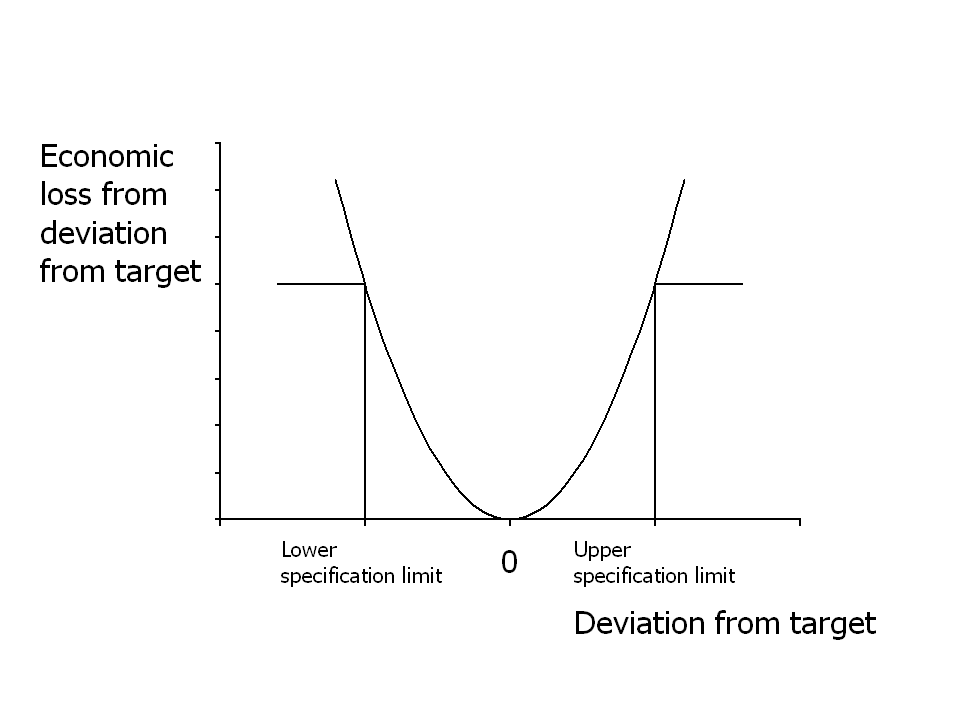
Taguchi1This is the subtlest point to turn your attention towards once everything is within specification. In the train example, the customer wants the train to be on time. Every deviation either side of that results in customer dissatisfaction. It also results in practical operating and timetable problems and costs for the railway. In the 1960s, Japanese statistician Genechi Taguchi put forward the idea that such losses should be recognised and form the basis of measuring improvement. The Taguchi loss function captures the idea that losses start with every departure from nominal and then start to escalate.

That leads to the practical insight that the improvement objective of any business process is “on target, minimum variation”.

What the Spencer-de Lopez statements ultimately say is that the vendor is willing to tolerate any train being 5 minutes late and 5% of trains being delayed even longer than that, perhaps indefinitely. Whether even that depressing standard is achieved in the future, who knows? Perhaps the customer will be lucky.

I fear that such statements will not promote your business. What will promote your business is using measurement to establish, maintain and improve process capability. That will provide the sort of excellent customer experience that can be mapped, promoted and fed back into confident, data based marketing campaigns aimed at enhancing reputation. Reputation supports talent recruitment and fosters a virtuous circle of excellence. This is what reputation management is about.

I do note that Spencer and de Lopez protest that this is only a working paper but it has been on their website since mid-2012 so I presume they are now owning the contents.

Just as a final caveat I think I should point out that the capability indices Cp and Cpk, though useful, do not measure Taguchi loss. That is the topic for another blog.