Deconstructing Deming I – Constancy of Purpose

File:W. Edwards Deming.gifMy 20 December 2013 post on W Edwards Deming attracted quite a lot of interest. The response inspired me to take a detailed look at his ideas 20 years on, starting with his 14 Points.

Deming’s 14 Points for Management are his best remembered takeaway. Deming put them forward as representative of the principles adopted by Japanese industry in its rise from 1950 to the prestigious position it held in manufacturing at the beginning of the 1980s.

Point 1. Create constancy of purpose toward improvement of product and service, with the aim to become competitive and to stay in business, and to provide jobs.

In his 1983 elaboration of the point in Out of the Crisis, Deming explained what he meant. Managing a business was not only about exploiting existing products and processes to generate a stream of profits. It was also about re-inventing those products and processes, innovating and developing to retain and capture market. Deming was fearful that management focused too much on short term profits from existing products and services, and that an effort of leadership was needed to reorient attention and resource towards design and development. The “improvement” that Deming was referring to is that through design and redesign, not simply the incremental improvement of existing value streams. Critically, Deming saw design and redesign as a key business process that should itself be the target of incremental continual improvement. Design and re-design was not an ad hoc project initiated by some rare, once in a generation sea-change in the market or motivated by a startling idea from an employee. It was a routine and “constant” part of the business of a business.

Some of Deming’s latter day followers sometimes deprecate the radical redesign of processes in approaches such as Business Process Re-engineering, and instead promote the incremental improvement of existing processes by those who work in them. That is exactly the approach that Deming was warning against in Point 1.

It is worth recalling the economic and geographic climate within which Deming put forwards this principle. During the early 1980s, the US and Western Europe suffered a significant recession, their populations beset with the dual evils of unemployment and inflation. The economic insecurities were aggravated by social unrest in the West and the intensification of the Cold War.

In 1980 Robert Hayes and William Abernathy, academics at the Harvard Business School, attacked US management in their seminal paper Managing our Way to Economic Decline. They found that fewer and fewer executives were from engineering and operations backgrounds, but increasingly from law and finance. Such managers had little understanding, they said, of the mechanics of the businesses they ran or the markets in which they competed. That in turn led executives to tend to pursue short term profits from existing value streams. These were easy to measure and predict on the visible accounts. However, managers were allegedly ill placed to make informed decisions as to the new products or services that would determine future profits. The uncertainties of such decisions were unknown and unknowable other than to a discipline specialist. Franklin Fisher characterised matters in this way (1989, “Games economists play: a noncooperative view” Rand Journal of Economics 20, 113):

Bright young theorists tend to think of every problem in game theoretic terms, including problems that are easier to think of in other forms.

This all appeared in contrast to Japanese manufacturing industry and in particular Toyota. By 1980, Japanese manufactured goods had come increasingly to dominate global markets. Japanese success was perceived as the (Lawrence Freedman, 2013, Strategy: A History, p531):

… triumph of a focussed, patient, coherent, consensual culture, a reflection of dedicated operational efficiency, or else a combination of the two.

Certainly in my own automotive industry days, my employer had come to see its most successful products literally as commodities. They belatedly realised that, while they had been treating them as a mere income stream, admittedly spent largely on unsuccessful attempts to develop radical new products, Japanese competitors had been filing dozens of patents each year making incremental improvement to design and function, and threatening the company’s core revenues.

But did Deming choose the right target and, in any event, does the exhortation remain cogent? It feels in 2014 as though we all have much more appetite for innovation, invention and product design than we had in 1983. Blogs extol virtues of and strategies for entrepreneurship. Slogans proliferate such as “Fail early, fail fast, fail often”. It is not clear from this web activity whether innovation is being backed by capital. However, the very rate of technological change in society suggests that capital is backing novelty rather than simply engaging in the rent seeking that Hayes and Abernathy feared.

In 2007 Hayes reflected on his 1980 work. He felt that his views had become mainstream and uncontroversial, and been largely adopted in corporations. However, information and globalisation had created a new set of essentials to be addressed and to become part of the general competencies of a manager (“Managing Our Way… A Retrospective by Robert H. Hayes” Harvard Business Review, July-August 2007, 138-149).

I remain unpersuaded that there has been such a broadening in the skill set of managers. The game theorists, data scientists and economists seem to remain in the ascendancy. Whatever change of mind in attitudes to design has taken place, it has happened against a background where CEOs still hop industries. There are other explanations for lack of innovation. Daniel Ellsberg’s principle of ambiguity aversion predicts that quantifiable risks that are apparent from visible accounts will tend to be preferred over ambiguous returns on future inventions, even by subject matter experts. Prevailing comparative advantages may point some corporations away from research. Further, capital flows were particularly difficult in the early 1980s recession. Liberalisation of markets and the rolling back of the state in the 1980s led to more efficient allocation of capital and coincided with a palpable increase in the volume, variety and quality of available consumer goods in the West. There is no guarantee against a failure of strategy. My automotive employer hadn’t missed the importance of new product development but they made a strategic mistake in allocating resources.

Further, psychologist Daniel Kahneman found evidence for a balancing undue optimism about future business, referring to “entrepreneurial delusions” and “competition neglect”, two aspects of What you see is all there is. (Thinking, Fast and Slow, 2011, Chapter 24).

In Notes from Toyota-Land: An American Engineer in Japan (2005), Robert Perrucci and Darius Mehri criticised Toyota’s approach to business. Ironically, Mehri contended that Toyota performed weakly in innovation and encouraged narrow professional skills. It turned out that Japanese management didn’t prevent a collapse in the economy lasting from 1991 to the present. Toyota itself went on to suffer serious reputational damage (Robert E. Cole “What Really Happened to Toyota?” MIT Sloan Management Review, Summer 2011)

So Deming and others were right to draw attention to Western under performance in product design. However, I suspect that the adoption of a more design led culture is largely due to macroeconomic forces rather than exhortations.

There is still much to learn, however, in balancing the opportunities apparent from visible accounts with the uncertainties of imagined future income streams.

I think there remains an important message, perhaps a Point 1 for the 21st Century.

There’s a problem bigger than the one you’re working on. Don’t ignore it!

M5 “fireworks crash” – risk identification and reputation management

UK readers will recall this tragic accident in November 2011 when 51 people were injured and seven killed in an accident on a fog bound motorway.

What marked out the accident from a typical collision in fog was the suggestion that the environmental conditions had been exacerbated by smoke that had drifted onto the motorway from a fireworks display at nearby Taunton Rugby Club.

This suggestion excited a lot of press comment. Geoffrey Counsell, the fireworks professional who had been contracted to organise the event, was subsequently charged with manslaughter. The prosecutor’s allegation was that he had fallen so far below the standard or care he purportedly owed to the motorway traffic that a reasonable person would think a criminal sanction appropriate.

It is very difficult to pick out from the press exactly how this whole prosecution unravelled. Firstly the prosecutors resiled from the manslaughter charge, a most serious matter that in the UK can attract a life sentence. They substituted a charge under section 3(2) of the Health and Safety at Work etc. Act 1974 that Mr Counsell had failed “to conduct his undertaking in such a way as to ensure, so far as is reasonably practicable, that … other persons (not being his employees) who may be affected thereby are not thereby exposed to risks to their health or safety.”

There has been much commentary from judges and others on the meaning of “reasonably practicable” but suffice to say, for the purposes of this blog, that a self employed person is required to make substantial effort in protecting the public. That said, the section 3 offence carries a maximum sentence of no more than two years’ imprisonment.

The trial on the section 3(2) indictment opened on 18 November 2013. “Serious weaknesses” in the planning of the event were alleged. There were vague press reports about Mr Counsell’s risk assessment but insufficient for me to form any exact view. It does seem that he had not considered smoke drifting onto the motorway and interacting with fog to create an especial hazard to drivers.

A more worrying feature of the prosecution was the press suggestion that an expert meteorologist had based his opinion on a biased selection of witness statements that he had been provided with and which described which way the smoke from the fireworks display had been drifting. I only have the journalistic account of the trial but it looks far from certain that the smoke did in fact drift towards the motorway.

In any event, on 10 December 2013, following the close of the prosecution evidence, the judge directed the jury to acquit Mr Counsell. The prosecutors had brought forward insufficient evidence against Mr Counsell for a jury reasonably to return a conviction, even without any evidence in his defence.

An individual, no matter how expert, is at a serious disadvantage in identifying novel risks. An individual’s bounded rationality will always limit the futures he can conjure and the weight that he gives to them. To be fair to Mr Counsell, he says that he did seek input from the Highways Agency, Taunton Deane Borough Council and Avon and Somerset Police but he says that they did not respond. If that is the case, I am sure that those public bodies will now reflect on how they could have assisted Mr Counsell’s risk assessment the better to protect the motorists and, in fact, Mr Counsell. The judge’s finding, that this was an accident that Mr Counsell could not reasonably have foreseen, feels like a just decision.

Against that, hypothetically, had the fireworks been set by a household name corporation, they would rightly have felt ashamed at not having anticipated the risk and taken any necessary steps to protect the motorway drivers. There would have been reputational damage. A sufficient risk assessment would have provided the basis for investigating whether the smoke was in fact a cause of the accident and, where appropriate, advancing a robust and persuasive rebuttal of blame.

That is the power of risk assessment. Not only is it a critical foundational element of organisational management, it provides a powerful tool in managing reputation and litigation risk. Unfortunately, unless there is a critical mass of expertise dedicated to risk identification it is more likely that it will provide a predatory regulator with evidence of slipshod practice. Its absence is, of course, damning.

As a matter of good business and efficient leadership, the Highways Agency, Taunton Deane Borough Council, and Avon and Somerset Police ought to have taken Mr Counsell’s risk assessment seriously if they were aware of it. They would surely have known that they were in a better position than Mr Counsell to assess risks to motorists. Fireworks displays are tightly regulated in the UK yet all such regulation has failed to protect the public in this case. Again, I think that the regulators might look to their own role.

Organisations must be aware of external risks. Where they are not engaged with the external assessment of such risks they are really in an oppositional situation that must be managed accordingly. Where they are engaged the external assessments must become integrated into their own risk strategy.

It feels as though Mr Counsell has been unjustly singled out in this tragic matter. There was a rush to blame somebody and I suspect that an availability heuristic was at work. Mr Counsellor attracted attention because the alleged causation of the accident seemed so exotic and unusual. The very grounds on which the court held him blameless.

Do I have to be a scientist to assess food safety?

I saw this BBC item on the web before Christmas: Why are we more scared of raw egg than reheated rice? Just after Christmas seemed like a good time to blog about food safety. Actually, the link I followed asked Are some foods more dangerous that others? A question that has a really easy answer.

However, understanding the characteristic risks of various foods and how most safely to prepare them is less simple. Risk theorist John Adams draws a distinction between readily identified inherent and obvious risks, and risks that can only be perceived with the help of science. Food risks fall into the latter category. As far as I can see, “folk wisdom” is no reliable guide here, even partially. The BBC article refers to risks from rice, pasta and salad vegetables which are not obvious. At the same time, in the UK at least, the risk from raw eggs is very small.

Ironically, raw eggs are one food that springs readily to British people’s minds when food risk is raised, largely due to the folk memory of a high profile but ill thought out declaration by a government minister in the 1980s. This is an example of what Amos Tversky and Daniel Kahneman called an availability heuristic: If you can think of it, it must be important.

Food safety is an environment where an individual is best advised to follow the advice of scientists. We commonly receive this filtered, even if only for accessibility, through government agencies. That takes us back to the issue of trust in bureaucracy on which I have blogged before.

I wonder whether governments are in the best position to provide such advice. It is food suppliers who suffer from the public’s misallocated fears. The egg fiasco of the 1980s had a catastrophic effect on UK egg sales. All food suppliers have an interest in a market characterised by a perception that the products are safe. The food industry is also likely to be in the best position to know what is best practice, to improve such practice, to know how to communicate it to their customers, to tailor it to their products and to provide the effective behavioural “nudges” that promote safe handling. Consumers are likely to be cynical about governments, “one size fits all” advice and cycles of academic meta-analysis.

I think there are also lessons here for organisations. Some risks are assessed on the basis of scientific analysis. It is important that the prestige of that origin is communicated to all staff who will be involved in working with risk. The danger for any organisation is that an individual employee might make a reassessment based on local data and their own self-serving emotional response. As I have blogged before, some individuals have particular difficulty in aligning themselves with the wider organisation.

Of course, individuals must also be equipped with the means of detecting when the assumptions behind the science have been violated and initiating an agile escalation so that employee, customer and organisation can be protected while a reassessment is conducted. Social media provide new ways of sharing experience. I note from the BBC article that, in the UK at least, there is no real data on the origins of food poisoning outbreaks.

So the short answer to the question at the head of this blog still turns out to be “yes”. There are some things where we simply have to rely on science if we want to look after ourselves, our families and our employees.

But even scientists are limited by their own bounded rationality. Science is a work in progress. Using that science itself as a background against which to look for novel phenomena and neglected residual effects leverages that original risk analysis into a key tool in managing, improving and growing a business.

It was 20 years ago today …

W._Edwards_Deming[1]Today, 20 December 2013, marks the twentieth anniversary of the death of W Edwards Deming. Deming was a hugely influential figure in management science, in Japan during the 1950s, 1960s and 1970s, then internationally from the early 1980s until his death. His memory persists in a continuing debate about his thinking among a small and aging sector of the operational excellence community, and in a broader reputation as a “management guru”, one of the writers who from the 1980s onwards championed and popularised the causes of employee engagement and business growth through customer satisfaction.
Deming’s training had been in mathematics and physics but in his professional life he first developed into a statistician, largely because of the influence of Walter Shewhart, an early mentor. It was fundamental to Deming’s beliefs that an organisation could only be managed effectively with widespread business measurement and trenchant statistical criticism of data. In that way he anticipated writers of a later generation such as Nate Silver and Nassim Taleb.

Since Deming’s death the operational excellence landscape has become more densely populated. In particular, lean operations and Six Sigma have variously been seen as competitors for Deming’s approach, as successors, usurpers, as complementary, as development, or as tools or tool sets to be deployed within Deming’s business strategy. In many ways, the pragmatic development of lean and Six Sigma have exposed the discursive, anecdotal and sometimes gnomic way Deming liked to communicate. In his book Out of the Crisis: Quality, Productivity and Competitive Position (1982) minor points are expanded over whole chapters while major ideas are finessed in a few words. Having elevated the importance of measurement and a proper system for responding to data he goes on to observe that the most important numbers are unknown and unknowable. I fear that this has often been an obstacle to managers finding the hard science in Deming.

For me, the core of Deming’s thinking remains this. There is only one game in town, the continual improvement of the alignment between the voice of the process and the voice of the customer. That improvement is achieved by the diligent use of process behaviour charts. Pursuit of that aim will collaterally reduce organisational costs.

Deming pursued the idea further. He asked what kind of organisation could most effectively exploit process behaviour charts. He sought philosophical justifications for successful heuristics. It is here that his writing became more difficult to accept for many people. In his last book, The New Economics for Industry, Government, Education, he trespassed on broader issues usually reserved to politics and social science, areas in which he was poorly qualified to contribute. The problem with Deming’s later work is that where it is new, it is not economics, and where it is economics, it is not new. It is this part of his writing that has tended to attract a few persistent followers. What is sad about Deming’s continued following is the lack of challenge. Every seminal thinker’s works are subject to repeated criticism, re-evaluation and development. Not simply development by accumulation but development by revision, deletion and synthesis. It is here that Deming’s memory is badly served. At the top of the page is a link to Deming’s Wikipedia entry. It is disturbing that everything is stated as though a settled and triumphant truth, a treatment that contrasts with the fact that his work is now largely ignored in mainstream management. Managers have found in lean and Six Sigma systems they could implement, even if only partially. In Deming they have not.

What Deming deserves, now that a generation, a global telecommunications system and a world wide web separate us from him, is a robust criticism and challenge of his work. The statistical thinking at the heart is profound. For me, the question of what sort of organisation is best placed to exploit that thinking remains open. Now is the time for the re-evaluation because I believe that out of it we can join in reaching new levels of operational excellence.

Sad news on railway suicide statistics

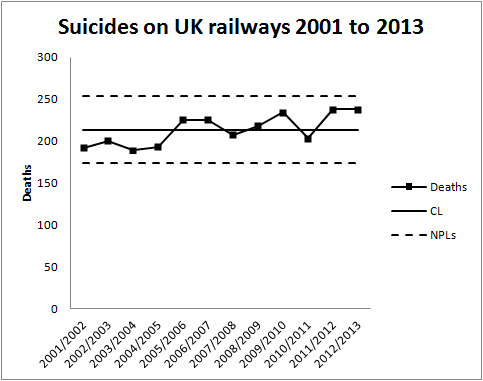
I recently blogged about statistics of suicides on British railways here and here. Some very worthwhile programmes had been put in place with the objective of reducing these tragic deaths. However, my view at the point of my earlier posts was that this was a stable system of trouble, that there was neither a deteriorating trend nor any sign of improvement.

I now have the statistics for 2012/2013 to hand, released without any framing press notice. Here is the updated process behaviour chart.
RailwaySuicides2

Readers should note the following about the chart.

  • Some of the numbers for earlier years have been updated by the statistical authority.
  • I have recalculated natural process limits as there are still no more than 20 annual observations.
  • There is still no signal of improvement or deterioration.

I fear that this is the tough discipline of the chart. It confronts us with current reality and deprives us of the opportunity to find comforting messages. Only a signal on the chart would be evidence of improvement. Statistics are not there to be selectively reported only when they fit our wishes and hopes. Statistics are to be charted, and reported, and discussed, and used as a basis for managing any operation; year in, year out.

Remember that in leading any operation the manager is confined to the retreating picture in the rearview mirror. Without the process behaviour chart, the manager is deprived even of that rear view.

It is a sad picture but improvement only comes from confronting current failure and finding new ways to intervene and redesign. Nobody will benefit from an ultimately vain quest for comforting messages.