#executivetimeseries

ExecTS1OxfordDon Wheeler coined the term executive time series. I was just leaving court in Oxford the other day when I saw this announcement on a hoarding. I immediately thought to myself “#executivetimeseries”.

Wheeler introduced the phrase in his 2000 book Understanding Variation: The Key to Managing Chaos. He meant to criticise the habitual way that statistics are presented in business and government. A comparison is made between performance at two instants in time. Grave significance is attached as to whether performance is better or worse at the second instant. Well, it was always unlikely that it would be the same.

The executive time series has the following characteristics.

  • It as applied to some statistic, metric, Key Performance Indicator (KPI) or other measure that will be perceived as important by its audience.
  • Two time instants are chosen.
  • The statistic is quoted at each of the two instants.
  • If the latter is greater than the first then an increase is inferred. A decrease is inferred from the converse.
  • Great significance is attached to the increase or decrease.

Why is this bad?

At its best it provides incomplete information devoid of context. At its worst it is subject to gross manipulation. The following problems arise.

  • Though a signal is usually suggested there is inadequate information to infer this.
  • There is seldom explanation of how the time points were chosen. It is open to manipulation.
  • Data is presented absent its context.
  • There is no basis for predicting the future.

The Oxford billboard is even worse than the usual example because it doesn’t even attempt to tell us over what period the carbon reduction is being claimed.

Signal and noise

Let’s first think about noise. As Daniel Kahneman put it “A random event does not … lend itself to explanation, but collections of random events do behave in a highly regular fashion.” Noise is a collection of random events. Some people also call it common cause variation.

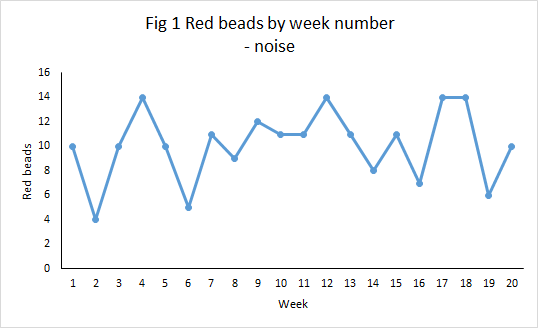
Imagine a bucket of thousands of beads. Of the beads, 80% are white and 20%, red. You are given a paddle that will hold 50 beads. Use the paddle to stir the beads then draw out 50 with the paddle. Count the red beads. Repeat this, let us say once a week, until you have 20 counts. The data might look something like this.
RedBeads1

What we observe in Figure 1 is the irregular variation in the number of red beads. However, it is not totally unpredictable. In fact, it may be one of the most predictable things you have ever seen. Though we cannot forecast exactly how many red beads we will see in the coming week, it will most likely be in the rough range of 4 to 14 with rather more counts around 10 than at the extremities. The odd one below 4 or above 14 would not surprise you I think.

But nothing changed in the characteristics of the underlying process. It didn’t get better or worse. The percentage of reds in the bucket was constant. It is a stable system of trouble. And yet measured variation extended between 4 and 14 red beads. That is why an executive time series is so dangerous. It alleges change while the underlying cause-system is constant.

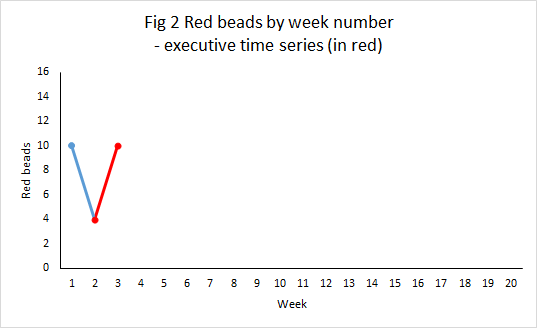
Figure 2 shows how an executive time series could be constructed in week 3.
RedBeads2

The number of beads has increase from 4 to 10, a 150% increase. Surely a “significant result”. And it will always be possible to find some managerial initiative between week 2 and 3 that can be invoked as the cause. “Between weeks 2 and 3 we changed the angle of inserting the paddle and it has increased the number of red beads by 150%.”

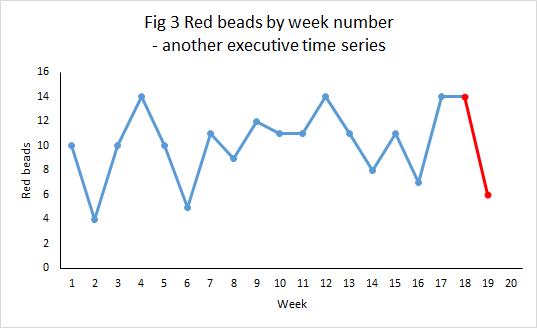
But Figure 2 is not the only executive time series that the data will support. In Figure 3 the manager can claim a 57% reduction from 14 to 6. More than the Oxford banner. Again, it will always be possible to find some factor or incident supposed to have caused the reduction. But nothing really changed.
RedBeads3

The executive can be even more ambitious. “Between week 2 and 17 we achieved a 250% increase in red beads.” Now that cannot be dismissed as a mere statistical blip.

RedBeads4

#executivetimeseries

Data has no meaning apart from its context.

Walter Shewhart

Not everyone who cites an executive time series is seeking to deceive. But many are. So anybody who relies on an executive times series, devoid of context, invites suspicion that they are manipulating the message. This is Langian statistics. par excellence. The fallacy of What you see is all there is. It is essential to treat all such claims with the utmost caution. What properly communicates the present reality of some measure is a plot against time that exposes its variation, its stability (or otherwise) and sets it in the time context of surrounding events.

We should call out the perpetrators. #executivetimeseries

Techie note

The data here is generated from a sequence of 20 Bernoulli experiments with probability of “red” equal to 0.2 and 50 independent trials in each experiment.

Productivity and how to improve it: I -The foundational narrative

Again, much talk in the UK media recently about weak productivity statistics. Chancellor of the Exchequer (Finance Minister) George Osborne has launched a 15 point macroeconomic strategy aimed at improving national productivity. Some of the points are aimed at incentivising investment and training. There will be few who argue against that though I shall come back to the investment issue when I come to talk about signal and noise. I have already discussed training here. In any event, the strategy is fine as far as these things go. Which is not very far.

There remains the microeconomic task for all of us of actually improving our own productivity and that of the systems we manage. That is not the job of government.

Neither can I offer any generalised system for improving productivity. It will always be industry and organisation dependent. However, I wanted to write about some of the things that you have to understand if your efforts to improve output are going to be successful and sustainable.

  • Customer value and waste.
  • The difference between signal and noise.
  • How to recognise flow and manage a constraint.

Before going on to those in future weeks I first wanted to go back and look at what has become the foundational narrative of productivity improvement, the Hawthorne experiments. They still offer some surprising insights.

The Hawthorne experiments

In 1923, the US electrical engineering industry was looking to increase the adoption of electric lighting in American factories. Uptake had been disappointing despite the claims being made for increased productivity.

[Tests in nine companies have shown that] raising the average initial illumination from about 2.3 to 11.2 foot-candles resulted in an increase in production of more than 15%, at an additional cost of only 1.9% of the payroll.

Earl A Anderson
General Electric
Electrical World (1923)

E P Hyde, director of research at GE’s National Lamp Works, lobbied government for the establishment of a Committee on Industrial Lighting (“the CIL”) to co-ordinate marketing-oriented research. Western Electric volunteered to host tests at their Hawthorne Works in Cicero, IL.

Western Electric came up with a study design that comprised a team of experienced workers assembling relays, winding their coils and inspecting them. Tests commenced in November 1924 with active support from an elite group of academic and industrial engineers including the young Vannevar Bush, who would himself go on to an eminent career in government and science policy. Thomas Edison became honorary chairman of the CIL.

It’s a tantalising historical fact that Walter Shewhart was employed at the Hawthorne Works at the time but I have never seen anything suggesting his involvement in the experiments, nor that of his mentor George G Edwards, nor protégé Joseph Juran. In later life, Juran was dismissive of the personal impact that Shewhart had had on operations there.

However, initial results showed no influence of light level on productivity at all. Productivity rose throughout the test but was wholly uncorrelated with lighting level. Theories about the impact of human factors such as supervision and motivation started to proliferate.

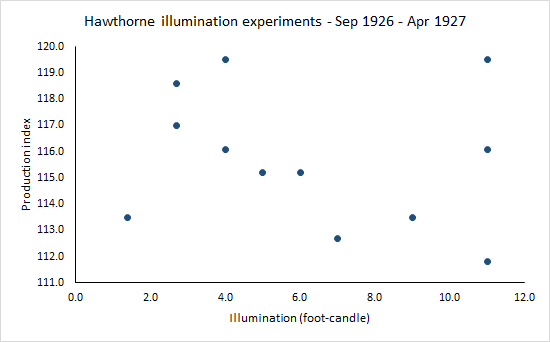
A further schedule of tests was programmed starting in September 1926. Now, the lighting level was to be reduced to near darkness so that the threshold of effective work could be identified. Here is the summary data (from Richard Gillespie Manufacturing Knowledge: A History of the Hawthorne Experiments, Cambridge, 1991).

Hawthorne data-1

It requires no sophisticated statistical analysis to see that the data is all noise and no signal. Much to the disappointment of the CIL, and the industry, there was no evidence that illumination made any difference at all, even down to conditions of near darkness. It’s striking that the highest lighting levels embraced the full range of variation in productivity from the lowest to the highest. What had seemed so self evidently a boon to productivity was purely incidental. It is never safe to assume that a change will be an improvement. As W Edwards Deming insisted, “In God was trust. All others bring data.”

But the data still seemed to show a relentless improvement of productivity over time. The participants were all very experienced in the task at the start of the study so there should have been no learning by doing. There seemed no other explanation than that the participants were somehow subliminally motivated by the experimental setting. Or something.

Hawthorne data-2

That subliminally motivated increase in productivity came to be known as the Hawthorne effect. Attempts to explain it led to the development of whole fields of investigation and organisational theory, by Elton Mayo and others. It really was the foundation of the management consulting industry. Gillespie (supra) gives a rich and intriguing account.

A revisionist narrative

Because of the “failure” of the experiments’ purpose there was a falling off of interest and only the above summary results were ever published. The raw data were believed destroyed. Now “you know, at least you ought to know, for I have often told you so” about Shewhart’s two rules for data presentation.

  1. Data should always be presented in such a way as to preserve the evidence in the data for all the predictions that might be made from the data.
  2. Whenever an average, range or histogram is used to summarise observations, the summary must not mislead the user into taking any action that the user would not take if the data were presented in context.

The lack of any systematic investigation of the raw data led to the development of a discipline myth that every single experimental adjustment had led forthwith to an increase in productivity.

In 2009, Steven Levitt, best known to the public as the author of Freakonomics, along with John List and their research team, miraculously discovered a microfiche of the raw study data at a “small library in Milwaukee, WI” and the remainder in Boston, MA. They went on to analyse the data from scratch (Was there Really a Hawthorne Effect at the Hawthorne Plant? An Analysis of the Original Illumination Experiments, National Bureau of Economic Research, Working Paper 15016, 2009).

LevittHawthonePlot

Figure 3 of Levitt and List’s paper (reproduced above) shows the raw productivity measurements for each of the experiments. Levitt and List show how a simple plot such as this reveals important insights into how the experiments developed. It is a plot that yields a lot of information.

Levitt and List note that, in the first phase of experiments, productivity rose then fell when experiments were suspended. They speculate as to whether there was a seasonal effect with lower summer productivity.

The second period of experiments is that between the third and fourth vertical lines in the figure. Only room 1 experienced experimental variation in this period yet Levitt and List contend that productivity increased in all three rooms, falling again at the end of experimentation.

During the final period, data was only collected from room 1 where productivity continued to rise, even beyond the end of the experiment. Looking at the data overall, Levitt and List find some evidence that productivity responded more to changes in artificial light than to natural light. The evidence that increases in productivity were associated with every single experimental adjustment is weak. To this day, there is no compelling explanation of the increases in productivity.

Lessons in productivity improvement

Deming used to talk of “disappointment in great ideas”, the propensity for things that looked so good on paper simply to fail to deliver the anticipated benefits. Nobel laureate psychologist Daniel Kahneman warns against our individual bounded rationality.

To guard against entrapment by the vanity of imagination we need measurement and data to answer the ineluctable question of whether the change we implemented so passionately resulted in improvement. To be able to answer that question demands the separation of signal from noise. That requires trenchant data criticism.

And even then, some factors may yet be beyond our current knowledge. Bounded rationality again. That is why the trick of continual improvement in productivity is to use the rigorous criticism of historical data to build collective knowledge incrementally.

If you torture the data enough, nature will always confess.

Ronald Coase

Eventually.

FIFA and the Iron Law of Oligarchy

Йозеф Блаттер.jpgIn 1911, Robert Michels embarked on one of the earliest investigations into organisational culture. Michels was a pioneering sociologist, a student of Max Weber. In his book Political Parties he aggregated evidence about a range of trade unions and political groups, in particular the German Social Democratic Party.

He concluded that, as organisations become larger and more complex, a bureaucracy inevitably forms to take, co-ordinate and optimise decisions. It is the most straightforward way of creating alignment in decision making and unified direction of purpose and policy. Decision taking power ends up in the hands of a few bureaucrats and they increasingly use such power to further their own interests, isolating themselves from the rest of the organisation to protect their privilege. Michels called this the Iron Law of Oligarchy.

These are very difficult matters to capture quantitavely and Michels’ limited evidential sampling frame has more of the feel of anecdote than data. “Iron Law” surely takes the matter too far. However, when we look at the allegations concerning misconduct within FIFA it is tempting to feel that Michels’ theory is validated, or at least has gathered another anecdote to take the evidence base closer to data.

But beyond that, what Michels surely identifies is a danger that a bureaucracy, a management cadre, can successfully isolate itself from superior and inferior strata in an organisation, limiting the mobility of business data and fostering their own ease. The legitimate objectives of the organisation suffer.

Michels failed to identify a realistic solution, being seduced by the easy, but misguided, certainties of fascism. However, I think that a rigorous approach to the use of data can guard against some abuses without compromising human rights.

Oligarchs love traffic lights

I remember hearing the story of a CEO newly installed in a mature organisation. His direct reports had instituted a “traffic light” system to report status to the weekly management meeting. A green light meant all was well. An amber light meant that some intervention was needed. A red light signalled that threats to the company’s goals had emerged. At his first meeting, the CEO found that nearly all “lights” were green, with a few amber. The new CEO perceived an opportunity to assert his authority and show his analytical skills. He insisted that could not be so. There must be more problems and he demanded that the next meeting be an opportunity for honesty and confronting reality.

At the next meeting there was a kaleidoscope of red, amber and green “lights”. Of course, it turned out that the managers had flagged as red the things that were either actually fine or could be remedied quickly. They could then report green at the following meeting. Real career limiting problems were hidden behind green lights. The direct reports certainly didn’t want those exposed.

Openness and accountability

I’ve quoted Nobel laureate economist Kenneth Arrow before.

… a manager is an information channel of decidedly limited capacity.

Essays in the Theory of Risk-Bearing

Perhaps the fundamental problem of organisational design is how to enable communication of information so that:

  • Individual managers are not overloaded.
  • Confidence in the reliable satisfaction of process and organisational goals is shared.
  • Systemic shortfalls in process capability are transparent to the managers responsible, and their managers.
  • Leading indicators yield early warnings of threats to the system.
  • Agile responses to market opportunities are catalysed.
  • Governance functions can exploit the borrowing strength of diverse data sources to identify misreporting and misconduct.

All that requires using analytics to distinguish between signal and noise. Traffic lights offer a lousy system of intra-organisational analytics. Traffic light systems leave it up to the individual manager to decide what is “signal” and what “noise”. Nobel laureate psychologist Daniel Kahneman has studied how easily managers are confused and misled in subjective attempts to separate signal and noise. It is dangerous to think that What you see is all there is. Traffic lights offer a motley cloak to an oligarch wishing to shield his sphere of responsibility from scrutiny.

The answer is trenchant and candid criticism of historical data. That’s the only data you have. A rigorous system of goal deployment and mature use of process behaviour charts delivers a potent stimulus to reluctant data sharers. Process behaviour charts capture the development of process performance over time, for better or for worse. They challenge the current reality of performance through the Voice of the Customer. They capture a shared heuristic for characterising variation as signal or noise.

Individual managers may well prefer to interpret the chart with various competing narratives. The message of the data, the Voice of the Process, will not always be unambiguous. But collaborative sharing of data compels an organisation to address its structural and people issues. Shared data generation and investigation encourage an organisation to find practical ways of fostering team work, enabling problem solving and motivating participation. It is the data that can support the organic emergence of a shared organisational narrative that adds further value to the data and how it is used and developed. None of these organisational and people matters have generalised solutions but a proper focus on data drives an organisation to find practical strategies that work within their own context. And to test the effectiveness of those strategies.

Every week the press discloses allegations of hidden or fabricated assets, repudiated valuations, fraud, misfeasance, regulators blindsided, creative reporting, anti-competitive behaviour, abused human rights and freedoms.

Where a proper system of intra-organisational analytics is absent, you constantly have to ask yourself whether you have another FIFA on your hands. The FIFA allegations may be true or false but that they can be made surely betrays an absence of effective governance.

#oligarchslovetrafficlights

Does noise make you fat?

“A new study has unearthed some eye-opening facts about the effects of noise pollution on obesity,” proclaimed The Huffington Post recently in another piece or poorly uncritical data journalism.

Journalistic standards notwithstanding, in Exposure to traffic noise and markers of obesity (BMJ Occupational and environmental medicine, May 2015) Andrei Pyko and eight (sic) collaborators found “evidence of a link between traffic noise and metabolic outcomes, especially central obesity.” The particular conclusion picked up by the press was that each 5 dB increase in traffic noise could add 2 mm to the waistline.

Not trusting the press I decided I wanted to have a look at this research myself. I was fortunate that the paper was available for free download for a brief period after the press release. It took some finding though. The BMJ insists that you will now have to pay. I do find that objectionable as I see that the research was funded in part by the European Union. Us European citizens have all paid once. Why should we have to pay again?

On reading …

I was though shocked reading Pyko’s paper as the Huffington Post journalists obviously hadn’t. They state “Lack of sleep causes reduced energy levels, which can then lead to a more sedentary lifestyle and make residents less willing to exercise.” Pyko’s paper says no such thing. The researchers had, in particular, conditioned on level of exercise so that effect had been taken out. It cannot stand as an explanation of the results. Pyko’s narrative concerned noise-induced stress and cortisol production, not lack of exercise.

In any event, the paper is densely written and not at all easy to analyse and understand. I have tried to pick out the points that I found most bothering but first a statistics lesson.

Prediction 101

Frame(Almost) the first thing to learn in statistics is the relationship between population, frame and sample. We are concerned about the population. The frame is the enumerable and accessible set of things that approximate the population. The sample is a subset of the frame, selected in an economic, systematic and well characterised manner.

In Some Theory of Sampling (1950), W Edwards Deming drew a distinction between two broad types of statistical studies, enumerative and analytic.

  • Enumerative: Action will be taken on the frame.
  • Analytic: Action will be on the cause-system that produced the frame.

It is explicit in Pyko’s work that the sampling frame was metropolitan Stockholm, Sweden between the years 2002 and 2006. It was a cross-sectional study. I take it from the institutional funding that the study intended to advise policy makers as to future health interventions. Concern was beyond the population of Stockholm, or even Sweden. This was an analytic study. It aspired to draw generalised lessons about the causal mechanisms whereby traffic noise aggravated obesity so as to support future society-wide health improvement.

How representative was the frame of global urban areas stretching over future decades? I have not the knowledge to make a judgment. The issue is mentioned in the paper but, I think, with insufficient weight.

There are further issues as to the sampling from the frame. Data was taken from participants in a pre-existing study into diabetes that had itself specific criteria for recruitment. These are set out in the paper but intensify the questions of whether the sample is representative of the population of interest.

The study

The researchers chose three measures of obesity, waist circumference, waist-hip ratio and BMI. Each has been put forwards, from time to time, as a measure of health risk.

There were 5,075 individual participants in the study, a sample of 5,075 observations. The researchers performed both a linear regression simpliciter and a logistic regression. For want of time and space I am only going to comment on the former. It is the origin of the headline 2 mm per 5 dB claim.

The researchers have quoted p-values but they haven’t committed the worst of sins as they have shown the size of the effects with confidence intervals. It’s not surprising that they found so many soi-disant significant effects given the sample size.

However, there was little assistance in judging how much of the observed variation in obesity was down to traffic noise. I would have liked to see a good old fashioned analysis of variance table. I could then at least have had a go at comparing variation from the measurement process, traffic noise and other effects. I could also have calculated myself an adjusted R2.

Measurement Systems Analysis

Understanding variation from the measurement process is critical to any analysis. I have looked at the World Health Organisation’s definitive 2011 report on the effects of waist circumference on health. Such Measurement Systems Analysis as there is occurs at p7. They report a “technical error” (me neither) of 1.31 cm from intrameasurer error (I’m guessing repeatability) and 1.56 cm from intermeasurer error (I’m guessing reproducibility). They remark that “Even when the same protocol is used, there may be variability within and between measurers when more than one measurement is made.” They recommend further research but I have found none. There is no way of knowing from what is published by Pyko whether the reported effects are real or flow from confounding between traffic noise and intermeasurer variation.

When it comes to waist-hip ratio I presume that there are similar issues in measuring hip circumference. When the two dimensions are divided then the individual measurement uncertainties aggregate. More problems, not addressed.

Noise data

The key predictor of obesity was supposed to be noise. The noise data used were not in situ measurements in the participants’ respective homes. The road traffic noise data were themselves predicted from a mathematical model using “terrain data, ground surface, building height, traffic data, including 24 h yearly average traffic flow, diurnal distribution and speed limits, as well as information on noise barriers”. The model output provided 5 dB contours. The authors then applied some further ad hoc treatments to the data.

The authors recognise that there is likely to be some error in the actual noise levels, not least from the granularity. However, they then seem to assume that this is simply an errors in variables situation. That would do no more than (conservatively) bias any observed effect towards zero. However, it does seem to me that there is potential for much more structured systematic effects to be introduced here and I think this should have been explored further.

Model criticism

The authors state that they carried out a residuals analysis but they give no details and there are no charts, even in the supplementary material. I would like to have had a look myself as the residuals are actually the interesting bit. Residuals analysis is essential in establishing stability.

In fact, in the current study there is so much data that I would have expected the authors to have saved some of the data for cross-validation. That would have provided some powerful material for model criticism and validation.

Given that this is an analytic study these are all very serious failings. With nine researchers on the job I would have expected some effort on these matters and some attention from whoever was the statistical referee.

Results

Separate results are presented for road, rail and air traffic noise. Again, for brevity I am looking at the headline 2 mm / 5 dB quoted for road traffic noise. Now, waist circumference is dependent on gross body size. Men are bigger than women and have larger waists. Similarly, the tall are larger-waisted than the short. Pyko’s regression does not condition on height (as a gross characterisation of body size).

BMI is a factor that attempts to allow for body size. Pyko found no significant influence on BMI from road traffic noise.

Waist-hip ration is another parameter that attempts to allow for body size. It is often now cited as a better predictor of morbidity than BMI. That of course is irrelevant to the question of whether noise makes you fat. As far as I can tell from Pyko’s published results, a 5 dB increase in road traffic noise accounted for a 0.16 increase in waist-hip ratio. Now, let us look at this broadly. Consider a woman with waist circumference 85 cm, hip 100 cm, hence waist-hip ratio, 0.85. All pretty typical for the study. Predictively the study is suggesting that a 5 dB increase in road traffic noise might unremarkably take her waist-hip ratio up over 1.0. That seems barely consistent with the results from waist circumference alone where there would not only be millimetres of growth. It is incredible physically.

I must certainly have misunderstood what the waist-hip result means but I could find no elucidation in Pyko’s paper.

Policy

Research such as this has to be aimed at advising future interventions to control traffic noise in urban environments. Broadly speaking, 5 dB is a level of noise change that is noticeable to human hearing but no more. All the same, achieving such a reduction in an urban environment is something that requires considerable economic resources. Yet, taking the research at its highest, it only delivers 2 mm on the waistline.

I had many criticisms other than those above and I do not, in any event, consider this study adequate for making any prediction about a future intervention. Nothing in it makes me feel the subject deserves further study. Or that I need to avoid noise to stay slim.

Toxic

Engine exhaust contrailsMuch in the UK press this week about alleged personal injuries from what has been described as “toxic air” in aircraft. Contamination of cabin air with, perhaps, organophosphates from the engines, either ambiently or during “fume events”, is alleged to cause ill health both in air crew and passengers. It seems that pre-action correspondence is being sent and litigation is afoot.

Of course, the issues, engineering, physiological and legal, are complex and await a proper forensic exploration. The courts are actually very good at this sort of thing as I shall go on to discuss below. However, the press coverage reminded me of one of the recurrent themes in this blog, trust in bureaucracy.

Trust

Part of the background to the litigation is found in the work of the Committee on Toxicity (“the CoT”). The CoT consists of working scientists who provide independent advice to the UK government. The CoT looked into the “toxic air” allegations. In their report, the CoT concede that the measurement systems for measuring cabin air quality are not entirely satisfactory. However, the CoT go on to arrive at the following conclusion as to ambient exposure;

For the types of aircraft studied, and in the absence of a major fume event, airborne concentrations of the pollutants that were measured in the study are likely to be very low (well below the levels that might cause symptoms) during most flights. The data do not rule out the possibility of higher concentrations on some flights … or of higher concentrations of other pollutants that were not measured.

— and for the “fume events”:

… the Committee considers that a toxic mechanism for the illness that has been reported in temporal relation to fume incidents is unlikely. Many different chemicals have been identified in the bleed air from aircraft engines, but to cause serious acute toxicity, they would have to occur at very much higher concentrations than have been found to date (although lower concentrations of some might cause an odour or minor irritation of the eyes or airways). Furthermore, the symptoms that have been reported following fume incidents have been wide-ranging (including headache, hot flushes, nausea, vomiting, chest pain, respiratory problems, dizziness and light-headedness), whereas toxic effects of chemicals tend to be more specific. However, uncertainties remain, and a toxic mechanism for symptoms cannot confidently be ruled out.

It’s not unusual for academics to be guarded if asked for an opinion and the CoT certainly don’t regard fume related injuries as impossible. However, having taken the matter as far as they are able with their resources, their honest opinion is that the reported symptoms were not caused by toxic fumes. I have not been able to find any fully argued study that says that they are. And yet, as the BBC points out, there are anecdotes that have to be considered against a background of data that, in itself, does not conclusively exclude the alleged symptoms. The matter is not quite closed but this turns out to be another issue beset with personal attitudes to evidence and risk.

Any lawyer has to be on the side of their client. However, when the BBC interviewed aviation lawyer Frank Cannon I think he went a little further than mere advocacy in his cause. He said:

If you look at the tobacco industry, the asbestos, contaminated blood issues, if you look at all that, the government say it’s perfectly safe, perfectly safe and then “wham”, they suddenly have to admit they got it wrong for so many years.

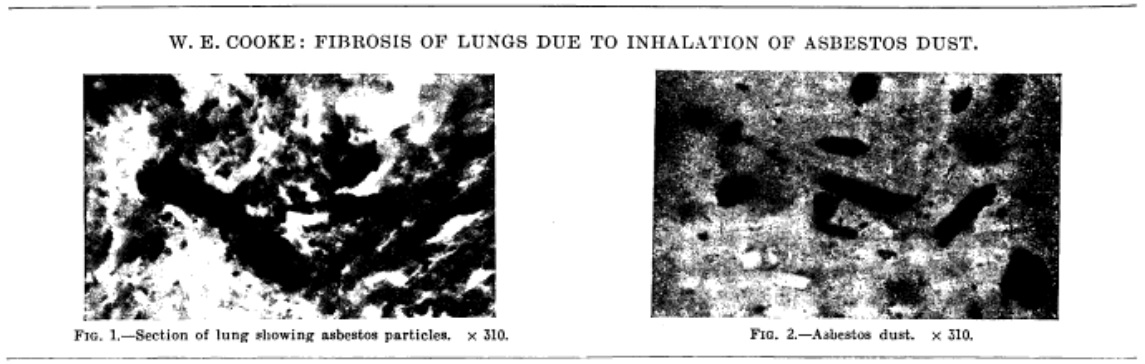
I am pretty sure that the UK government, at least, never advised that tobacco or asbestos was safe. William Cooke, the pathologist of Wigan infirmary, made arguably the first scientific report of lung disease caused by asbestos in 1924. There had been anecdotal evidence previously but Cooke’s was the first systematic analysis. Regulation and successful litigation soon followed. I am not aware of any serious body of scientific opinion ever saying that airborne asbestos exposure was safe after that point.

AsbestosCooke

As to smoking tobacco, the first statistical evidence associating smoking with cancer seems to have come in 1929 from Fritz Lickint. After Richard Doll’s work from the 1950s onwards I don’t think there was serious scientific dispute.

Of course, in the early years of the twentieth century life was comparatively unregulated. Though an absence of regulatory framework may now appear like a governmental endorsement that is to apply a very much post-World War II perspective. In any event, governments did respond with regulation, on both smoking and asbestos, even if its rigour is condemned by hindsight. The story of asbestos is a particularly tragic one. The story of contaminated blood is, I admit, more complex. I think it will make an edifying subject for a further blog.

The narrative of a callous, self-serving government bureaucracy only exposed by the heroic endeavours of maverick scientists is an attractive one to many people. Its prototype is Ibsen’s 1882 play An Enemy of the People. The twist in that drama is [spoiler alert!] that the population join the bureaucracy in turning against the scientist, whose credibility goes notably unchallenged by the author.

Attitudes to risk are entangled with emotional responses to broader cultural matters, as I blogged about here. That ecology of personal attitudes also feeds into how individuals react to the outputs of a bureaucracy, even one holding itself out as an exemplar of scientific objectivity, as I blogged about here. It is amid those conflicting cultural responses that forensic examination has a real part to play in resolving the conflicting doubts.

Forensics

Thereza Imanishi-Kari was a postdoctoral researcher in molecular biology at the Massachusetts Institute of Technology. In 1986 a co-worker raised inconsistencies in Imanishi-Kari’s earlier published work that led to allegations that she had fabricated results to validate publicly funded research. In his excellent 1998 book The Baltimore Case, Daniel Kevles details the growing intensity of the allegations against Imanishi-Kari over the following decade, involving the US Congress, the Office of Scientific Integrity and the FBI. Imanishi-Kari was ultimately exonerated by a departmental appeal board constituted of an eminent molecular biologist and two lawyers. The board allowed cross-examination of the relevant experts including those in statistics and document examination. It was that cross-examination that exposed the allegations as without foundation.

As eminent an engineer as George Stephenson found that he could not ask Parliament to approve the building of the Liverpool and Manchester Railway on the basis of faulty surveying that he had not properly supervised. After his cross-examination by Edward Hall Alderson he complained:

I was not long in the witness box before I began to wish for a hole to creep out at.

Certainly in England and Wales, expert evidence only provides guidelines within which the court makes its findings of fact. In the Canadian case of Reynolds v C.S.N. the learned judge, analysing whether a strike induced shut down at an aluminium facility had caused plant damage, disregarded the evidence of two statisticians, who could not agree how to calculate a Kaplan-Meier estimator, and preferred that of an engineer who had adopted a superficially less exact approach.

Process improvement

Though every branch of science has been advancing with sure and rapid strides, it is perhaps not too much to say that from the time of Lord Mansfield, and Folkes v Chadd, to the present; there has been a steady decrease in the credit awarded to the testimony of scientific witnesses.

Anonymous
“Expert testimony”
American Law Review (1870)

Throughout the nineteenth century the forensic evidence of scientific experts garnered a poor reputation. Robert Angus Smith, the discoverer of acid rain, refused to take expert work as he regarded it as corrupt beyond remedy and wished not to taint his reputation.

However, English law gradually drew the matter under supervision. The whole process by which English law adapted to embrace the conflicting evidence of specialists, woven through their respective esoteric expertise, is set out by Tal Golan in Chapter Three of his 2004 history of expert evidence, Laws of Men and Laws of Nature. Within the common law world, evaluation of expert evidence continues to evolve. The Australian courts have made important contributions with innovations such as hot tubbing. The common law courts have developed into a sophisticated forum for adjudicating on competing claims as to knowledge, not from an absolute standpoint, but from the pragmatic worldview of allocating resources. For practical people there has to be an end to every dispute.

The life of the law has not been logic; it has been experience… The law embodies the story of a nation’s development through many centuries, and it cannot be dealt with as if it contained only the axioms and corollaries of a book of mathematics.

Oliver Wendell Holmes
The Common Law (1881)