The art of managing footballers

Van Persie (15300483040) (crop).jpg… or is it a science? Robin van Persie’s penalty miss against West Bromwich Albion on 2 May 2015 was certainly welcome news to my ears. It eased the relegation pressures on West Brom and allowed us to advance to 40 points for the season. Relegation fears are only “mathematical” now. However, the miss also resulted in van Persie being relieved of penalty taking duties, by Manchester United manager Louis van Gaal, until further notice.

He is now at the end of the road. It is always [like that]. Wayne [Rooney] has missed also so when you miss you are at the bottom again.

The Daily Mail report linked above goes on to say that van Persie had converted his previous 6 penalties.

Van Gaal was, of course, referring to Rooney’s shot over the crossbar against West Ham in February 2013, when Rooney had himself invited then manager Sir Alex Ferguson to retire him as designated penalty taker. Rooney’s record had apparently been 9 misses from 27 penalties. I have all this from this Daily Telegraph report.

I wonder if statistics can offer any insight into soccer management?

The benchmark

It was very difficult to find, very quickly, any exhaustive statistics on penalty conversion rates on the web. However, I would like to start by establishing what constituted “good” performance for a penalty taker. As a starting point I have looked at Table 2 on this Premier League website. The data is from February 2014 and shows, at that date, data on the players with the best conversion rates in the League’s history. Players who took fewer than 10 penalties were excluded. It shows that of the ten top converting players, who must rank as the very good if not the ten best, in the aggregate they converted 155 of 166 penalties. That is a conversion rate of 93.4%. At first sight that suggests a useful baseline against which to assess any individual penalty taker.

Several questions come to mind. The aggregate statistics do not tell us how individual players have developed over time, whether improving or losing their nerve. That said, it is difficult to perform that sort of analysis on these comparatively low volumes of data when collected in this way. There is however data (Table 4) on the overall conversion rate in the Premier League since its inception.

Penalties

That looks to me like a fairly stable system. That would be expected as players come and go and this is the aggregate of many effects. Perhaps there is latterly reduced season-to-season variation, which would be odd, but I am not really interested in that and have not pursued it. I am aware that during this period there has been a rule change allowing goalkeepers to move before the kick his taken but I have just spent 30 minutes on the web and failed to establish the date when that happened. The total aggregate statistics up to 2014 are 1,438 penalties converted out of 1,888. That is a conversion rate of 76.2%.

I did wonder if there was any evidence that some of the top ten players were better than others or whether the data was consistent with a common elite conversion rate of 93.4%. In that case the table positions would reflect nothing more than sampling variation. Somewhat reluctantly I calculated the chi-squared statistic for the table of successes and failures (I know! But what else to do?). The statistic came out as 2.02 which, with 9 degrees of freedom, has a p-value (I know!) of 0.8%. That is very suggestive of a genuine ranking among the elite penalty takers.

It inevitably follows that the elite are doing better than the overall success rate of 76.2%. Considering all that together I am happy to proceed with 93.4% as the sort of benchmark for a penalty taker that a team like Manchester United would aspire to.

Van Persie

This website, dated 6 Sept 2012, told me that van Persie had converted 18 penalties with a 77% success rate. That does not quite fit either 18/23 or 18/24 but let us take it at face value. If that is accurate then that is, more or less, the data on which Ferguson gave van Persie the job in February 2013. It is a surprising appointment given the Premier League average of 76.2% and the elite benchmark but perhaps it was the best that could be mustered from the squad.

Rooney’s 9 misses out of 27 yields a success rate of 67%. Not so much lower than van Persie’s historical performance but, in all the circumstances, it was not good enough.

The dismissal

What is fascinating is that, no matter what van Persie’s historical record on which he was appointed penalty taker, before his 2 May miss he had scored 6 out of 6. The miss made it 6 out of 7, 85.7%. That was his recent record of performance, even if selected to some extent to show him in a good light.

Selection of that run is a danger. It is often “convenient” to select a subset of data that favours a cherished hypothesis. Though there might be that selectivity, where was the real signal that van Persie had deteriorated or that the club would perform better were he replaced?

The process

Of course, a manager has more information than the straightforward success/ fail ratio. A coach may have observed goalkeepers increasingly guessing a penalty taker’s shot direction. There may have been many near-saves, a hesitancy on the part of the player, trepidation in training. Those are all factors that a manager must take into account. That may lead to the rotation of even the most impressive performer. Perhaps.

But that is not the process that van Gaal advocates. Keep scoring until you miss then go to the bottom of the list. The bottom! Even scorers in the elite-10 miss sometimes. Is it rational to then replace them with an alternative that will most likely be more average (i.e. worse)? And then make them wait until everyone else has missed.

With an average success rate of 76.2% it is more likely than not that van Persie’s replacement will score their first penalty. Van Gaal will be vindicated. That is the phenomenon called regression to the mean. An extreme event (a miss) is most likely followed by something more average (a goal). Economist Daniel Kahneman explores this at length in his book Thinking, Fast and Slow.

It is an odd strategy to adopt. Keep the able until they fail. Then replace them with somebody less able. But different.

 

Deconstructing Deming XI A – Eliminate numerical quotas for the workforce

11. Part A. Eliminate numerical quotas for the workforce.

W Edwards DemingI find this probably the most confused part of Deming’s thinking. Carefully reading Out of the Crisis (at pp70-75) Deming’s attack is not on standardised work, that is advocated as central to his message, but against specifications for the volume of work: calls answered per hour, finished parts per day.

Deming recognises management’s need to predict costs and revenues but condemns quotas as destructive of achieving productivity.

Deming also deprecates such quotas as corroding workplace pride. I shall return to that in Point 12.

Deming’s criticism of work quotas goes as follows.

  • Some individuals may achieve them easily and their productive capacity will then stand idle.
  • Some individuals may struggle and suffer poor moral.
  • Some individuals may compromise quality so as to make a quota or so as to make it sooner.
  • Achievement of quotas may be frustrated by faults in “the system” which are outside the individual worker’s control.

Deming gives the following example of how he would advise financial planning in a call centre of 500 people (at pp73-74).

  1. Set a preliminary budget.
  2. Make it clear to every one of the 500 that their aim is to give satisfaction to the customer, to take pride in their work.
  3. Everybody will keep a record of calls made.
  4. Customers with special problems will be referred to the supervisor.
  5. At the end of each week, sample 100 individuals’ record and summarise the data.
  6. Repeat steps 2 to 5 for several weeks.
  7. Analyse the data.
  8. Establish a continuing study following the above steps but on a reducing basis.
  9. Use the data to predict costs.

Now there is much merit in forecasting costs based on actual data. Further, improving performance based on the relentless criticism of historical data is essential. However, I think Deming’s prescription naïve and idealistic. The trick is to extract the ideals and industrialise them.

Planning

The simple matter is that any new enterprise has to be established on the basis of a robust business plan. There is competition for resources: people, capital, infrastructure … and everyone has to make their case. It is impossible to do that without judgment. No matter how much historical data or even qualitative experience is to hand we cannot simply project it into the future without establishing further conditions (RearView). It is unlikely this can ever be done exactly in a new establishment.

That competition for resources then prevents us from taking an overly conservative view of what can be achieved. Setting the bar too low for call centre operators starts off from an uncompetitive position. Further, the modest answering rate in the plan has to be resourced with infrastructure. Intentions to improve the answering rate post-launch are all very well but what will happen to the personnel and materiel that we bought in to accommodate the unambitious start-up?

Sometimes work needs to be set at a rate that is recognised by a team of co-workers and other parts of the organisation. Excess production is as contrary to the philosophy of lean operations as is shortage. The idea of takt time allows production lines to be balanced, receipts and deliveries co-ordinated, stock turns to be minimised and cash flows improved. In many situations that is sufficient to answer Deming’s fears about individuals distorting production to bank an accomplished target.

Stretch

What is now proved was once but imagined.

William Blake

Is it so wrong to set a target that nobody involved has seen achieved before? Deming would say that it was fine so long as there was a plan defining the means by which this could be achieved. There are many compelling stories from sports science telling how records have been broken by incremental improvement (e.g. Dave Brailsford and the GB cycling team).

But what about setting an ambitious stretch target without a plan for achieving it? That would be brave indeed. It would be based on no more than an exhortation to the call centre operators to work more furiously, more furiously than anyone had ever done before. I cannot say that would never work. In my athletics days I ran some of my best times when team mates were urging me on from the sidelines. However, as a business strategy it faces the social realities of employees’ collective ability to resist quietly that to which they do not assent. With a carefully recruited and motivated team it could work. It would certainly require a high degree of collective problem solving and improvement by the operators. But of all strategies for operational excellence it looks the most limited and the most risky. There is no obvious Plan B.

The Ringelmann effect

There is a tension between unrealistic stretch targets and a further problem that Deming ignores entirely, the Ringelmann effect. It may sadden the hearts of those who believe in the inherent fulfilling joy of work and best intentions of workers to do a good job but evidence is overwhelming that there are situations where individuals exert less effort in a group environment than they would if acting individually.

In 1913, Max Ringelmann conducted experiments that showed that individuals pulled less strenuously on a rope when pulling in a group than when pulling alone.

A realistically set and communicated takt time can assist in concentrating effort and communicating common work standards and the expectations of peers.

The poor supervisor

If Deming was so pessimistic as to believe that workers would sacrifice quality to hit targets then they would surely be more than happy to shunt enquiries off to their supervisor in order to post commendable performance. All that Deming’s proposal does is to divert the whole problem of difficult calls to the supervisor who, presumably, is either beset with his own performance problems or operates outside business measurement.

Deconstructing Deming X – Eliminate slogans!

10. Eliminate slogans, exhortations and targets for the workforce.

W Edwards Deming

Neither snow nor rain nor heat nor gloom of night stays these couriers from the swift completion of their appointed rounds.

Inscription on the James Farley Post Office, New York City, New York, USA
William Mitchell Kendall pace Herodotus

Now, that’s what I call a slogan. Is this what Point 10 of Deming’s 14 Points was condemning? There are three heads here, all making quite distinct criticisms of modern management. The important dimension of this criticism is the way in which managers use data in communicating with the wider organisation, in setting imperatives and priorities and in determining what individual workers will consider important when they are free from immediate supervision.

Eliminate slogans!

The US postal inscription at the head of this blog certainly falls within the category of slogans. Apparently the root of the word “slogan” is the Scottish Gaelic sluagh-ghairm meaning a battle cry. It seeks to articulate a solidarity and commitment to purpose that transcends individual doubts or rationalisation. That is what the US postal inscription seeks to do. Beyond the data on customer satisfaction, the demands of the business to protect and promote its reputation, the service levels in place for individual value streams, the tension between current performance and aspiration, the disappointment of missed objectives, it seeks to draw together the whole of the organisation around an ideal.

Slogans are part of the broader oral culture of an organisation. In the words of Lawrence Freedman (Strategy: A History, Oxford, 2013, p564) stories, and I think by extension slogans:

[make] it possible to avoid abstractions, reduce complexity, and make vital points indirectly, stressing the importance of being alert to serendipitous opportunities, discontented staff, or the one small point that might ruin an otherwise brilliant campaign.

But Freedman was quick to point out the use of stories by consultants and in organisations frequently confused anecdote with data. They were commonly used selectively and often contrived. Freedman sought to extract some residual value from the culture of business stories, in particular drawing on the work of psychologist Jerome Bruner along with Daniel Kahneman’s System 1 and System 2 thinking. The purpose of the narrative of an organisation, including its slogans and shared stories, is not to predict events but to define a context for action when reality is inevitably overtaken by a special cause.

In building such a rich narrative, slogans alone are an inert and lifeless tactic unless woven with the continual, rigorous criticism of historical data. In fact, it is the process behaviour chart that acts as the armature around which the narrative can be wound. Building the narrative will be critical to how individuals respond to the messages of the chart.

Deming himself coined plenty of slogans: “Drive out fear”, “Create joy in work”, … . They are not forbidden. But to be effective they must form a verisimilar commentary on, and motivation for, the hard numbers and ineluctable signals of the process behaviour chart.

Eliminate exhortations!

I had thought I would dismiss this in a single clause. It is, though, a little more complicated. The sports team captain who urges her teammates onwards to take the last gasp scoring opportunity doesn’t necessarily urge in vain. There is no analysis of this scenario. It is only muscle, nerve, sweat and emotion.

The English team just suffered a humiliating exit from the Cricket World Cup. The head coach’s response was “We’ll have to look at the data.” Andrew Miller in The Times (London) (10 March 2015) reflected most cricket fans’ view when he observed that “a team of meticulously prepared cricketers suffered a collective loss of nerve and confidence.” Exhortations might not have gone amiss.

It is not, though, a management strategy. If your principal means of managing risk, achieving compelling objectives, creating value and consistently delivering customer excellence, day in, day out is to yell “one more heave!” then you had better not lose your voice. In the long run, I am on the side of the analysts.

Slogans and exhortations will prove a brittle veneer on a stable system of trouble (RearView). It is there that they will inevitably corrode engagement, breed cynicism, foster distrust, and mask decline. Only the process behaviour chart can guard against the risk.

Eliminate targets for the workforce!

This one is more complicated. How do I communicate to the rest of the organisation what I need from them? What are the consequences when they don’t deliver? How do the rest of the organisation communicate with me? This really breaks down into two separate topics and they happen to be the two halves of Deming’s Point 11.

I shall return to those in my next two posts in the Deconstructing Deming series.


Deconstructing Deming IX – Break down barriers between staff areas

9. Break down barriers between staff areas.

W Edwards Deming

Something there is that doesn’t love a wall,
That wants it down!

Robert Frost
Mending Wall (1914)

Point 9 of Deming’s 14 Points. One that is always attractive to a self describing iconoclast. Barriers must be bad if they prevent the exchange and interaction of ideas, or worse if they lead to optimisation within a subunit that suboptimises the wider system. Deming was thinking of managers such as John Browett. Browett was given charge of Apple’s retail operations and immediately started to cut staff numbers and hours in order to reduce his own budget. However, Apple’s avowed strategy is to foster reputation and brand loyalty through a distinctive, unconventional and delightfully effective Apple Store encounter. My wife is more of an enthusiast for Apple products than I, but I am always wowed by our Store visits.

I feel sorry for Browett as he was clearly left to guess the corporation’s strategy. Some organisational functions are just there because they enable the principle value streams. Without them profits would fall. Silo management is the term mockingly used to satirise a management dominated by pillars of functional expertise bolstered by professional status and mute to its “rival” silos.

Deming reminded us that somebody in a leadership position does need to maintain a synoptic view of the business system to prevent Browett type misunderstandings.

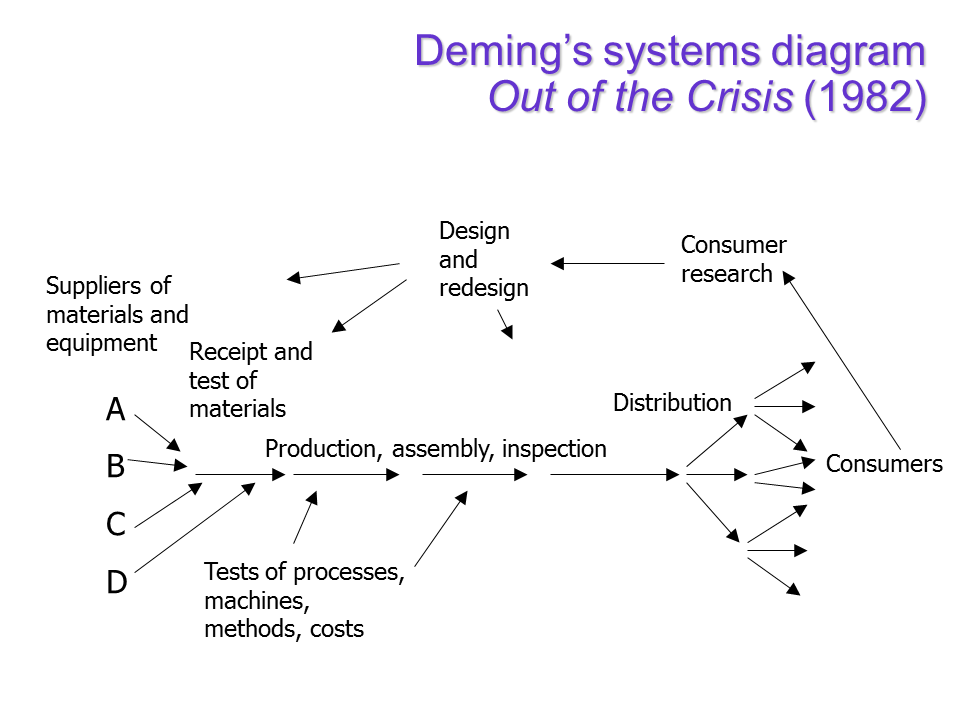
Deming system diagramAnybody who has been to a Deming seminar will have seen the Deming system diagram. Deming invited participants to focus on the system that created revenues for the organisation and, further, to see that system as a network of processes. Deming used the diagram to emphasis that the critical business processes transect organisational boundaries. Raw materials, whether physical or transactional, run into and out of the silos. Some processes don’t transform the raw materials but act as critical support for the supplier-customer strand. Deming argued that equipment maintenance, product development etc. are nonetheless processes transforming their own inputs into vital enablers and accelerants of the revenue generating activities.

Further, held Deming, those processes run across the external boundaries of the organisation into suppliers and customer. A manufacturer making car tyres is part of a bigger picture including the manufacture of the tyre rubber and even the way the end user drives his motor car. Only by understanding the whole can the tyre performance be optimised, customer value maximised, and growing market share and revenues realised.

Yet the power of the functions remains and is seldom mitigated by implementing process management. Process management is something with which organisations still struggle.Those who try to follow the idea of dispersing expertise into the processes frequently find that individuals embedded in cross-functional teams perform less well than within their concentrated centres of excellence. It is worth remembering how two counterbalancing forces arise.

Behaviour

Any proposed system of reward must be risk assessed against the behaviours it is likely to encourage or discourage. Managers given the job of reducing the cost of running their own silo will do just that. All managers are optimising within their own bounded rationality.

Goal deployment

One tactic that can help prevent managers from optimising their own subsystem at the expense of the greater is to adopt some system of goal deployment such as hoshin kanri. Visibility, both horizontally and vertically, of how individual results contribute to organisational goals, effected through objective supervision and strategic governance, ought to discourage suboptimisation and reveal any such trends at an early time.

Professional expertise is important

In 1776, Scottish philosopher Adam Smith told the parable of the pin maker. Smith set out a detailed argument for the benefits of specialisation and the division of labour. The silos provide the means of rewarding the development of expertise in itself, something whose value may only be seen in the future, and of fostering the application of that expertise in management.

Deming was somewhat inimical to this idea and thought that managers should work in a variety of roles across functions as they ascended the hierarchy, as he felt they did in Japan. Yet it is critical in that environment to maintain the virtues of the silos as incubators of expertise. This is not so easily achieved.

Organisational boundaries exist for a reason

In The Democratic Corporation (1994) Russell Ackoff asked why we could not make a business out of mutually and severally co-operating individuals, each negotiating a web of personal contracts that made up the system that delivered the goods.

Nobel laureate economist Ronald Coase had already answered the question in his 1937 paper The Nature of the Firm. Coase explained why organisations are promoted and employ the people who might otherwise be a market of interacting individual contractors. It simply came down to the costs of operating such a market and the savings that could be made from making a global decision to bring some people and facilities under a single enduring roof.

Organisational and even function boundaries often arise from subtle cost structures. Perhaps these develop over time as more connected ways of remote working become commonplace. But it is important to analyse the forces that created and perpetuate the silos. Otherwise, it should be no surprise when the benefits of process management go unrealised.

Deconstructing Deming VII – Adopt and institute leadership

7. Adopt and institute leadership.

W Edwards Deming Point 7 of Deming’s 14 Points. This point leaves me with some of the same uncertainty as Point 6 Institute training on the job. But everybody thinks they know what training is. Leadership is a much more elusive concept.

In a recent review of Archie Brown’s book The Myth of the Strong Leader: Political Leadership in the Modern Age (Times (London) 12 April 2014), Philip Collins observed as follows.

The problem with Brown’s book is his idea that there is a single entity called “leadership” that covers all these categories. It does not follow from the existence of leaders that there is such a thing as “leadership”. It may be no more possible to distil wisdom on leadership than it is on love. Every lover is different, I would imagine. There doesn’t seem to be much profit in the attempt to set out a theory of “lovership” as if there were common traits in every act of seduction.

Collins identifies a common discomfort. Yet there remain good and bad leaders, as there are good and bad lovers. All who aspire to improve must start by distinguishing the characteristics of the good and the bad.

Deming elaborates his own Point 7 further in Out of the Crisis and, predictably, several distinct positions emerge. I identify four but they don’t all help me understanding what leadership is.

1. Abolish focus on outcomes

Deming’s point is well taken that, for the statistically naïve, day to day management based on historical outcomes typically leads to over adjustment, what Deming called tampering. The consequences are increased operating costs that have been themselves induced by the over active management.

However, outcomes must be the overriding benchmark by which all management is measured. The problem with the over adjustment that flows from a lack of rigorous criticism of data is that it frustrates the very outcomes it aspired to serve. There has ultimately to be some measure of success and failure, an outcome. That is the inevitable focus of every leader.

2. Remove barriers to pride in workmanship

This is picked up at greater depth in Deming’s Point 12. I shall come back to it then.

3. Leaders must know the work they supervise

Alan Clark was a British politician, a very minor, and comically gaff prone, minister in the Thatcher government of the 1980s. He is now mostly remembered as a notorious self styled bon viveur and womaniser. His diaries are as scandalous as they are apocryphal. A good read for those who like that sort of thing.

In 1961, Clark published an historical work about the First World War, The Donkeys. The book adopted a common popular sentiment of mid-twentieth-century Britain, that the enlisted men of the war were lions led by donkeys. The donkeys were the officer class, their leaders. Clark helped to reinforce the idea that the private soldier was brave and capable, but betrayed by a self styled elite who failed to equip and direct them with commensurate valour. Historian Basil Liddell Hart endorsed Clark’s proofs.

To be fair there is legitimate controversy about the matter. But I think that now academic, and certainly popular, sentiment has swung the other way, no longer regarding the leaders as incompetent and indifferent, but rather as diligent and compassionate though overwhelmed. Historian Robin Neillands put it thus:

… the idea that they were indifferent to the sufferings of their men is constantly refuted by the facts, and only endures because some commentators wish to perpetuate the myth that these generals, representing the upper classes, did not give a damn what happened to the lower orders.

I find Deming content to perpetuate a similar trope about industrial managers in his writings. In Out of the Crisis:

There was a time, years ago, when a foreman selected his people, trained them, helped them, worked with them. He knew the job. … Supervision on the factory floor is, I fear, in many companies, an entry position for college boys and girls [sic] to learn about the company, six months here, six months there. … He does not understand the problem. and could get nothing done about it if he did.

I frankly don’t know where to start with that. It goes on. I constantly see Deming’s followers approving and sharing this sort of article. They all simply have the whiff of lamp oil about them. They fail to ring true and betray the same sort of lazy, chippy, defensive emotions as the donkeys attribution.

Other than in the simplest of endeavours, perhaps a window cleaning business, perhaps, the value of an enterprise flows from the confluence and integration of diverse materials, skills, technologies, knowledge and people. A manager or leader is the person who makes that confluence occur. But for the manager it would not have happened. Inevitably that means that the leader’s domain knowledge of any particular element is limited. It is the manager’s ability to absorb and assimilate information from a variety of sources that enables the enterprise. Leadership demands capacity to trust that other people know what they are doing, and to use the borrowing strength of diverse sources of information to signal when assumptions are betrayed. The hope that the leader can be a craft master of all he or she seeks to integrate is forlorn.

4. Leaders understand variation

I dealt with this under Point 6. It is a strong point. Without understanding of statistics, rigorous criticism of historical data is impossible. Signal and noise cannot be efficiently separated. That leads to over adjustment, tampering, increased costs and frustrated outcome. Only managers who are not held to outcomes will ultimately be indulged in an innumerate pursuit of over adjustment. But it takes a long time for things to shake out.

The role of a manager of people

Deming wrote under this head in his last book The New Economics. There are another 14 points with overlaps and extensions of his original 14. A lot of it expands Principal Point 12. I will need to come back to them at another time. However, Deming certainly saw a leader as somebody with a plan and an ability to explain the plan to the workforce.

Attempts to define leadership abound yet no single one is, to me, compelling. However, part of it must be engagement with strategy. Strategy is the way of dealing with the painful experience that plans do not survive for very long. I liked the way Lawrence Freedman put it in his recent Strategy: A History.

The strategist has to accept that even when there is an obvious climax (a battle or an election), the story line will still be open-ended … leaving a number of issues to be resolved later. Even when the desired endpoint is reached, it is not really the end, The enemy may have surrendered, the election won, the target company taken over, the revolutionary opportunity seized, but that just means there is now an occupied country to run, a new government to be formed, a whole new revolutionary order to be established, or distinctive sets of corporate activities to be merged. … The transition is immediate and may well be conditional on how the original endpoint was reached. This takes us back to the observation that much strategy is about getting to the next stage rather than some ultimate destination. Rather than think of strategy as a three-act play, it is better to think of it as a soap opera with a continuing cast of characters and plot lines that unfold over a series of episodes. Each of these episodes will be self-contained and set up the subsequent episode. Unlike a play with a definite ending, there is no need for a soap opera to ever reach a conclusion, even though the central characters and their circumstances change.

That leads us to my first response to Deming’s Point 7.

  • Leaders take responsibility for aligning outcomes to targets.
  • Targets are in constant motion.
  • Continual rigorous statistical criticism of historical data is the way to align outcomes and targets, by avoiding over adjustment and by navigating the sort of strategic soap opera Freedman describes.
  • Leaders need to trust that their team know what they are doing.
  • Leaders use the borrowing strength of diverse data to monitor performance.

There is much else to leadership. I have not addressed people or engagement. That takes me back to Deming’s Principal Point 12 (yet to come). I want to look closely at those topics at a later time within the framework of Max Weber’s ethics of responsibility.

I also want to come back to Freedman’s narrative approach to strategy and the work of G L S Shackle on statisics, economics and imagination. It will have to wait.