By coincidence, this item appeared on the BBC today.
More on British railway suicides
1

By coincidence, this item appeared on the BBC today.
I chose a prosaic title because it’s not a subject about which levity is appropriate. I remain haunted by this cyclist on the level crossing. As a result I thought I would delve a little into railway accident statistics. The data is here. Unfortunately, the data only goes back to 2001/2002. This is a common feature of government data. There is no long term continuity in measurement to allow proper understanding of variation, trends and changes. All this encourages the “executive time series” that are familiar in press releases. I think that I shall call this political amnesia. When I have more time I shall look for a longer time series. The relevant department is usually helpful if contacted directly.
However, while I was searching I found this recent report on Railway Suicides in the UK: risk factors and prevention strategies. The report is by Kamaldeep Bhui and Jason Chalangary of the Wolfson Institute of Preventive Medicine, and Edgar Jones of the Institute of Psychiatry, King’s College, London. Originally, I didn’t intend to narrow my investigation to suicides but there were some things in the paper that bothered me and I felt were worth blogging about.
Obviously this is really important work. No civilised society is indifferent to tragedies such as suicide whose consequences are absorbed deeply into the community. The report analyses a wide base of theories and interventions concerning railway suicide risk. There is a lot of information and the authors have done an important job in bringing together and seeking conclusions. However, I was bothered by this passage (at p5).
The Rail Safety and Standards Board (RSSB) reported a progressive rise in suicides and suspected suicides from 192 in 2001-02 to a peak 233 in 2009-10, the total falling to 208 in 2010-11.
Oh dear! An “executive time series”. Let’s look at the data on a process behaviour chart.
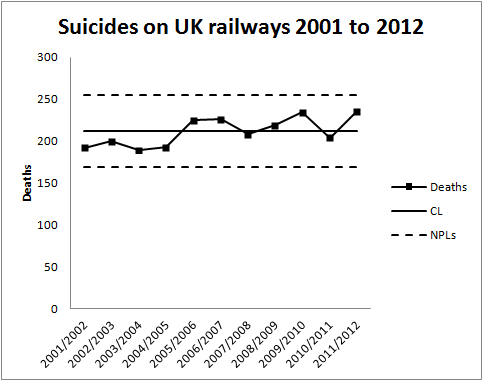
There is no signal, even ignoring the last observation in 2011/2012 which the authors had not had to hand. There has been no increasing propensity for suicide since 2001. The writers have been, as Nassim Taleb would put it, “fooled by randomness”. In the words of Nate Silver, they have confused signal and noise. The common cause variation in the data has been over interpreted by zealous and well meaning policy makers as an upward trend. However, all diligent risk managers know that interpretation of a chart is forbidden if there is no signal. Over interpretation will lead to (well meaning) over adjustment and admixture of even more variation into a stable system of trouble.
Looking at the development of the data over time I can understand that there will have been a temptation to perform a regression analysis and calculate a p-value for the perceived slope. This is an approach to avoid in general. It is beset with the dangers of testing effects suggested by the data and the general criticisms of p-values made by McCloskey and Ziliak. It is not a method that will be a reliable guide to future action. For what it’s worth I got a p-value of 0.015 for the slope but I am not impressed. I looked to see if I could find a pattern in the data then tested for the pattern my mind had created. It is unsurprising that it was “significant”.
The authors of the report go on to interpret the two figures for 2009/2010 (233 suicides) and 2010/2011 (208 suicides) as a “fall in suicides”. It is clear from the process behaviour chart that this is not a signal of a fall in suicides. It is simply noise, common cause variation from year to year.
Having misidentified this as a signal they go on to seek a cause. Of course they “find” a potential cause. A partnership between Network Rail and the Samaritans, Men on the Ropes, had started in January 2010. The programme’s aim was to reduce suicides by 20% over five years. I genuinely hope that the programme shows success. However, the programme will not be assisted by thinking that it has yet shown signs of improvement.
With the current mean annual total at 211, a 20% reduction entails a new mean of 169 annual suicides.That is an ambitious target I think, and I want to emphasise that the programme is entirely laudable and plausible. However, whether it succeeds is to be judged by the figures on the process behaviour chart, not by any post hoc rationalisation. This is the tough discipline of the charts. It is no longer possible to claim an improvement where that is not supported by the data.
I will come back to this data next year and look to see if there are any signs of encouragement.
Last weekend I was reading Dominic Lawson’s Sunday Times (London) review (10 November 2013) of Normal Greenspan’s recent book The Map and the Territory: Risk, Human Nature, and the Future of Forecasting. Lawson expresses his astonishment at what Greenspan says.
I and other economic forecasters didn’t understand that markets are prone to wild and even deranging mood swings that are uncoupled from any underlying rational basis.
I have to share Lawson’s astonishment. After all, Greenspan was the man who criticised the markets’ irrational exuberance back in the 1990s.
Lawson usefully reminded me of an important observation by eighteenth century philosopher David Hume.
Reason is … only the slave of the passions and can never pretend to any other office.
Perhaps computer pioneer Marvin Minksy put it in a more colloquial way.
Logic doesn’t apply in the real world.
That is something that we have to be very wary of in the management of an enterprise. Whatever the consensual mission, it is ultimately under threat from narrow decisions by individuals, or self-reinforcing groups, that might be influenced more by emotional reactions to local events than by an appreciation of the organisational system. I think that there are some things leaders can do to minimise the risks.
Firstly, put key measures on a process behaviour chart and run it continuously. This provides a focus for discussion, for testing opinions and for placing decision making in context.
Secondly, formalise periodic reviews of process capability accompanied by a reappraisal of, and immersion in, the voice of the customer. Communicate this review widely. Do not allow it to be ignored or minimised in any discussions or decision processes.
Thirdly, just be aware of the risks that decisions might be emotionally founded with only post hoc rationalisation. Keep an eye on people who chronically avoid engagement in the process behaviour chart and capability study. Be mindful of your own internal thought processes. They are certainly less rational than you think.
I think that with those precautions organisations can harness the positive emotions that generate enthusiasm for a product or process and passion for its continual improvement.
Richard Dawkins has recently had a couple of bad customer experiences. In each he was confronted with a system that seemed to him indifferent to his customer feedback. I sympathise with him on one matter but not the other. The two incidents do, in my mind, elucidate some important features of process discipline.
In the first, Dawkins spent a frustrating spell ordering a statement from his bank over the internet. He wanted to tell the bank about his experience and offer some suggestions for improvement, but he couldn’t find any means of channelling and communicating his feedback.
Embedding a business process in software will impose a rigid discipline on its operation. However, process discipline is not the same thing as process petrification. The design assumptions of any process include, or should include, the predicted range and variety of situations that the process is anticipated to encounter. We know that the bounded rationality of the designers will blind them to some of the situations that the process will subsequently confront in real world operation. There is no shame in that but the necessary adjunct is that, while the process is operated diligently as designed, data is accumulated on its performance and, in particular, on the customer’s experience. Once an economically opportune moment arrives (I have glossed over quote a bit there) the data can be reviewed, design assumptions challenged and redesign evaluated. Following redesign the process then embarks on another period of boring operation. The “boring” bit is essential to success. Perhaps I should say “mindful” rather than “boring” though I fear that does not really work with software.
Dawkins’ bank have missed an opportunity to listen to the voice of the customer. That weakens their competitive position. Ignorance cannot promote competitiveness. Any organisation that is not continually improving every process for planning, production and service (pace W Edwards Deming) faces the inevitable fact that its competitors will ultimately make such products and services obsolete. As Dawkins himself would appreciate, survival is not compulsory.
Dawkins’ second complaint was that security guards at a UK airport would not allow him to take a small jar of honey onto his flight because of a prohibition on liquids in the passenger cabin. Dawkins felt that the security guard should have displayed “common sense” and allowed it on board contrary to the black letter of the regulations. Dawkins protests against “rule-happy officials” and “bureaucratically imposed vexation”. Dawkins displays another failure of trust in bureaucracy. He simply would not believe that other people had studied the matter and come to a settled conclusion to protect his safety. It can hardly have been for the airport’s convenience. Dawkins was more persuaded by something he had read on the internet. He fell into the trap of thinking that What you see is all there is. I fear that Dawkins betrays his affinities with the cyclist on the railway crossing.
When we give somebody a process to operate we legitimately expect them to do so diligently and with self discipline. The risk of an operator departing from, adjusting or amending a process on the basis of novel local information is that, within the scope of the resources they have for taking that decision, there is no way of reliably incorporating the totality of assumptions and data on which the process design was predicated. Even were all the data available, when Dawkins talks of “common sense” he was demanding what Daniel Kahneman called System 2 thinking. Whenever we demand System 2 thinking ex tempore we are more likely to get System 1 and it is unlikely to perform effectively. The rationality of an individual operator in that moment is almost certainly more tightly bounded than that of the process designers.
In this particular case, any susceptibility of a security guard to depart from process would be exactly the behaviour that a terrorist might seek to exploit once aware of it.
Further, departures from process will have effects on the organisational system, upstream, downstream and collateral. Those related processes themselves rely on the operator’s predictable compliance. The consequence of ill discipline can be far reaching and unanticipated.
That is not to say that the security process was beyond improvement. In an effective process-oriented organisation, operating the process would be only one part of the security guard’s job. Part of the bargain for agreeing to the boring/ mindful diligent operation of the process is that part of work time is spent improving the process. That is something done offline, with colleagues, with the input of other parts of the organisation and with recognition of all the data including the voice of the customer.
Had he exercised the “common sense” Dawkins demanded, the security guard would have risked disciplinary action by his employers for serious misconduct. To some people, threats of sanctions appear at odds with engendering trust in an organisation’s process design and decision making. However, when we tell operators that something is important then fail to sanction others who ignore the process, we undermine the basis of the bond of trust with those that accepted our word and complied. Trust in the bureaucracy and sanctions for non-compliance are complementary elements of fostering process discipline. Both are essential.
I have recently been reading Gina Perry’s book Behind the Shock Machine which analyses, criticises and re-assesses the “obedience” experiments of psychologist Stanley Milgram performed in the early 1960s. For the uninitiated there is a brief description of the experiments on Dr Perry’s website. You can find a video of the experiments here.
The experiments have often been cited as evidence for a constitutional human bias towards compliance in the face of authority. From that interpretation has grown a doctrine that the atrocities of war and of despotism are enabled by the common man’s (sic) unresistsing obedience to even a nominal superior, and further that inherent cruelty is eager to express itself under the pretext of an order.
Perry mounts a detailed challenge to the simplicity of that view. In particular, she reveals how Milgram piloted his experiments and fine tuned them so that they would produce the most signal obedient behaviour. The experiments took place within the context of academic research. The experimenter did everything to hold himself out as the representative of an overwhelmingly persuasive body of scientific knowledge. At every stage the experimenter reassured the subject and urged them to proceed. Given this real pressure applied to the experimental subjects, even a 65% compliance rate was hardly dramatic. Most interestingly, the actual reaction of the subjects to their experience was complex and ambiguous. It was far from the conventional view of the cathartic release of supressed violence facilitated by a directive from a figure with a superficial authority. Erich Fromm made some similar points about the experiments in his 1973 book The Anatomy of Human Destructiveness.
What interests me about the whole affair is its relevance to an issue which I have raised before on this blog: trust in bureaucracy. Max Weber was one of the first sociologists to describe how modern societies and organisations rely on a bureaucracy, an administrative policy-making group, to maintain the operation of complex dynamic systems. Studies of engineering and science as bureaucratic professions include Diane Vaughan’s The Challenger Launch Decision.
The majority of Milgram’s subjects certainly trusted the bureaucracy represented by the experimenter, even in the face of their own fears that they were doing harm. This is a stark contrast to some failures of such trust that I have blogged about here. By their mistrust, the cyclist on the railway crossing and the parents who rejected the MMR vaccination placed themselves and others in genuine peril. These were people who had, as far as I have been able to discover, no compelling evidence that the engineers who designed the railway crossing or the scientists who had tested the MMR vaccine might act against their best interests.
So we have a paradox. The majority of Milgram’s subjects ignored their own compelling fears and trusted authority. The cyclist and the parents recklessly ignored or actively mistrusted authority without a well developed alternative world view. Whatever our discomfort with Milgram’s demonstrations of obedience we feel no happier with the cyclist’s and parents’ disobedience. Prof Jerry M Burger partially repeated Milgram’s experiments in 2007. He is quoted by Perry as saying:
It’s not as clear cut as it seems from the outside. When you’re in that situation, wondering, should I continue or should I not, there are reasons to do both. What you do have is an expert in the room who knows all about this study and presumably has been through this many times before with many participants, and he’s telling you, there’s nothing wrong. The reasonable, rational thing to do is to listen to the guy who’s the expert when you’re not sure what to do.
Organisations depend on a workforce aligned around trust in that organisation’s policy and decision making machinery. Even in the least hierarchical of organisations, not everybody gets involved in every decision. Whether it’s the decision of a co-worker with an exotic expertise or the policy of a superior in the hierarchy, compliance and process discipline will succeed or fail on the basis of trust.
The “trust” that Milgram’s subjects showed towards the experimenter was manufactured and Perry discusses how close the experiment ran to acceptable ethical standards.
Organisations cannot rely on such manufactured “trust”. Breakdown of trust among employees is a major enterprise risk for most organisations. The trust of customers is essential to reputation. A key question in all decision making is whether the outcome will foster trust or destroy it.
thoughts on particle physics, statistics, and other stuff I find interesting and know something about
Strength in Numbers
"Statistical thinking will one day be as necessary for efficient citizenship as the ability to read and write." - H.G. Wells
Warning: "graphic" content...
... Anthony Cutler's blog on operational excellence and risk management
Ever tried. Ever failed. No matter. Try Again. Fail again. Fail better.
Accelerating Innovation in Harmony
A blog about Master Data Management, Product Information Management, Data Quality Management and more
... Anthony Cutler's blog on operational excellence and risk management
... Anthony Cutler's blog on operational excellence and risk management
... Anthony Cutler's blog on operational excellence and risk management
... Anthony Cutler's blog on operational excellence and risk management
... Anthony Cutler's blog on operational excellence and risk management
... Anthony Cutler's blog on operational excellence and risk management
The Undercover Economist
... Anthony Cutler's blog on operational excellence and risk management
... Anthony Cutler's blog on operational excellence and risk management
... Anthony Cutler's blog on operational excellence and risk management
... Anthony Cutler's blog on operational excellence and risk management
 Unanticipated Knowledge