Deconstructing Deming III – Cease reliance on inspection

3. Cease dependence on inspection to achieve quality. Eliminate the need for massive inspection by building quality into the product in the first place.

W Edwards Deming Point 3 of Deming’s 14 Points. This at least cannot be controversial. For me it goes to the heart of Deming’s thinking.

The point is that every defective item produced (or defective service delivered) has taken cash from the pockets of customers or shareholders. They should be more angry. One day they will be. Inputs have been purchased with their cash, their resources have been deployed to transform the inputs and they will get nothing back in return. They will even face the costs of disposing of the scrap, especially if it is environmentally noxious.

That you have an efficient system for segregating non-conforming from conforming is unimpressive. That you spend even more of other people’s money reworking the product ought to be a matter of shame. Lean Six Sigma practitioners often talk of the hidden factory where the rework takes place. A factory hidden out of embarrassment. The costs remain whether you recognise them or not. Segregation is still more problematic in service industries.

The insight is not unique to Deming. This is a common theme in Lean, Six Sigma, Theory of Constraints and other approaches to operational excellence. However, Deming elucidated the profound statistical truths that belie the superficial effectiveness of inspection.

Inspection is inefficient

When I used to work in the railway industry I was once asked to look at what percentage of signalling scheme designs needed to be rechecked to defend against the danger of a logical error creeping through. The problem requires a simple application of Bayes’ theorem. I was rather taken aback at the result. There were only two strategies that made sense: recheck everything or recheck nothing. I didn’t at that point realise that this is a standard statistical result in inspection theory. For a wide class of real world situations, where the objective is to segregate non-conforming from conforming, the only sensible sampling schemes are 100% or 0%.

Where the inspection technique is destructive, such as a weld strength test, there really is only one option.

Inspection is ineffective

All inspection methods are imperfect. There will be false-positives and false-negatives. You will spend some money scrapping product you could have sold for cash. Some defective product will escape onto the market. Can you think of any examples in your own experience? Further, some of the conforming product will be only marginally conforming. It won’t delight the customer.

So build quality into the product

… and the process for producing the product (or delivering the service). Deming was a champion of the engineering philosophy of Genechi Taguchi who put forward a three-stage approach for achieving, what he called, off-line quality control.

  1. System design – in developing a product (or process) concept think about how variation in inputs and environment will affect performance. Choose concepts that are robust against sources of variation that are difficult or costly to control.
  2. Parameter design – choose product dimensions and process settings that minimise the sensitivity of performance to variation.
  3. Tolerance design – work out the residual sources of variation to which performance remains sensitive. Develop control plans for measuring, managing and continually reducing such variation.

Is there now no need to measure?

Conventional inspection aimed at approving or condemning a completed batch of output. The only thing of interest was the product and whether it conformed. Action would be taken on the batch. Deming called the application of statistics to such problems an enumerative study.

But the thing managers really need to know about is future outcomes and how they will be influenced by present decisions. There is no way of sampling the future. So sampling of the past has to go beyond mere characterisation and quantification of the outcomes. You are stuck with those and will have to take the consequences one way or another. Sampling (of the past) has to aim principally at understanding the causes of those historic outcomes. Only that enables managers to take a view on whether those causes will persist in the future, in what way they might change and how they might be adjusted. This is what Deming called an analytic study.

Essential to the ability to project data into the future is the recognition of common and special causes of variation. Only when managers are confident in thinking and speaking in those terms will their organisations have a sound basis for action. Then it becomes apparent that the results of inspection represent the occult interaction of inherent variation with threshold effects. Inspection obscures the distinction between common and special causes. It seduces the unwary into misguided action that exacerbates quality problems and reputational damage. It obscures the sad truth that, as Terry Weight put it, a disappointment is not necessarily a surprise.

The programme

  1. Drive out sensitivity to variation at the design stage.
  2. Routinely measure the inputs whose variation threatens product performance.
  3. Measure product performance too. Your bounded rationality may have led you to get (2) wrong.
  4. No need to measure every unit. We are trying to understand the cause system not segregate items.
  5. Plot data on a process behaviour chart.
  6. Stabilise the system.
  7. Establish capability.
  8. Keep on measuring to maintain stability and improve capability.

Some people think they have absorbed Deming’s thinking, mastered it even. Yet the test is the extent to which they are able to analyse problems in terms of common and special causes of variation. Is that the language that their organisation uses to communicate exceptions and business performance, and to share analytics, plans, successes and failures?

There has always been some distaste for Deming’s thinking among those who consider it cold, statistically driven and paralysed by data. But the data are only a means to getting beyond the emotional reaction to those two impostors: triumph and disaster. The language of common and special causes is a profound tool for building engagement, fostering communication and sharing understanding. Above that, it is the only sound approach to business measurement.
Adoption statistics for England – signals of improvement?

I am adopted so I follow the politics of adoption fairly carefully. I was therefore interested to see this report on the BBC, claiming a “record” increase in adoptions. The quotation marks are the BBC’s. The usual meaning of such quotes is that the word “record” is not being used with its usual meaning. I note that the story was repeated in several newspapers this morning.

The UK government were claiming a 15% increase in children adopted from local authority care over the last year and the highest total since data had been collected on this basis starting in 1992.

Most people will, I think, recognise what Don Wheeler calls an executive time series. A comparison of two numbers ignoring any broader historical trends or context. Of course, any two consecutive numbers will be different. One will be greater than the other. Without the context that gives rise to the data, a comparison of two numbers is uninformative.

I decided to look at the data myself by following the BBC link to the GOV.UK website. I found a spreadsheet there but only with data from 2009 to 2013. I dug around a little more and managed to find 2006 to 2008. However, the website told me that to find any earlier data I would have to consult the National Archives. At the same time it told me that the search function at the National Archives did not work. I ended up browsing 30 web pages of Department of Education documents and managed to get figures back to 2004. However, when I tried to browse back beyond documents dated January 2008, I got “Sorry, the page you were looking for can’t be found” and an invitation to use the search facility. Needless to say, I failed to find the missing data back to 1992, there or on the Office for National Statistics website. It could just be my internet search skills that are wanting but I spent an hour or so on this.

Gladly, Justin Ushie and Julie Glenndenning from the Department for Education were able to help me and provided much of the missing data. Many thanks to them both. Unfortunately, even they could not find the data for 1992 and 1993.

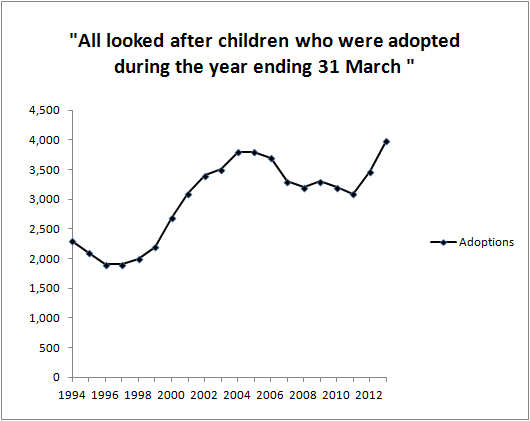
Here is the run chart.

Adoption1

Some caution is needed in interpreting this chart because there is clearly some substantial serial correlation in the annual data. That said, I am not able to quite persuade myself that the 2013 figure represents a signal. Things look much better than the mid-1990s but 2013 still looks consistent with a system that has been stable since the early years of the century.

The mid 1990s is a long time ago so I also wanted to look at adoptions as a percentage of children in care. I don’t think that that is automatically a better measure but I wanted to check that it didn’t yield a different picture.

Adoption2

That confirms the improvement since the mid-1990s but the 2013 figures now look even less remarkable against the experience base of the rest of the 21st century.

I would like to see these charts with all the interventions and policy changes of respective governments marked. That would then properly set the data in context and assist interpretation. There would be an opportunity to build a narrative, add natural process limits and come to a firmer view about whether there was a signal. Sadly, I have not found an easy way of building a chronology of intervention from government publications.

Anyone holding themselves out as having made an improvement must bring forward the whole of the relevant context for the data. That means plotting data over time and flagging background events. It is only then that the decision maker, or citizen, can make a proper assessment of whether there has been an improvement. The simple chart of data against time, even without natural process limits, is immensely richer than a comparison of two selected numbers.

Properly capturing context is the essence of data visualization and the beginnings of graphical excellence.

One my favourite slogans:

In God we trust. All else bring data.

W Edwards Deming

I plan to come back to this data in 2014.

Music is silver but …

The other day I came across a report on the BBC website that non-expert listeners could pick out winners of piano competitions more reliably when presented with silent performance videos than when exposed to sound alone. In the latter case they performed no better than chance.

The report was based on the work of Chia-Jung Tsay at University College London, in a paper entitled Sight over sound in the judgment of music performance.

The news report immediately leads us to suspect that the expert evaluating a musical performance is not in fact analysing and weighing auditory complexity and aesthetics but instead falling under the subliminal influence of the proxy data of the artist’s demeanour and theatrics.

That is perhaps unsurprising. We want to believe, as does the expert critic, that performance evaluation is a reflective, analytical and holistic enterprise, demanding decades of exposure to subtle shades of interpretation and developing skills of discrimination by engagement with the ascendant generation of experts. This is what Daniel Kahneman calls a System 2 task. However, a wealth of psychological study shows only too well that System 2 is easily fatigued and distracted. When we believe we are thinking in System 2, we are all too often loafing in System 1 and using simplistic learned heuristics as a substitute. It is easy to imagine that the visual proxy data might be such a heuristic, a ready reckoner that provides a plausible result in a wide variety of commonly encountered situations.

These behaviours are difficult to identify, even for the most mindful individual. Kahneman notes:

… all of us live much of our lives guided by the impressions of System 1 – and we do not know the source of these impressions. How do you know that a statement is true? If it is strongly linked by logic or association to other beliefs or preferences you hold, or comes from a source you trust and like, you will feel a sense of cognitive ease. The trouble is that there may be other causes for your feeling of ease … and you have no simple way of tracing your feelings to their source”

Thinking, Fast and Slow, p64

The problem is that what Kahneman describes is exactly what I was doing in finding my biases confirmed by this press report. I have had a superficial look at the statistics in this study and I am now less persuaded than when I read the press item. I shall maybe blog about this later and the difficulties I had in interpreting the analysis. Really, this is quite a tentative and suggestive study on a very limited frame. I would certainly like to see more inter-laboratory studies in psychology. The study is open to multiple interpretations and any individual will probably have difficulty making an exhaustive list.  There is always a danger of falling into the trap of What You See Is All There Is (WYSIATI).

That notwithstanding, even anecdotally, the story is another reminder of an important lesson of process management that, even though what we have been doing has worked in the past, we may not understand what it is that has been working.

Late-night drinking laws saved lives

That was the headline in The Times (London) on 19 August 2013. The copy went on:

“Hundreds of young people have escaped death on Britain’s roads after laws were relaxed to allow pubs to open late into the night, a study has found.”

It was accompanied by a chart.

How death toll fell

This conclusion was apparently based on a report detailing work led by Dr Colin Green at Lancaster University Management School. The report is not on the web but Lancaster were very kind in sending me a copy and I extend my thanks to them for the courtesy.

This is very difficult data to analyse. Any search for a signal has to be interpreted against a sustained fall in recorded accidents involving personal injury that goes back to the 1970s and is well illustrated in the lower part of the graphic (see here for data). The base accident data is therefore manifestly not stable and predictable. To draw inferences we need to be able to model the long term trend in a persuasive manner so that we can eliminate its influence and work with a residual data sequence amendable to statistical analysis.

It is important to note, however, that the authors had good reason to believe that relaxation of licensing laws may have an effect so this was a proper exercise in Confirmatory Data Analysis.

Reading the Lancaster report I learned that The Times graphic is composed of five-month moving averages. I do not think that I am attracted by that as a graphic. Shewhart’s Second Rule of Data Presentation is:

Whenever an average, range or histogram is used to summarise observations, the summary must not mislead the user into taking any action that the user would not take if the data were presented in context.

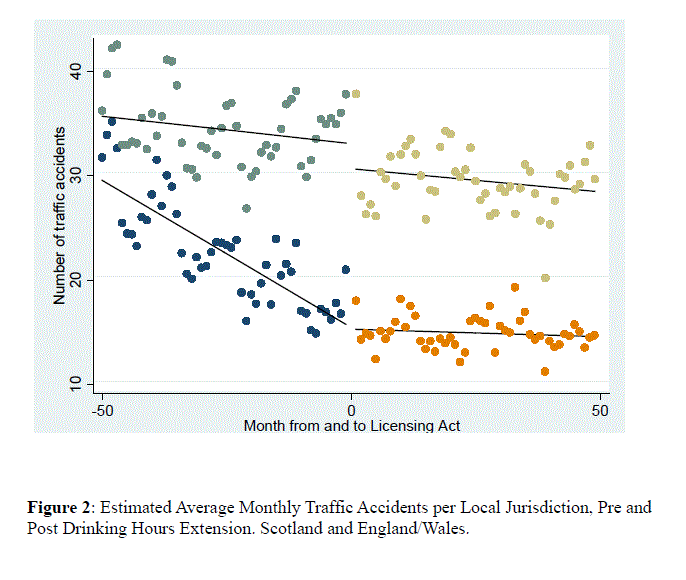
I fear that moving-averages will always obscure the message in the data. I preferred this chart from the Lancaster report. The upper series are for England, the lower for Scotland.

Drink Drive scatter

Now we can see the monthly observations. Subjectively there looks to be, at least in some years, some structure of variation throughout the year. That is unsurprising but it does ruin all hope of justifying an assumption of “independent identically distributed” residuals. Because of that alone, I feel that the use of p-values here is inappropriate, the usual criticisms of p-values in general notwithstanding (see the advocacy of Stephen Ziliak and Deirdre McCloskey).

As I said, this is very tricky data from which to separate signal and noise. Because of the patterned variation within any year I think that there is not much point in analysing other than annual aggregates. The analysis that I would have liked to have seen would have been a straight line regression through the whole of the annual data for England. There may be an initial disappointment that that gives us “less data to play with”. However, considering the correlation within the intra-year monthly figures, a little reflection confirms that there is very little sacrifice of real information. I’ve had a quick look at the annual aggregates for the period under investigation and I can’t see a signal. The analysis could be taken further by calculating an R2. That could then be compared with an R2 calculated for the Lancaster bi-linear “change point” model. Is the extra variation explained worth having for the extra parameters?

I see that the authors calculated an R2 of 42%. However, that includes accounting for the difference between English and Scottish data which is the dominant variation in the data set. I’m not sure what the Scottish data adds here other than to inflate R2.

There might also be an analysis approach by taking out the steady long term decline in injuries using a LOWESS curve then looking for a signal in the residuals.

What that really identifies are three ways of trying to cope with the long term declining trend, which is a nuisance in this analysis: straight line regression, straight line regression with “change point”, and LOWESS. If they don’t yield the same conclusions then any inference has to be treated with great caution. Inevitably, any signal is confounded with lack of stability and predictability in the long term trend.

I comment on this really to highlight the way the press use graphics without explaining what they mean. I intend no criticism of the Lancaster team as this is very difficult data to analyse. Of course, the most important conclusion is that there is no signal that the relaxation in licensing resulted in an increase in accidents. I trust that my alternative world view will be taken constructively.

Trust in data – I

I was listening to the BBC’s election coverage on 2 May (2013) when Nick Robinson announced that UKIP supporters were five times more likely than other voters to believe that the MMR vaccine was dangerous.

I had a search on the web. The following graphic had appeared on Mike Smithson’s PoliticalBetting blog on 21 April 2013.

MMR plot

It’s not an attractive bar chart. The bars are different colours. There is a “mean” bar that tends to make the variation look less than it is and makes the UKIP bar (next to it) look more extreme. I was, however, intrigued so I had a look for the original data which had come from a YouGov survey of 1765 respondents. You can find the data here.

Here is a summary of the salient points of the data from the YouGov website in a table which I think is less distracting than the graphic.

Voting   intention Con. Lab. Lib. Dem. UKIP
No. Of   respondents 417 518 142 212
% % % %
MMR safe 99 85 84 72
MMR unsafe 1 3 12 28
Don’t know 0 12 3 0

My first question was: Where had Nick Robinson and Mike Smithson got their numbers from? It is possible that there was another survey I have not found. It is also possible that I am being thick. In any event, the YouGov data raises some interesting questions. This is an exploratory date analysis exercise. We are looking for interesting theories. I don’t think there is any doubt that there is a signal in this data. How do we interpret it? There does look to be some relationship between voting intention and attitude to public safety data.

Should anyone be tempted to sneer at people with political views other than their own, it is worth remembering that it is unlikely that anyone surveyed had scrutinised any of the published scientific research on the topic. All will have digested it, most probably at third hand, through the press, internet, or cooler moment. They may not have any clear idea of the provenance of the assurances as to the vaccination’s safety. They may not have clearly identified issues as to whether what they had absorbed was a purportedly independent scientific study or a governmental policy statement that sought to rely on the science. I suspect that most of my readers have given it no more thought.

The mental process behind the answers probably wouldn’t withstand much analysis. This would be part of Kahneman’s System 1 thinking. However, the question of how such heuristics become established is an interesting one. I suspect there is a factor here that can be labelled “trust in data”.

Trust in data is an issue we all encounter, in business and in life. How do we know when we can trust data?

A starting point for many in this debate is the often cited observation of Brian Joiner that, when presented with a numerical target, a manager has three options: Manage the system so as to achieve the target, distort the system so the target is achieved but at the cost of performance elsewhere (possibly not on the dashboard), or simply distort the data. This, no doubt true, observation is then cited in support of the general proposition that management by numerical target is at best ineffective and at worst counter productive. John Seddon is a particular advocate of the view that, whatever benefits may flow from management by target (and they are seldom championed with any great energy), they are outweighed by the inevitable corruption of the organisation’s data generation and reporting.

It is an unhappy view. One immediate objection is that the broader system cannot operate without targets. Unless the machine part’s diameter is between 49.99 and 50.01 mm it will not fit. Unless chlorine concentrations are below the safe limit, swimmers risk being poisoned. Unless demand for working capital is cut by 10% we will face the consequences of insolvency. Advocates of the target free world respond that those matters can be characterised as the legitimate voice of the customer/ business. It is only arbitrary targets that are corrosive.

I am not persuaded that the legitimate/ arbitrary distinction is a real one, nor how the distinction motivates two different kinds of behaviour. I will blog more about this later. Leadership’s urgent task is to ensure that all managers have the tools to measure present reality and work to improve it. Without knowing how much improvement is essential a manager cannot make rational decisions about the allocation of resources. In that context, when the correct management control is exercised, improving the system is easier than cheating. I shall blog about goal deployment and Hoshin Kanri on another occasion.

Trust in data is just a factor of trust in general. In his popular book on evolutionary psychology and economics, The Origins of Virtue, Matt Ridley observes the following.

Trust is as vital a form of social capital as money is a form of actual capital. … Trust, like money, can be lent (‘I trust you because I trust the person who told me he trusts you’), and can be risked, hoarded or squandered. It pays dividends in the currency of more trust.

Within an organisation, trust in data is something for everybody to work on building collaboratively under diligent leadership. As to the public sphere, trust in data is related to trust in politicians and that may be a bigger problem to solve. It is also a salutary warning as to what happens when there is a failure of trust in leadership.