Why would a lawyer blog about statistics?

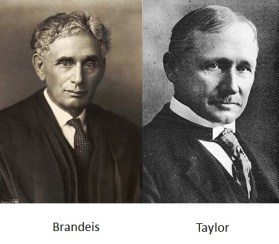
Brandeis and Taylor… is a question I often get asked. I blog here about statistics, data, quality, data quality, productivity, management and leadership. And evidence. I do it from my perspective as a practising lawyer and some people find that odd. Yet it turns out that the collaboration between law and quantitative management science is a venerable one.

The grandfather of scientific management is surely Frederick Winslow Taylor (1856-1915). Taylor introduced the idea of scientific study of work tasks, using data and quantitative methods to redesign and control business processes.

Yet one of Taylorism’s most effective champions was a lawyer, Louis Brandeis (1856-1941). In fact, it was Brandeis who coined the term scientific management.

Taylor

Taylor was a production engineer who advocated a four stage strategy for productivity improvement.

  1. Replace rule-of-thumb work methods with methods based on a scientific study of the tasks.
  2. Scientifically select, train, and develop each employee rather than passively leaving them to train themselves.
  3. Provide “Detailed instruction and supervision of each worker in the performance of that worker’s discrete task”.1
  4. Divide work nearly equally between managers and workers, so that the managers apply scientific management principles to planning the work and the workers actually perform the tasks.

Points (3) and (4) tend to jar with millennial attitudes towards engagement and collaborative work. Conservative political scientist Francis Fukuyama criticised Taylor’s approach as “[epitomising] the carrying of the low-trust, rule based factory system to its logical conclusion”.2 I have blogged many times on here about the importance of trust.

However, (1) and (2) provided the catalyst for pretty much all subsequent management science from W Edwards Deming, Elton Mayo, and Taiichi Ohno through to Six Sigma and Lean. Subsequent thinking has centred around creating trust in the workplace as inseparable from (1) and (2). Peter Drucker called Taylor the “Isaac Newton (or perhaps the Archimedes) of the science of work”.

Taylor claimed substantial successes with his redesign of work processes based on the evidence he had gathered, avant la lettre, in the gemba. His most cogent lesson was to exhort managers to direct their attention to where value was created rather than to confine their horizons to monthly accounts and executive summaries.

Of course, Taylor was long dead before modern business analytics began with Walter Shewhart in 1924. There is more than a whiff of the #executivetimeseries about some of Taylor’s work. Once management had Measurement System Analysis and the Shewhart chart there would no longer be any hiding place for groundless claims to non-existent improvements.

Brandeis

Brandeis practised as a lawyer in the US from 1878 until he was appointed a Justice of the Supreme Court in 1916. Brandeis’ principles as a commercial lawyer were, “first, that he would never have to deal with intermediaries, but only with the person in charge…[and] second, that he must be permitted to offer advice on any and all aspects of the firm’s affairs”. Brandies was trenchant about the benefits of a coherent commitment to business quality. He also believed that these things were achieved, not by chance, but by the application of policy deployment.

Errors are prevented instead of being corrected. The terrible waste of delays and accidents is avoided. Calculation is substituted for guess; demonstration for opinion.

Brandeis clearly had a healthy distaste for muda.3 Moreover, he was making a land grab for the disputed high ground that these days often earns the vague and fluffy label strategy.

The Eastern Rate Case

The worlds of Taylor and Brandeis embraced in the Eastern Rate Case of 1910. The Eastern Railroad Company had applied to the Interstate Commerce Commission (“the ICC”) arguing that their cost base had inflated and that an increase in their carriage rates was necessary to sustain the business. The ICC was the then regulator of those utilities that had a monopoly element. Brandeis by this time had taken on the role of the People’s Lawyer, acting pro bono in whatever he deemed to be the public interest.

Brandeis opposed the rate increase arguing that the escalation in Eastern’s cost base was the result of management failure, not an inevitable consequence of market conditions. The cost of a monopoly’s ineffective governance should, he submitted, not be born by the public, nor yet by the workers. In court Brandeis was asked what Eastern should do and he advocated scientific management. That is where and when the term was coined.4

Taylor-Brandeis

The insight that profit cannot simply be wished into being by the fiat of cost plus, a fortiori of the hourly rate, is the Milvian bridge to lean.

But everyone wants to occupy the commanding heights of an integrated policy nurturing quality, product development, regulatory compliance, organisational development and the economic exploitation of customer value. What’s so special about lawyers in the mix? I think we ought to remind ourselves that if lawyers know about anything then we know about evidence. And we just might know as much about it as the statisticians, the engineers and the enforcers. Here’s a tale that illustrates our value.

Thereza Imanishi-Kari was a postdoctoral researcher in molecular biology at the Massachusetts Institute of Technology. In 1986 a co-worker raised inconsistencies in Imanishi-Kari’s earlier published work that escalated into allegations that she had fabricated results to validate publicly funded research. Over the following decade, the allegations grew in seriousness, involving the US Congress, the Office of Scientific Integrity and the FBI. Imanishi-Kari was ultimately exonerated by a departmental appeal board constituted of an eminent molecular biologist and two lawyers. The board heard cross-examination of the relevant experts including those in statistics and document examination. It was that cross-examination that exposed the allegations as without foundation.5

Lawyers can make a real contribution to discovering how a business can be run successfully. But we have to live the change we want to be. The first objective is to bring management science to our own business.

The black-letter man may be the man of the present but the man of the future is the man of statistics and the master of economics.

Oliver Wendell Holmes, 1897

References

  1. Montgomery, D (1989) The Fall of the House of Labor: The Workplace, the State, and American Labor Activism, 1865-1925, Cambridge University Press, p250
  2. Fukuyama, F (1995) Trust: The Social Virtues and the Creation of Prosperity, Free Press, p226
  3. Kraines, O (1960) “Brandeis’ philosophy of scientific management” The Western Political Quarterly 13(1), 201
  4. Freedman, L (2013) Strategy: A History, Oxford University Press, pp464-465
  5. Kevles, D J (1998) The Baltimore Case: A Trial of Politics, Science and Character, Norton
Regression done right: Part 3: Forecasts to believe in

There are three Sources of Uncertainty in a forecast.

  1. Whether the forecast is of “an environment that is sufficiently regular to be predictable”.1
  2. Uncertainty arising from the unexplained (residual) system variation.
  3. Technical statistical sampling error in the regression calculation.

Source of Uncertainty (3) is the one that fascinates statistical theorists. Sources (1) and (2) are the ones that obsess the rest of us. I looked at the first in Part 1 of this blog and, the second in Part 2. Now I want to look at the third Source of Uncertainty and try to put everything together.

If you are really most interested in (1) and (2), read “Prediction intervals” then skip forwards to “The fundamental theorem of forecasting”.

Prediction intervals

A prediction interval2 captures the range in which a future observation is expected to fall. Bafflingly, not all statistical software generates prediction intervals automatically so it is necessary, I fear, to know how to calculate them from first principles. However, understanding the calculation is, in itself, instructive.

But I emphasise that prediction intervals rely on a presumption that what is being forecast is “an environment that is sufficiently regular to be predictable”, that the (residual) business process data is exchangeable. If that presumption fails then all bets are off and we have to rely on a Cardinal Newman analysis. Of course, when I say that “all bets are off”, they aren’t. You will still be held to your existing contractual commitments even though your confidence in achieving them is now devastated. More on that another time.

Sources of variation in predictions

In the particular case of linear regression we need further to break down the third Source of Uncertainty.

  1. Uncertainty arising from the unexplained (residual) variation.
  2. Technical statistical sampling error in the regression calculation.
    1. Sampling error of the mean.
    2. Sampling error of the slope

Remember that we are, for the time being, assuming Source of Uncertainty (1) above can be disregarded. Let’s look at the other Sources of Uncertainty in turn: (2), (3A) and (3B).

Source of Variation (2) – Residual variation

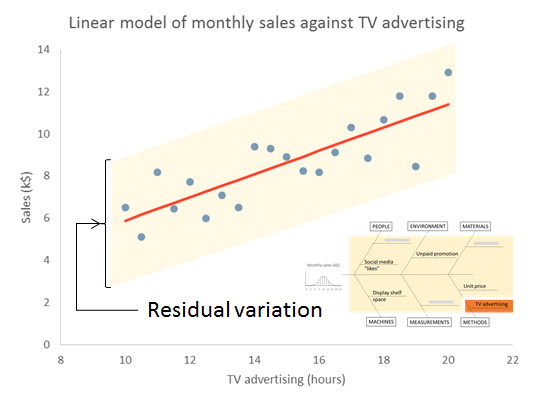
We start with the Source of Uncertainty arising from the residual variation. This is the uncertainty because of all the things we don’t know. We talked about this a lot in Part 2. We are content, for the moment, that they are sufficiently stable to form a basis for prediction. We call this common cause variation. This variation has variance s2, where s is the residual standard deviation that will be output by your regression software.

RegressionResExpl2

Source of Variation (3A) – Sampling error in mean

To understand the next Source of Variation we need to know a little bit about how the regression is calculated. The calculations start off with the respective means of the X values ( X̄ ) and of the Y values ( Ȳ ). Uncertainty in estimating the mean of the Y , is the next contribution to the global prediction uncertainty.

An important part of calculating the regression line is to calculate the mean of the Ys. That mean is subject to sampling error. The variance of the sampling error is the familiar result from the statistics service course.

RegEq2

— where n is the number of pairs of X and Y. Obviously, as we collect more and more data this term gets more and more negligible.

RegressionMeanExpl

Source of Variation (3B) – Sampling error in slope

This is a bit more complicated. Skip forwards if you are already confused. Let me first give you the equation for the variance of predictions referable to sampling error in the slope.

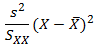
RegEq3

This has now introduced the mysterious sum of squaresSXX. However, before we learn exactly what this is, we immediately notice two things.

  1. As we move away from the centre of the training data the variance gets larger.3
  2. As SXX gets larger the variance gets smaller.

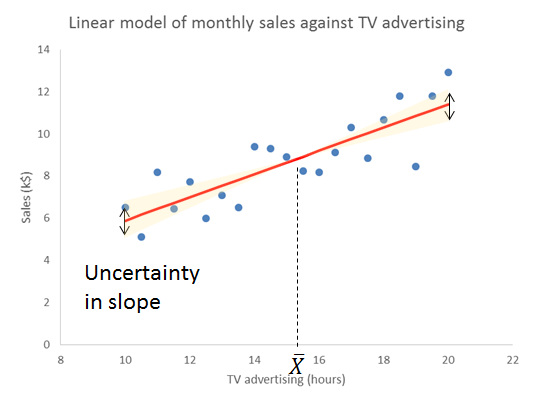
The reason for the increasing sampling error as we move from the mean of X is obvious from thinking about how variation in slope works. The regression line pivots on the mean. Travelling further from the mean amplifies any disturbance in the slope.

RegressionSlopeExpl

Let’s look at where SXX comes from. The sum of squares is calculated from the Xs alone without considering the Ys. It is a characteristic of the sampling frame that we used to train the model. We take the difference of each X value from the mean of X, and then square that distance. To get the sum of squares we then add up all those individual squares. Note that this is a sum of the individual squares, not their average.

RegressionSXXTable

Two things then become obvious (if you think about it).

  1. As we get more and more data, SXX gets larger.
  2. As the individual Xs spread out over a greater range of XSXX gets larger.

What that (3B) term does emphasise is that even sampling error escalates as we exploit the edge of the original training data. As we extrapolate clear of the original sampling frame, the pure sampling error can quickly exceed even the residual variation.

Yet it is only a lower bound on the uncertainty in extrapolation. As we move away from the original range of Xs then, however happy we were previously with Source of Uncertainty (1), that the data was from “an environment that is sufficiently regular to be predictable”, then the question barges back in. We are now remote from our experience base in time and boundary. Nothing outside the original X-range will ever be a candidate for a comfort zone.

The fundamental theorem of prediction

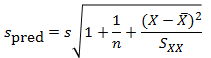
Variances, generally, add up so we can sum the three Sources of Variation (2), (3A) and (3B). That gives the variance of an individual prediction, spred2. By an individual prediction I mean that somebody gives me an X and I use the regression formula to give them the (as yet unknown) corresponding Ypred.

RegEq4

It is immediately obvious that s2 is common to all three terms. However, the second and third terms, the sampling errors, can be made as small as we like by collecting more and more data. Collecting more and more data will have no impact on the first term. That arises from the residual variation. The stuff we don’t yet understand. It has variance s2, where s is the residual standard deviation that will be output by your regression software.

This, I say, is the fundamental theorem of prediction. The unexplained variation provides a hard limit on the precision of forecasts.

It is then a very simple step to convert the variance into a standard deviation, spred. This is the standard error of the prediction.4,5

RegEq5

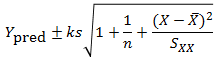
Now, in general, where we have a measurement or prediction that has an uncertainty that can be characterised by a standard error u, there is an old trick for putting an interval round it. Remember that u is a measure of the variation in z. We can therefore put an interval around z as a number of standard errors, z±ku. Here, k is a constant of your choice. A prediction interval for the regression that generates prediction Ypred then becomes:

RegEq7

Choosing k=3 is very popular, conservative and robust.6,7 Other choices of k are available on the advice of a specialist mathematician.

It was Shewhart himself who took this all a bit further and defined tolerance intervals which contain a given proportion of future observations with a given probability.8 They are very much for the specialist.

Source of Variation (1) – Special causes

But all that assumes that we are sampling from “an environment that is sufficiently regular to be predictable”, that the residual variation is solely common cause. We checked that out on our original training data but the price of predictability is eternal vigilance. It can never be taken for granted. At any time fresh causes of variation may infiltrate the environment, or become newly salient because of some sensitising event or exotic interaction.

The real trouble with this world of ours is not that it is an unreasonable world, nor even that it is a reasonable one. The commonest kind of trouble is that it is nearly reasonable, but not quite. Life is not an illogicality; yet it is a trap for logicians. It looks just a little more mathematical and regular than it is; its exactitude is obvious, but its inexactitude is hidden; its wildness lies in wait.

G K Chesterton

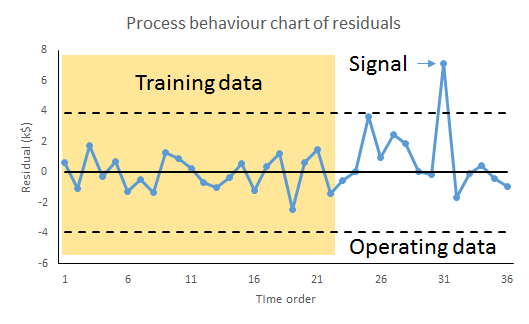
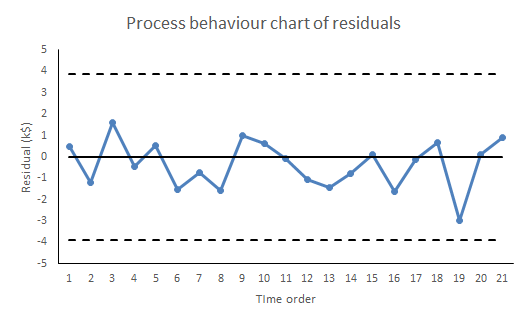
The remedy for this risk is to continue plotting the residuals, the differences between the observed value and, now, the prediction. This is mandatory.

RegressionPBC2

Whenever we observe a signal of a potential special cause it puts us on notice to protect the forecast-user because our ability to predict the future has been exposed as deficient and fallible. But it also presents an opportunity. With timely investigation, a signal of a possible special cause may provide deeper insight into the variation of the cause-system. That in itself may lead to identifying further factors to build into the regression and a consequential reduction in s2.

It is reducing s2, by progressively accumulating understanding of the cause-system and developing the model, that leads to more precise, and more reliable, predictions.

Notes

  1. Kahneman, D (2011) Thinking, Fast and Slow, Allen Lane, p240
  2. Hahn, G J & Meeker, W Q (1991) Statistical Intervals: A Guide for Practitioners, Wiley, p31
  3. In fact s2/SXX is the sampling variance of the slope. The standard error of the slope is, notoriously, s/√SXX. A useful result sometimes. It is then obvious from the figure how variation is slope is amplified as we travel father from the centre of the Xs.
  4. Draper, N R & Smith, H (1998) Applied Regression Analysis, 3rd ed., Wiley, pp81-83
  5. Hahn & Meeker (1991) p232
  6. Wheeler, D J (2000) Normality and the Process Behaviour Chart, SPC Press, Chapter 6
  7. Vysochanskij, D F & Petunin, Y I (1980) “Justification of the 3σ rule for unimodal distributions”, Theory of Probability and Mathematical Statistics 21: 25–36
  8. Hahn & Meeker (1991) p231

Regression done right: Part 2: Is it worth the trouble?

In Part 1 I looked at linear regression from the point of view of machine learning and asked the question whether the data was from “An environment that is sufficiently regular to be predictable.”1 The next big question is whether it was worth it in the first place.

Variation explained

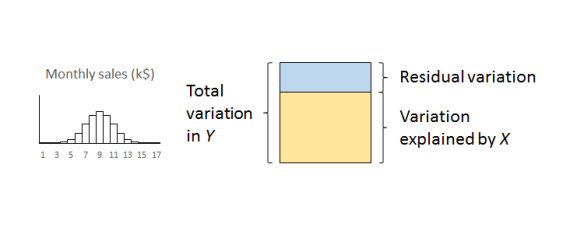
We previously looked at regression in terms of explaining variation. The original Big Y was beset with variation and uncertainty. We believed that some of that variation could be “explained” by a Big X. The linear regression split the variation in Y into variation that was explained by X and residual variation whose causes are as yet obscure.

I slipped in the word “explained”. Here it really means that we can draw a straight line relationship between X and Y. Of course, it is trite analytics that “association is not causation”. As long ago as 1710, Bishop George Berkeley observed that:2

The Connexion of Ideas does not imply the Relation of Cause and Effect, but only a Mark or Sign of the Thing signified.

Causation turns out to be a rather slippery concept, as all lawyers know, so I am going to leave it alone for the moment. There is a rather good discussion by Stephen Stigler in his recent book The Seven Pillars of Statistical Wisdom.3

That said, in real world practical terms there is not much point bothering with this if the variation explained by the X is small compared to the original variation in the Y with the majority of the variation still unexplained in the residuals.

Measuring variation

A useful measure of the variation in a quantity is its variance, familiar from the statistics service course. Variance is a good straightforward measure of the financial damage that variation does to a business.4 It also has the very nice property that we can add variances from sundry sources that aggregate together. Financial damage adds up. The very useful job that linear regression does is to split the variance of Y, the damage to the business that we captured with the histogram, into two components:

  • The contribution from X; and
  • The contribution of the residuals.

RegressionBlock1
The important thing to remember is that the residual variation is not some sort of technical statistical artifact. It is the aggregate of real world effects that remain unexamined and which will continue to cause loss and damage.

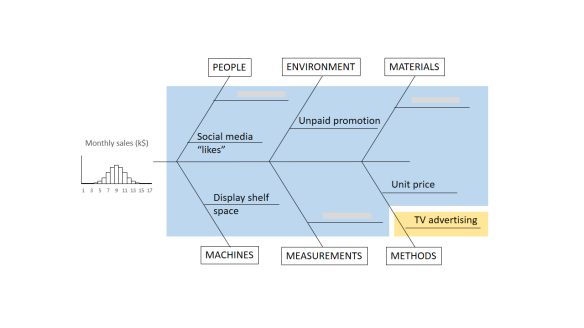
RegressionIshikawa2

Techie bit

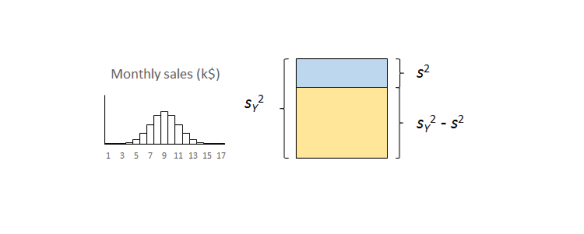
Variance is the square of standard deviation. Your linear regression software will output the residual standard deviation, s, sometimes unhelpfully referred to as the residual standard error. The calculations are routine.5 Square s to get the residual variance, s2. The smaller is s2, the better. A small s2 means that not much variation remains unexplained. Small s2 means a very good understanding of the cause system. Large s2 means that much variation remains unexplained and our understanding is weak.
RegressionBlock2

The coefficient of determination

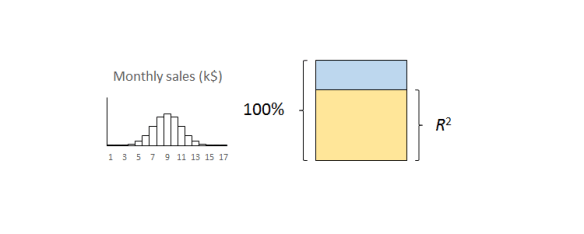
So how do we decide whether s2 is “small”? Dividing the variation explained by X by the total variance of Y, sY2,  yields the coefficient of determination, written as R2.6 That is a bit of a mouthful so we usually just call it “R-squared”. R2 sets the variance in Y to 100% and expresses the explained variation as a percentage. Put another way, it is the percentage of variation in Y explained by X.

RegressionBlock3The important thing to remember is that the residual variation is not a statistical artifact of the analysis. It is part of the real world business system, the cause-system of the Ys.7 It is the part on which you still have little quantitative grasp and which continues to hurt you. Returning to the cause and effect diagram, we picked one factor X to investigate and took its influence out of the data. The residual variation is the variation arising from the aggregate of all the other causes.

As we shall see in more detail in Part 3, the residual variation imposes a fundamental bound on the precision of predictions from the model. It turns out that s is the limiting standard error of future predictions

Whether your regression was a worthwhile one or not so you will want to probe the residual variation further. A technique like DMAIC works well. Other improvement processes are available.

So how big should R2 be? Well that is a question for your business leaders not a statistician. How much does the business gain financially from being able to explain just so much variation in the outcome? Anybody with an MBA should be able to answer this so you should have somebody in your organisation who can help.

The correlation coefficient

Some people like to take the square root of R2 to obtain what they call a correlation coefficient. I have never been clear as to what this was trying to achieve. It always ends up telling me less than the scatter plot. So why bother? R2 tells me something important that I understand and need to know. Leave it alone.

What about statistical significance?

I fear that “significance” is, pace George Miller, “a word worn smooth by many tongues”. It is a word that I try to avoid. Yet it seems a natural practice for some people to calculate a p-value and ask whether the regression is significant.

I have criticised p-values elsewhere. I might calculate them sometimes but only because I know what I am doing. The terrible fact is that if you collect sufficient data then your regression will eventually be significant. Statistical significance only tells me that you collected a lot of data. That’s why so many studies published in the press are misleading. Collect enough data and you will get a “significant” result. It doesn’t mean it matters in the real world.

R2 is the real world measure of sensible trouble (relatively) impervious to statistical manipulation. I can make p as small as I like just by collecting more and more data. In fact there is an equation that, for any given R2, links p and the number of observations, n, for linear regression.8

FvR2 equation

Here, Fμ, ν(x) is the F-distribution with μ and ν degrees of freedom. A little playing about with that equation in Excel will reveal that you can make p as small as you like without R2 changing at all. Simply by making n larger. Collecting data until p is small is mere p-hacking. All p-values should be avoided by the novice. R2 is the real world measure (relatively) impervious to statistical manipulation. That is what I am interested in. And what your boss should be interested in.

Next time

Once we are confident that our regression model is stable and predictable, and that the regression is worth having, we can move on to the next stage.

Next time I shall look at prediction intervals and how to assess uncertainty in forecasts.

References

  1. Kahneman, D (2011) Thinking, Fast and Slow, Allen Lane, p240
  2. Berkeley, G (1710) A Treatise Concerning the Principles of Human Knowledge, Part 1, Dublin
  3. Stigler, S M (2016) The Seven Pillars of Statistical Wisdom, Harvard University Press, pp141-148
  4. Taguchi, G (1987) The System of Experimental Design: Engineering Methods to Optimize Quality and Minimize Costs, Quality Resources
  5. Draper, N R & Smith, H (1998) Applied Regression Analysis, 3rd ed., Wiley, p30
  6. Draper & Smith (1998) p33
  7. For an appealing discussion of cause-systems from a broader cultural standpoint see: Bostridge, I (2015) Schubert’s Winter Journey: Anatomy of an Obsession, Faber, pp358-365
  8. Draper & Smith (1998) p243

Regression done right: Part 1: Can I predict the future?

I recently saw an article in the Harvard Business Review called “Refresher on Regression Analysis”. I thought it was horrible so I wanted to set the record straight.

Linear regression from the viewpoint of machine learning

Linear regression is important, not only because it is a useful tool in itself, but because it is (almost) the simplest statistical model. The issues that arise in a relatively straightforward form are issues that beset the whole of statistical modelling and predictive analytics. Anyone who understands linear regression properly is able to ask probing questions about more complicated models. The complex internal algorithms of Kalman filters, ARIMA processes and artificial neural networks are accessible only to the specialist mathematician. However, each has several general features in common with simple linear regression. A thorough understanding of linear regression enables a due diligence of the claims made by the machine learning advocate. Linear regression is the paradigmatic exemplar of machine learning.

There are two principal questions that I want to talk about that are the big takeaways of linear regression. They are always the first two questions to ask in looking at any statistical modelling or machine learning scenario.

  1. What predictions can I make (if any)?
  2. Is it worth the trouble?

I am going to start looking at (1) in this blog and complete it in a future Part 2. I will then look at (2) in a further Part 3.

Variation, variation, variation

Variation is a major problem for business, the tendency of key measures to fluctuate irregularly. Variation leads to uncertainty. Will the next report be high or low? Or in the middle? Because of the uncertainty we have to allow safety margins or swallow some non-conformancies. We have good days and bad days, good products and not so good. We have to carry costly working capital because of variation in cash flow. And so on.

We learned in our high school statistics class to characterise variation in a key process measure, call it the Big Y, by an histogram of observations. Perhaps we are bothered by the fluctuating level of monthly sales.

RegressionHistogram

The variation arises from a whole ecology of competing and interacting effects and factors that we call the cause-system of the outcome. In general, it is very difficult to single out individual factors as having been the cause of a particular observation, so entangled are they. It is still useful to capture them for reference on a cause and effect diagram.

RegressionIshikawa

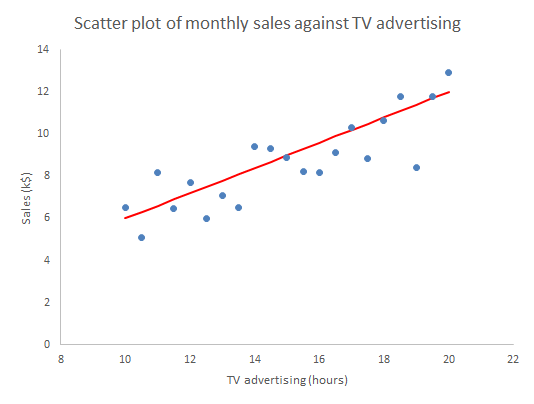
One of the strengths of the cause and effect diagram is that it may prompt the thought that one of the factors is particularly important, call it Big X, perhaps it is “hours of TV advertising” (my age is showing). Motivated by that we can generate a sample of corresponding measurements data of both the Y and X and plot them on a scatter plot.

RegressionScatter1

Well what else is there to say? The scatter plot shows us all the information in the sample. Scatter plots are an important part of what statistician John Tukey called Exploratory Data Analysis (EDA). We have some hunches and ideas, or perhaps hardly any idea at all, and we attack the problem by plotting the data in any way we can think of. So much easier now than when W Edwards Deming wrote:1

[Statistical practice] means tedious work, such as studying the data in various forms, making tables and charts and re-making them, trying to use and preserve the evidence in the results and to be clear enough to the reader: to endure disappointment and discouragement.

Or as Chicago economist Ronald Coase put it.

If you torture the data enough, nature will always confess.

The scatter plot is a fearsome instrument of data torture. It tells me everything. It might even tempt me to think that I have a basis on which to make predictions.

Prediction

In machine learning terms, we can think of the sample used for the scatter plot as a training set of data. It can be used to set up, “train”, a numerical model that we will then fix and use to predict future outcomes. The scatter plot strongly suggests that if we know a future X alone we can have a go at predicting the corresponding future Y. To see that more clearly we can draw a straight line by hand on the scatter plot, just as we did in high school before anybody suggested anything more sophisticated.

RegressionScatter2

Given any particular X we can read off the corresponding Y.

RegressionScatter3

The immediate insight that comes from drawing in the line is that not all the observations lie on the line. There is variation about the line so that there is actually a range of values of Y that seem plausible and consistent for any specified X. More on that in Parts 2 and 3.

In understanding machine learning it makes sense to start by thinking about human learning. Psychologists Gary Klein and Daniel Kahneman investigated how firefighters were able to perform so successfully in assessing a fire scene and making rapid, safety critical decisions. Lives of the public and of other firefighters were at stake. This is the sort of human learning situation that machines, or rather their expert engineers, aspire to emulate. Together, Klein and Kahneman set out to describe how the brain could build up reliable memories that would be activated in the future, even in the agony of the moment. They came to the conclusion that there are two fundamental conditions for a human to acquire a skill.2

  • An environment that is sufficiently regular to be predictable.
  • An opportunity to learn these regularities through prolonged practice

The first bullet point is pretty much the most important idea in the whole of statistics. Before we can make any prediction from the regression, we have to be confident that the data has been sampled from “an environment that is sufficiently regular to be predictable”. The regression “learns” from those regularities, where they exist. The “learning” turns out to be the rather prosaic mechanics of matrix algebra as set out in all the standard texts.3 But that, after all, is what all machine “learning” is really about.

Statisticians capture the psychologists’ “sufficiently regular” through the mathematical concept of exchangeability. If a process is exchangeable then we can assume that the distribution of events in the future will be like the past. We can project our historic histogram forward. With regression we can do better than that.

Residuals analysis

Formally, the linear regression calculations calculate the characteristics of the model:

Y = mX + c + “stuff”

The “mX+c” bit is the familiar high school mathematics equation for a straight line. The “stuff” is variation about the straight line. What the linear regression mathematics does is (objectively) to calculate the m and c and then also tell us something about the “stuff”. It splits the variation in Y into two components:

  • What can be explained by the variation in X; and
  • The, as yet unexplained, variation in the “stuff”.

The first thing to learn about regression is that it is the “stuff” that is the interesting bit. In 1849 British astronomer Sir John Herschel observed that:

Almost all the greatest discoveries in astronomy have resulted from the consideration of what we have elsewhere termed RESIDUAL PHENOMENA, of a quantitative or numerical kind, that is to say, of such portions of the numerical or quantitative results of observation as remain outstanding and unaccounted for after subducting and allowing for all that would result from the strict application of known principles.

The straight line represents what we guessed about the causes of variation in Y and which the scatter plot confirmed. The “stuff” represents the causes of variation that we failed to identify and that continue to limit our ability to predict and manage. We call the predicted Ys that correspond to the measured Xs, and lie on the fitted straight line, the fits.

fiti = mXic

The residual values, or residuals, are obtained by subtracting the fits from the respective observed Y values. The residuals represent the “stuff”. Statistical software does this for us routinely. If yours doesn’t then bin it.

residuali = Yi – fiti

RegressionScatter4

There are a number of properties that the residuals need to satisfy for the regression to work. Investigating those properties is called residuals analysis.4 As far as use for prediction in concerned, it is sufficient that the “stuff”, the variation about the straight line, be exchangeable.5 That means that the “stuff” so far must appear from the data to be exchangeable and further that we have a rational belief that such a cause system will continue unchanged into the future. Shewhart charts are the best heuristics for checking the requirement for exchangeability, certainly as far as the historical data is concerned. Our first and, be under no illusion, mandatory check on the ability of the linear regression, or any statistical model, to make predictions is to plot the residuals against time on a Shewhart chart.

RegressionPBC

If there are any signals of special causes then the model cannot be used for prediction. It just can’t. For prediction we need residuals that are all noise and no signal. However, like all signals of special causes, such will provide an opportunity to explore and understand more about the cause system. The signal that prevents us from using this regression for prediction may be the very thing that enables an investigation leading to a superior model, able to predict more exactly than we ever hoped the failed model could. And even if there is sufficient evidence of exchangeability from the training data, we still need to continue vigilance and scrutiny of all future residuals to look out for any novel signals of special causes. Special causes that arise post-training provide fresh information about the cause system while at the same time compromising the reliability of the predictions.

Thorough regression diagnostics will also be able to identify issues such as serial correlation, lack of fit, leverage and heteroscedasticity. It is essential to regression and its ommision is intolerable. Residuals analysis is one of Stephen Stigler’s Seven Pillars of Statistical Wisdom.6 As Tukey said:

The greatest value of a picture is when it forces us to notice what we never expected to see.

To come:

Part 2: Is my regression significant? … is a dumb question.
Part 3: Quantifying predictions with statistical intervals.

References

  1. Deming, W E (‎1975) “On probability as a basis for action”, The American Statistician 29(4) pp146-152
  2. Kahneman, D (2011) Thinking, Fast and Slow, Allen Lane, p240
  3. Draper, N R & Smith, H (1998) Applied Regression Analysis, 3rd ed., Wiley, p44
  4. Draper & Smith (1998) Chs 2, 8
  5. I have to admit that weaker conditions may be adequate in some cases but these are far beyond any other than a specialist mathematician.
  6. Stigler, S M (2016) The Seven Pillars of Statistical Wisdom, Harvard University Press, Chapter 7

On leadership and the Chinese contract

Hanyu trad simp.svgBetween 1958 and 1960, 67 of the 120 inhabitants of the Chinese village of Xiaogang starved to death. But Mao Zedong’s cruel and incompetent collectivist policies continued to be imposed into the 1970s. In December 1978, 18 of Xiaogang’s leading villagers met secretly and illegally to find a way out of borderline starvation and grinding poverty. The first person to speak up at the meeting was Yan Jingchang. He suggested that the village’s principal families clandestinely divide the collective farm’s land among themselves. Then each family should own what it grew. Jingchang drew up an agreement on a piece of paper for the others to endorse. Then he hid it in a bamboo tube in the rafters of his house. Had it been discovered Jingchang and the village would have suffered brutal punishment and reprisal as “counter-revolutionaries”.

The village prospered under Jingchang’s structure. During 1979 the village produced more than it had in the previous five years. That attracted the attention of the local Communist Party chief who summoned Jingchang for interrogation. Jingchang must have given a good account of what had been happening. The regional party chief became intrigued at what was going on and prepared a report on how the system could be extended across the whole region.

Mao had died in 1976 and, amid the emerging competitors for power, it was still uncertain as to how China would develop economically and politically. By 1979, Deng Xiaoping was working his way towards the effective leadership of China. The report into the region’s proposals for agricultural reform fell on his desk. His contribution to the reforms was that he did nothing to stop them.

I have often found the idea of leadership a rather dubious one and wondered whether it actually described anything. It was, I think, Goethe who remarked that “When an idea is wanting, a word can always be found to take its place.” I have always been tempted to suspect that that was the case with “leadership”. However, the Jingchang story did make me think.1 If there is such a thing as leadership then this story exemplifies it and it is worth looking at what was involved.

Personal risk

This leader took personal risks. Perhaps to do otherwise is to be a mere manager. A leader has, to use the graphic modern idiom, “skin in the game”. The risk could be financial or reputational, or to liberty and life.

Luck

Luck is the converse of risk. Real risks carry the danger of failure and the consequences thereof. Jingchang must have been aware of that. Napoleon is said to have complained, “I have plenty of clever generals but just give me a lucky one.2 Had things turned out differently with the development of Chinese history, the personalities of the party officials or Deng’s reaction, we would probably never have heard of Jingchang. I suspect though that the history of China since the 1970s would not have been very different.

The more I practice, the luckier I get.

Gary Player
South African golfer

Catalysing alignment

It was Jingchang who drew up the contract, who crystallised the various ideas, doubts, ambitions and thoughts into a written agreement. In law we say that a valid contract requires a consensus ad idem, a meeting of minds. Jingchang listened to the emerging appetite of the the other villagers and captured it in a form in which all could invest. I think that is a critical part of leadership. A leader catalyses alignment and models constancy of purpose.

However, this sort of leadership may not be essential in every system. Management scientists are enduringly fascinated by The Morning Star Company, a California tomato grower that functions without any conventional management. The particular needs and capabilities of the individuals interact to create an emergent order that evolves and responds to external drivers. Austrian economist Friedrich Hayek coined the term catallaxy for a self-organising system of voluntary co-operation and explained how such a thing could arise and sustain and what its benefits to society.3

But sometimes the system needs the spark of a leader like Jingchang who puts himself at risk and creates a vivid vision of the future state against which followers can align.

Deng kept out of the way. Jingchang put himself on the line. The most important characteristic of leadership is the sagacity to know when the system can manage itself and when to intervene.

References

  1. I have this story from Matt Ridley (2015) The Evolution of Everything, Fourth Estate
  2. Apocryphal I think.
  3. Hayek, F A (1982) Law, Legislation, and Liberty, vol.2, Routledge, pp108–9