Trouble at the EU

I enjoy Metro the UK national free morning newspaper. It has a very straightforward non-partisan style. This morning there was an article dealing with the European Union’s (EU’s) accounting difficulties. There were a couple of very telling admissions from an EU bureaucrat. We lawyers love an admission.

Aidas Palubinskas, from the European Court of Auditors, … described the error rate as ‘relatively stable from year to year’.

He admits that the EU’s accounting is a stable system of trouble. That is a system where there is only common cause variation, variation common to the whole of the output, but where the system is still incapable of reliably delivering what the customer wants. Recognising that one is embedded in such a problem is the first step towards operational improvement. W Edwards Deming addressed the implications of the stable system and the strategy for its improvement at length in his seminal book Out of the Crisis (1982). The problems are not intractable but the solution demands leadership and adoption of the correct improvement approach.

Unfortunately, the second half of the quote is less encouraging.

He said the errors highlighted in its report were ‘examples of inefficiency, but not necessarily of waste’.

This makes me fear that the correct approach is far off for the EU. Everything that is not efficient, timely and effective delivery of what the customer wants is waste, as Toyota call it muda. Waste represents the scope of opportunity for improvement, for improving service and simultaneously reducing its cost. The first step in improvement is taken by accepting that waste is not inevitable and that it can be incrementally eliminated through use of appropriate tools under competent leadership.

The next step to improvement is to commit to the discipline of eliminating waste progressively. That requires leadership. That sort of leadership is often found in successful organisations. The EU, however, faces particular difficulties as an international bureaucracy with a multi-partisan political master and a democratically disengaged public. It is not easy to see where leadership will come from. This is a common problem of state bureaucracies.

Palubinskas is right to seek to analyse the problems as a stable system of trouble. However, beyond that, the path to radical improvement lies in rejecting the casual acceptance of waste and in committing to continual improvement of every process for delivery of service.

Richard Dawkins champions intelligent design (for business processes)

Richard Dawkins has recently had a couple of bad customer experiences. In each he was confronted with a system that seemed to him indifferent to his customer feedback. I sympathise with him on one matter but not the other. The two incidents do, in my mind, elucidate some important features of process discipline.

In the first, Dawkins spent a frustrating spell ordering a statement from his bank over the internet. He wanted to tell the bank about his experience and offer some suggestions for improvement, but he couldn’t find any means of channelling and communicating his feedback.

Embedding a business process in software will impose a rigid discipline on its operation. However, process discipline is not the same thing as process petrification. The design assumptions of any process include, or should include, the predicted range and variety of situations that the process is anticipated to encounter. We know that the bounded rationality of the designers will blind them to some of the situations that the process will subsequently confront in real world operation. There is no shame in that but the necessary adjunct is that, while the process is operated diligently as designed, data is accumulated on its performance and, in particular, on the customer’s experience. Once an economically opportune moment arrives (I have glossed over quote a bit there) the data can be reviewed, design assumptions challenged and redesign evaluated. Following redesign the process then embarks on another period of boring operation. The “boring” bit is essential to success. Perhaps I should say “mindful” rather than “boring” though I fear that does not really work with software.

Dawkins’ bank have missed an opportunity to listen to the voice of the customer. That weakens their competitive position. Ignorance cannot promote competitiveness. Any organisation that is not continually improving every process for planning, production and service (pace W Edwards Deming) faces the inevitable fact that its competitors will ultimately make such products and services obsolete. As Dawkins himself would appreciate, survival is not compulsory.

Dawkins’ second complaint was that security guards at a UK airport would not allow him to take a small jar of honey onto his flight because of a prohibition on liquids in the passenger cabin. Dawkins felt that the security guard should have displayed “common sense” and allowed it on board contrary to the black letter of the regulations. Dawkins protests against “rule-happy officials” and “bureaucratically imposed vexation”. Dawkins displays another failure of trust in bureaucracy. He simply would not believe that other people had studied the matter and come to a settled conclusion to protect his safety. It can hardly have been for the airport’s convenience. Dawkins was more persuaded by something he had read on the internet. He fell into the trap of thinking that What you see is all there is. I fear that Dawkins betrays his affinities with the cyclist on the railway crossing.

When we give somebody a process to operate we legitimately expect them to do so diligently and with self discipline. The risk of an operator departing from, adjusting or amending a process on the basis of novel local information is that, within the scope of the resources they have for taking that decision, there is no way of reliably incorporating the totality of assumptions and data on which the process design was predicated. Even were all the data available, when Dawkins talks of “common sense” he was demanding what Daniel Kahneman called System 2 thinking. Whenever we demand System 2 thinking ex tempore we are more likely to get System 1 and it is unlikely to perform effectively. The rationality of an individual operator in that moment is almost certainly more tightly bounded than that of the process designers.

In this particular case, any susceptibility of a security guard to depart from process would be exactly the behaviour that a terrorist might seek to exploit once aware of it.

Further, departures from process will have effects on the organisational system, upstream, downstream and collateral. Those related processes themselves rely on the operator’s predictable compliance. The consequence of ill discipline can be far reaching and unanticipated.

That is not to say that the security process was beyond improvement. In an effective process-oriented organisation, operating the process would be only one part of the security guard’s job. Part of the bargain for agreeing to the boring/ mindful diligent operation of the process is that part of work time is spent improving the process. That is something done offline, with colleagues, with the input of other parts of the organisation and with recognition of all the data including the voice of the customer.

Had he exercised the “common sense” Dawkins demanded, the security guard would have risked disciplinary action by his employers for serious misconduct. To some people, threats of sanctions appear at odds with engendering trust in an organisation’s process design and decision making. However, when we tell operators that something is important then fail to sanction others who ignore the process, we undermine the basis of the bond of trust with those that accepted our word and complied. Trust in the bureaucracy and sanctions for non-compliance are complementary elements of fostering process discipline. Both are essential.

Trust in data – III – being honest about honesty

I found this presentation by Dan Ariely intriguing. I suspect that this is originally a TED talk with some patronising cartoons added. You can just listen.

When I started off in operational excellence learning about the Deming philosophy, my instructors always used to say These are honest men’s [sic] tools. From that point of view Airely’s presentation is pretty pessimistic. I don’t think I am entirely surprised when I recall Matt Ridley’s summary of evolutionary psychology from his book The Origins of Virtue.

Human beings have some instincts that foster the greater good and others that foster self-interest and anti-social behaviour. We must design a society that encourages the former and discourages the latter.

When wearing a change management hat it’s easy to be sanguine about designing a system or organisation that fosters virtue and the sort of diligent data collection that confronts present reality. However, it is useful to have a toolkit of tactics to build such a system. I think Ariely’s ideas are helpful here.

His idea of “reminders” is something that resonates with maintaining a continual focus on the Voice of the Customer/ Voice of the Business. Periodically exploring with data collectors the purpose of their data collection and the system wide consequences of fabrication is something that seems worthwhile in itself. However, the work Ariely refers to suggests that there might be reasons why such a “nudge” would be particularly effective in improving data trustworthiness.

His idea of “confessions” is a little trickier. I might reflect for a while then blog some more.

Managing a railway on historical data is like …

I was recently looking on the web for any news on the Galicia rail crash. I didn’t find anything current but came across this old item from The Guardian (London). It mentioned in passing that consortia tendering for a new high speed railway in Brazil were excluded if they had been involved in the operation of a high speed line that had had an accident in the previous five years.

Well, I don’t think that there is necessarily anything wrong with that in itself. But it is important to remember that a rail accident is not necessarily a Signal (sic). Rail accidents worldwide are often a manifestation of what W Edwards Deming called A stable system of trouble. In other words, a system that features only Noise but which cannot deliver the desired performance. An accident free record of five years is a fine thing but there is nothing about a stable system of trouble that says it can’t have long incident free periods.

In order to turn that incident free five years into evidence about future likely safety performance we also need hard evidence, statistical and qualitative, about the stability and predictability of the rail operator’s processes. Procurement managers are often much worse at looking for, and at, this sort of data. In highly sophisticated industries such as automotive it is routine to demand capability data and evidence of process surveillance from a potential supplier. Without that, past performance is of no value whatever in predicting future results.

Rearview

Adoption statistics for England – signals of improvement?

I am adopted so I follow the politics of adoption fairly carefully. I was therefore interested to see this report on the BBC, claiming a “record” increase in adoptions. The quotation marks are the BBC’s. The usual meaning of such quotes is that the word “record” is not being used with its usual meaning. I note that the story was repeated in several newspapers this morning.

The UK government were claiming a 15% increase in children adopted from local authority care over the last year and the highest total since data had been collected on this basis starting in 1992.

Most people will, I think, recognise what Don Wheeler calls an executive time series. A comparison of two numbers ignoring any broader historical trends or context. Of course, any two consecutive numbers will be different. One will be greater than the other. Without the context that gives rise to the data, a comparison of two numbers is uninformative.

I decided to look at the data myself by following the BBC link to the GOV.UK website. I found a spreadsheet there but only with data from 2009 to 2013. I dug around a little more and managed to find 2006 to 2008. However, the website told me that to find any earlier data I would have to consult the National Archives. At the same time it told me that the search function at the National Archives did not work. I ended up browsing 30 web pages of Department of Education documents and managed to get figures back to 2004. However, when I tried to browse back beyond documents dated January 2008, I got “Sorry, the page you were looking for can’t be found” and an invitation to use the search facility. Needless to say, I failed to find the missing data back to 1992, there or on the Office for National Statistics website. It could just be my internet search skills that are wanting but I spent an hour or so on this.

Gladly, Justin Ushie and Julie Glenndenning from the Department for Education were able to help me and provided much of the missing data. Many thanks to them both. Unfortunately, even they could not find the data for 1992 and 1993.

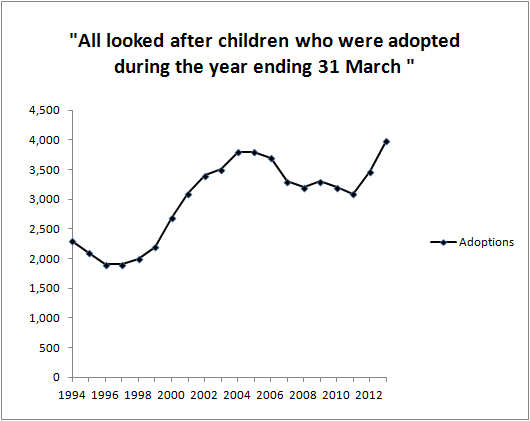
Here is the run chart.

Adoption1

Some caution is needed in interpreting this chart because there is clearly some substantial serial correlation in the annual data. That said, I am not able to quite persuade myself that the 2013 figure represents a signal. Things look much better than the mid-1990s but 2013 still looks consistent with a system that has been stable since the early years of the century.

The mid 1990s is a long time ago so I also wanted to look at adoptions as a percentage of children in care. I don’t think that that is automatically a better measure but I wanted to check that it didn’t yield a different picture.

Adoption2

That confirms the improvement since the mid-1990s but the 2013 figures now look even less remarkable against the experience base of the rest of the 21st century.

I would like to see these charts with all the interventions and policy changes of respective governments marked. That would then properly set the data in context and assist interpretation. There would be an opportunity to build a narrative, add natural process limits and come to a firmer view about whether there was a signal. Sadly, I have not found an easy way of building a chronology of intervention from government publications.

Anyone holding themselves out as having made an improvement must bring forward the whole of the relevant context for the data. That means plotting data over time and flagging background events. It is only then that the decision maker, or citizen, can make a proper assessment of whether there has been an improvement. The simple chart of data against time, even without natural process limits, is immensely richer than a comparison of two selected numbers.

Properly capturing context is the essence of data visualization and the beginnings of graphical excellence.

One my favourite slogans:

In God we trust. All else bring data.

W Edwards Deming

I plan to come back to this data in 2014.